MoMA
Posts by Charles Silver
March 2, 2010  |  An Auteurist History of Film
An Eisenstein Double Bill
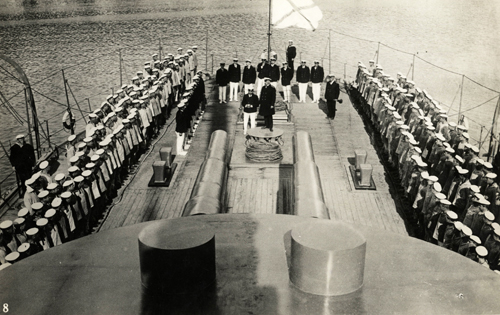
Battleship Potemkin. 1925. USSR. Directed by Sergei Eisenstein

Battleship Potemkin. 1925. USSR. Directed by Sergei Eisenstein

These notes accompany the Eisenstein Double Bill program, which screens on March 3, 4, and 5 in Theater 3.

Sergei Eisenstein (1898–1948) is a special case in many ways. He was undeniably one of the geniuses of the early cinema. As a theoretician, he wrote voluminously, positing his theory of montage (editing), derived from the work of D. W. Griffith (most notably from Intolerance). Eisenstein’s theory, which directly contradicted the German Expressionist approach most successfully promulgated by F. W. Murnau, was enormously influential on countless directors, although it did not always produce satisfactory results.

February 23, 2010  |  An Auteurist History of Film
King Vidor’s The Big Parade

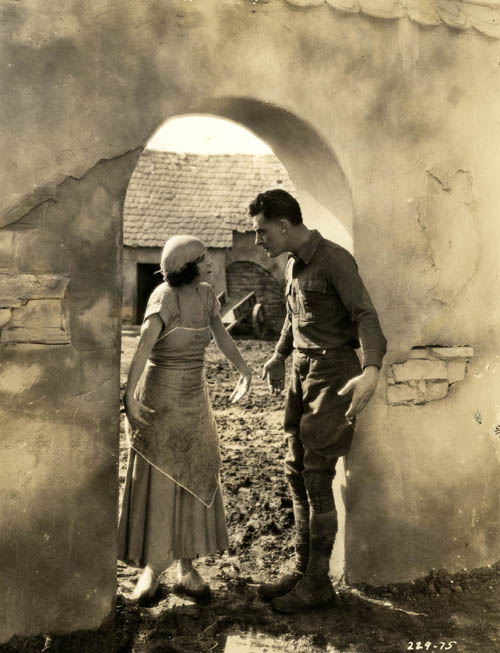
The Big Parade. 1925. USA. Directed by King Vidor

The Big Parade. 1925. USA. Directed by King Vidor

These notes accompany King Vidor’s</i>The Big Parade, which screens on February 24, 25, and 26 in Theater 3.</p>

In his autobiography A Tree Is a Tree, King Vidor recounts the origins of The Big Parade. Having made some good but ephemeral films for the fledgling M-G-M, Vidor told Irving Thalberg, “If I were to work on something that…had a chance at long runs…, I would put much more effort, and love, into its creation.”

If there is anything wrong with The Big Parade, it is that Vidor put too much into it. The film is at once a grand epic, an intimate romance, a comedy of camaraderie, and a savage polemic. Somehow, Vidor managed to hold all this together, and seemingly overnight became the leading “serious” director in America, assuming at age thirty-one the mantle which had fallen from D. W. Griffith’s shoulders when the Master was forced to sign a contract with Paramount earlier in 1925. Eighty-five years later, The Big Parade still dwarfs virtually every film made about World War I, and it is arguably Vidor’s finest achievement.

February 16, 2010  |  An Auteurist History of Film
Nordic Gods and Directors

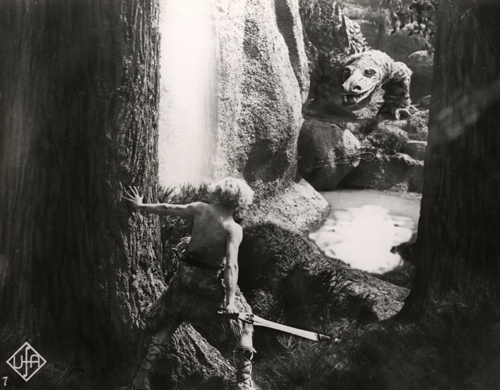
Siegfried (Part 1 of Die Nibelungen) 1924. Germany. Directed by Fritz Lang

Siegfried (Part 1 of Die Nibelungen) 1924. Germany. Directed by Fritz Lang

These notes accompany the Nordic Gods and Directors program, which screens on February 17, 18, and 19 in Theater 3.

In a sense, there are two Fritz Langs, with his life, career, and sensibility split almost literally in half by the rise of the Nazis. The German Lang is monumental, existing in a realm of the fantastic, the superhuman, the surreal. The American Lang is naturalistic, existing in a real world inhabited by ordinary earthlings, people with feelings, folks with whom we can identify. The crossover film was M (1931), Lang’s first talkie, in which Peter Lorre’s child murderer is accorded a sympathetic hearing, evoking the genuine emotion lacking in Lang’s work over the preceding twelve years. This is not to suggest that Lang (1890–1976) ever became a conventionally naturalistic and humanistic director in the course of his honorable and mostly successful American career. He was as much a progenitor of film noir as he was of the expressionism from whence it sprung, and his later ramblings—from Brecht to Zola, from the Philippines of Tyrone Power to Jean-Luc Godard’s Capri in Le Mepris—bespeak no ordinary career.

February 9, 2010  |  An Auteurist History of Film
F. W. Murnau’s The Last Laugh
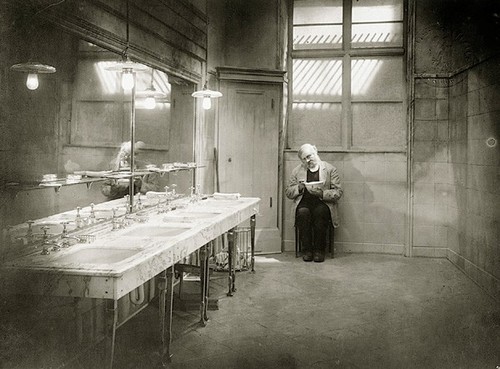
The Last Laugh. 1924. Germany. Directed by F. W. Murnau. Acquired from Universum-Film (UFA)

The Last Laugh. 1924. Germany. Directed by F. W. Murnau. Acquired from Universum-Film (UFA)

These notes accompany the screening of Der Letzte Mann (The Last Laugh), which screens on February 10, 11, and 12 in Theater 3.

Friedrich Wilhelm (F. W.) Murnau (1888–1931) had already made over a dozen films before The Last Laugh, but only Nosferatu (1922) can be said to have raised any blip on the international scene—and Nosferatu didn’t open in America until 1929 (after The Last Laugh, Tartuffe, Faust, and Sunrise), receiving a dismissively condescending review in The New York Times. So, few were prepared for what may be the best film ever made by a German in Germany.

The style of The Last Laugh is derived from the Kammerspiele, introduced by the great stage impresario Max Reinhardt, of whom Murnau (along with almost everyone else of note) was a disciple. Reinhardt proposed an intimate theater with dim lighting in which the audience was close enough to the stage for the actors to perform with greater subtlety. Lotte Eisner, the doyenne of film scholarship of the Weimar era, makes the point that the Expressionist technique that had come to predominance in German cinema by 1924 is only peripheral to Murnau’s achievement. She contends that Murnau’s moving camera “is never used decoratively or symbolically…every movement…has a precise, clearly-defined aim.” (Whatever its rationale, Murnau’s camera mobility and long takes set a standard for such future masters as Kenji Mizoguchi and Max Ophuls, and was developed into the counter-theory to the montage postulated by Sergei Eisenstein and the Soviets. One of the great achievements of Orson Welles was to synthesize these two approaches.) According to Eisner, the director’s use of “opalescent surfaces streaming with reflections, rain, or light…is an almost Impressionistic way of evoking atmosphere.” She also suggests that the supposed ponderousness of the film is a way of lending gravitas and significance to what is, after all, a trivial event: the demotion of a doorman to mens-room attendant.


February 2, 2010  |  An Auteurist History of Film
The Lubitsch Touch
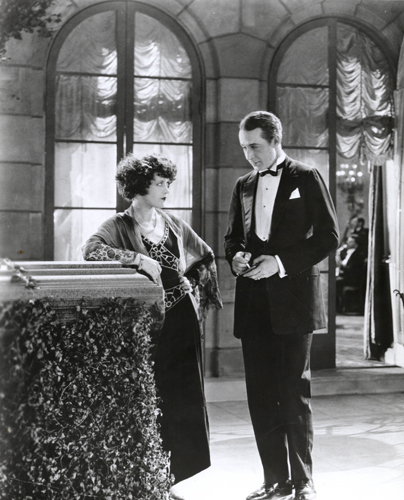
The Marriage Circle. 1924. USA. Directed by Ernst Lubitsch

The Marriage Circle. 1924. USA. Directed by Ernst Lubitsch

These notes accompany the program The Lubitsch Touch, which screens on February 3, 4, and 5 in Theater 3.

Ernst Lubitsch (1892–1947) was more responsible than anyone for bringing a continental flavor to the largely Anglo-Saxon American cinema. Although Erich von Stroheim preceded him, von Stroheim’s obsessions were too outré to be fully integrated into the American (Hollywood) sensibility. While Lubitsch remained fixated on European subjects and locales, his broadly humanistic humor did resonate with Americans in ways that von Stroheim’s esoteric naughtiness did not. Von Stroheim returned to Europe after World War II; Lubitsch died a Hollywood insider.

Lubitsch’s journey from Berlin took a few atypical turns. Starting in 1914 he directed himself in several crude comedies with an emphasis on a Jewish stereotype. Some of his more sophisticated satires (Die Austernprinzessin, Die Puppe, Romeo und Julia im Schnee) hold up well and reflect Lubitsch’s stage training with Max Reinhardt. He first gained notice in America with his ersatz D. W. Griffith spectacles (Madame DuBarry, Anna Boleyn), and Mary Pickford brought him to Hollywood to do the costume drama Rosita (1923), which she subsequently tried to destroy. Fortunately, Warner Brothers signed him to a contract, which resulted in a series of adult comedy/dramas, of which The Marriage Circle and So This Is Paris are representative.

January 26, 2010  |  An Auteurist History of Film
Buster’s Planet

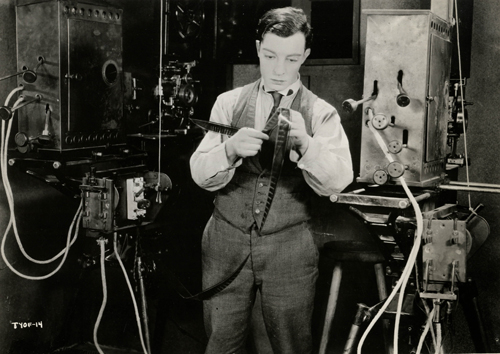
Sherlock, Jr. 1924. USA. Directed by Buster Keaton

These notes accompany the program Buster’s Planet, which screens on January 27, 28, and 29 in Theater 3.

Joseph Francis “Buster” Keaton (1895–1966) began appearing in his family’s vaudeville act at the age of three. Charles Chaplin made his first stage appearance at five. Psychologists can have—and have had—a field day tracing all kinds of problems to this lack of an ordinary childhood in the cinema’s two greatest comedy stars. The simple fact, perhaps, is that they loved to perform and make people laugh. Buster, whose nickname has been attributed to Harry Houdini, followed in Charlie’s footsteps, entering films in 1917 (four years later than Chaplin) under the tutelage of Roscoe “Fatty” Arbuckle.

January 19, 2010  |  An Auteurist History of Film
The Chaplin Revue

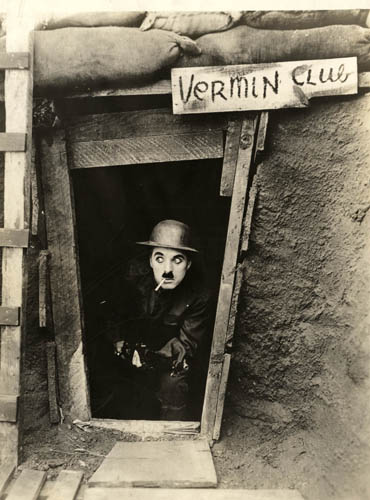
Shoulder Arms. 1918. USA. Directed by Charles Chaplin

Shoulder Arms. 1918. USA. Directed by Charles Chaplin

These notes accompany The Chaplin Revue, which screens on January 20, 21, and 22 in Theater 3.

I’ve written more about Charles Chaplin than about any other filmmaker (including the book Charles Chaplin: An Appreciation, published by MoMA in 1989), and I’m not exactly sure where to begin now. Certainly, he is the auteur’s auteur, having had more freedom than any other director to visualize on celluloid what he dreamed and imagined. This was the lucky consequence of being the most famous artist in the world, allowing him to purchase his own studio, rehearse endlessly, and save for his audience only that which he considered to be up to his standards. The great Jean Renoir said: “The master of masters, the film-maker of film-makers, for me is still Charlie Chaplin…Clifford Odets telephoned that he wanted us to meet the Chaplins. It was like inviting a devout Christian to meet God in person.” Rene Clair said that Chaplin was so “profoundly original” that he had little direct influence on the cinema, but that without Chaplin, “we would not have been altogether the same people we are today.” I share many of these feelings.

January 12, 2010  |  An Auteurist History of Film
Erich von Stroheim’s Foolish Wives
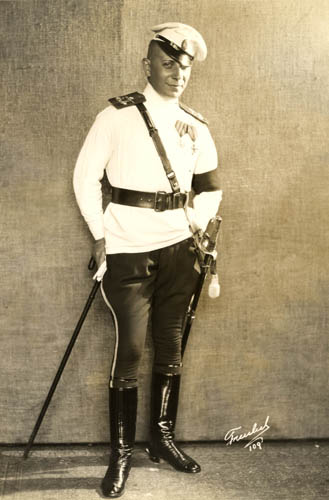
Erich von Stroheim in <i>Foolish Wives.</i> 1922. USA. Directed by Erich von Stroheim

Erich von Stroheim in Foolish Wives. 1922. USA. Directed by Erich von Stroheim

These notes accompany Foolish Wives, which screens on January 13, 14, and 15 in Theater 3.

The name Erich von Stroheim (1885–1957) generally provokes one of two reactions: he is considered either a great genius done in by imbecilic studio executives, or a self-immolating martyr to his own inflated ego. Although the truth obviously lies somewhere between these two extremes, I’m not sure exactly where. Von Stroheim’s life and career are wrapped in several overlapping enigmas that further confuse his identity. The first enigma, indeed, is the self-created myth of his identity.

January 5, 2010  |  An Auteurist History of Film
D. W. Griffith on a Smaller Canvas
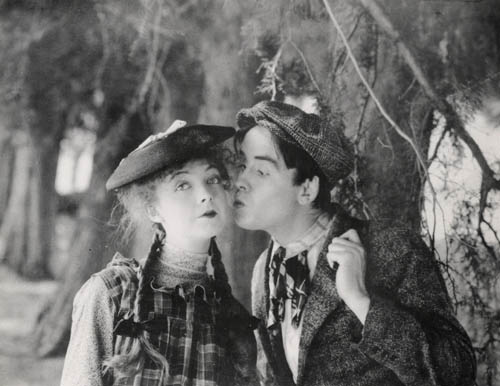
<i>True Heart Susie.</i> 1919. USA. Directed by D. W. Griffith

True Heart Susie. 1919. USA. Directed by D. W. Griffith


These notes accompany the program D. W. Griffith on a Smaller Canvas, which screens on January 6, 7, and 8 in Theater 3.


Although D. W. Griffith’s racism was unforgivable, nothing can ever take away the fact that he was the most gifted and creative director in the cinema’s first thirty years. In John McWhorter’s December 14, 2009 New Yorker review of Pops, Terry Teachout’s biography of Louis Armstrong, McWhorter says Armstrong’s early 78-rpm recordings “were as crucial in creating our modern musical sensibility as D. W. Griffith’s films were in creating the grammar of cinematic narrative.” McWhorter goes on to say of Armstrong that, “While performers around him assimilated his innovations, he never really grew.” One might also argue that this was true of Griffith, and not simply because he lost his independence for the final decade of his career due to his inept business sense and changing public tastes. However, his greatest gift never really failed him—his skill with actors.

December 22, 2009  |  An Auteurist History of Film
Send in the Clowns

These notes accompany the program Send in the Clowns, screening on December 23 and 24 in Theater 3.

While this is intended as a fun holiday program, a few comments might be in order. First, I should acknowledge my personal prejudice against slapstick. I have felt that Charles Chaplin and Buster Keaton rose to the heights of screen comedy by distancing themselves from their Sennett/Normand/Arbuckle roots. I know this hurts colleagues like our estimable pianist Ben Model and other friends, but the philosophy of “anything for a laugh” (evident also in most of Mel Brooks’s work and the early films of Woody Allen) seems incongruous to me, if we are talking about “ART.” I won’t even dignify The Three Stooges or Abbott and Costello (there go my other friends) with a mention. (So kindly disregard that mention.) Seriously, though, I have always sought out some logical structure, character development, or visual invention in determining the worthiness of a film. This doesn’t mean that I am incapable of laughing at silly antics, and I fully acknowledge that some of Keaton’s (The General, Steamboat Bill, Jr.) and Chaplin’s (Monsieur Verdoux, Limelight) greatest works can sometimes be painfully unfunny, but there is an imaginary line in what’s left of my brain that makes me distinguish between entertainment for its own sake and art. However, I don’t wish to rain on your parade or your holiday spirit. If nothing else, this program attempts to establish a lineage that eventually leads to greatness.