Duda: Hi, I’m Duda and I’m here with…
Vanny: Vanny, and we are both MoMA Teens in residence. And we are talking about: Why Are You Still Here?
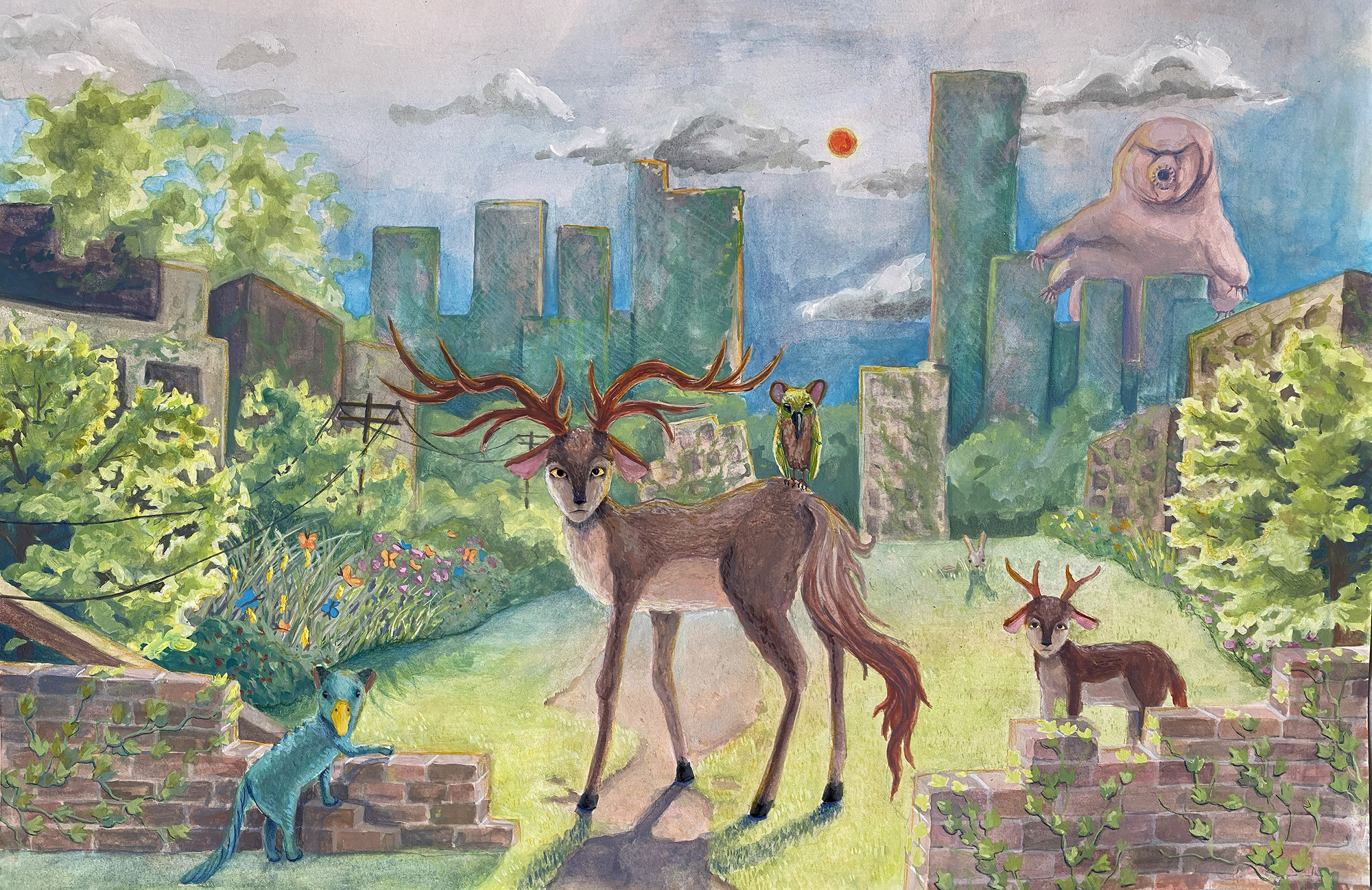
When you first look at this work of art, you see all these kinds of greenery and futuristic-looking animals—
Duda: —But not humans. We don’t see any.
Vanny: The buildings are covered in moss and vines. These buildings have not been inhabited by humans. And you notice this mutant worm on the top right.
Duda: What do you think about this animal? That I actually thought it was a dog. What do you think it’s representing?
Vanny: I guess what it can symbolize is the horrors that humans have created due to endangering the environment. But it could also mean new life, like a new beginning—
Duda: I like your idea!
Vanny: Yeah, thank you! That’s kind of what I see with this worm, but I want to ask you a question now, Duda.
Duda: Okay!
Vanny: When you also look at this work, you also see all the mutant animals. Why do you think that the butterflies have not changed in this?
Duda: For me, the butterflies are representing freedom. And I think the painting for me represents the freedom of the animals without the humans inside. So I think that the butterflies doesn’t change because the freedom doesn’t change.
Do you think the artist [is] meaning a changed world, a different world? Or the same world that we have today?
Vanny: I think it’s the same world because using the title, Why Are You Still Here?, it’s talk to us, the viewer. You, the human.
Duda: The artist said: “Most people think that humans will destroy the world. But in reality, we will only destroy ourselves.”
Vanny: You never know what the future holds. And I think this is why it’s such a good artwork to have in our show, Imagined Futures.