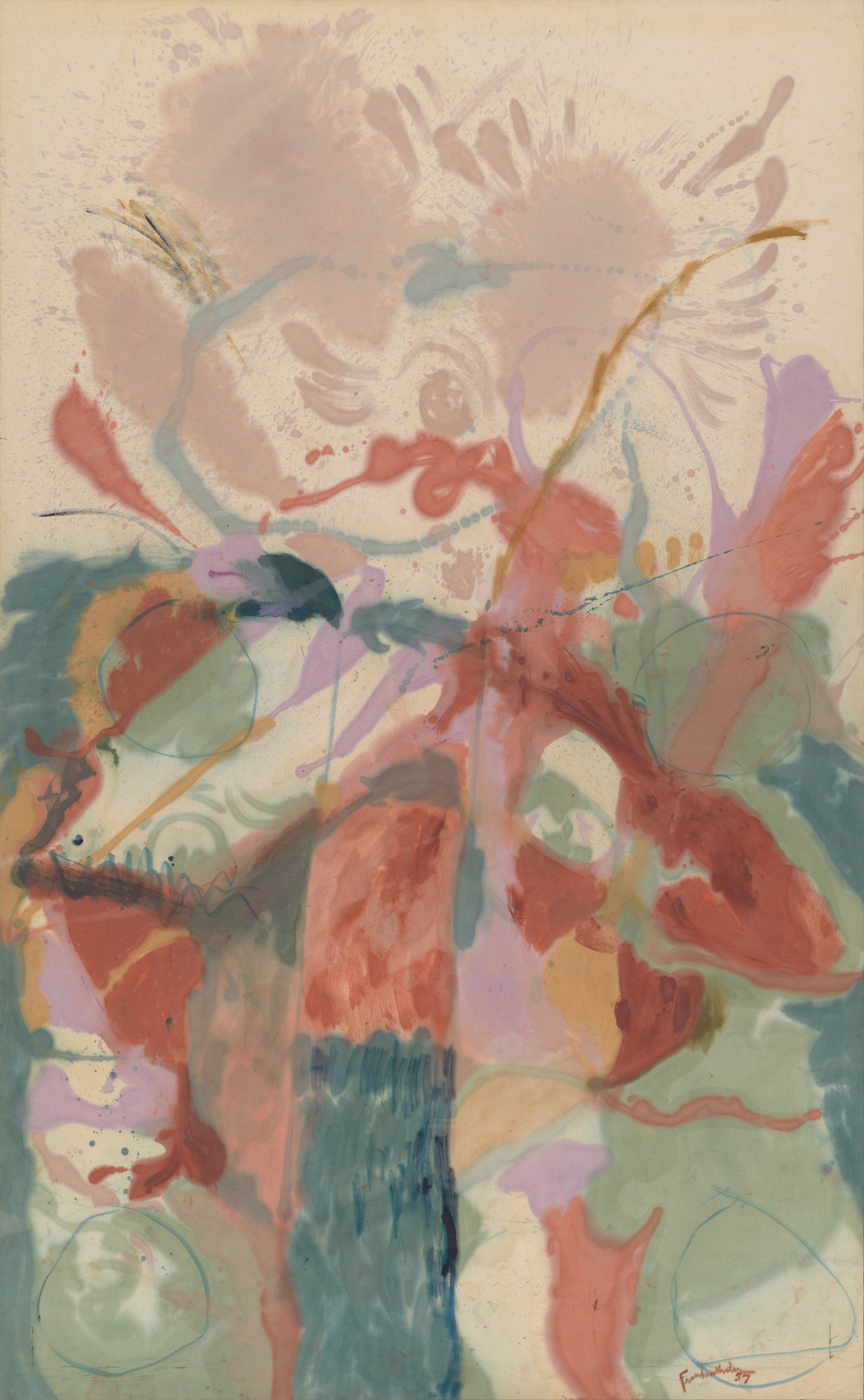
Curator, Samantha Friedman: The 1950s was when it was all happening for Frankenthaler and for abstract art in New York. She was one of a younger generation of Abstract Expressionist painters. Of those years, she later said:
Artist, Helen Frankenthaler: I think the luckiest thing was to be in one’s early twenties with a group that you could really talk, live, and argue pictures about. The whole business of galleries, money—it wasn’t a thought. It was much more a question of, “why didn’t you fill the upper left of the picture?”
Samantha Friedman: Frankenthaler used her “soak-stain” technique to make Jacob’s Ladder. You can see some areas where it appears to have been poured, others where it looks dripped, some where it was brushed.
Frankenthaler has spoken about the impact of Jackson Pollock, one of the early innovators of Abstract Expressionism. He moved the canvas to the floor and dripped or flung paint onto the canvas.
Helen Frankenthaler: I thought, I’d like to try that too. The approach took painting literally off the easel so that instead of dealing with four sides and four corners, you felt the boundaries of the canvas were endless.
Samantha Friedman: She also acknowledges that his example unleashed “a certain attitude that was probably in me already, but I hadn’t used it yet.”
Helen Frankenthaler: I think it was a sense of being as open and free and surprised as possible. Being able to know when to stop, when to labor, when to be puzzled, and to be free with what you are making.
Archival audio from: Helen Frankenthaler and John Jonas Gruen. Interview with Helen Frankenthaler, 1969 June 12. John Gruen and Jane Wilson papers, 1909-2016; and Oral history interview with Helen Frankenthaler, 1968. Archives of American Art, Smithsonian Institution.