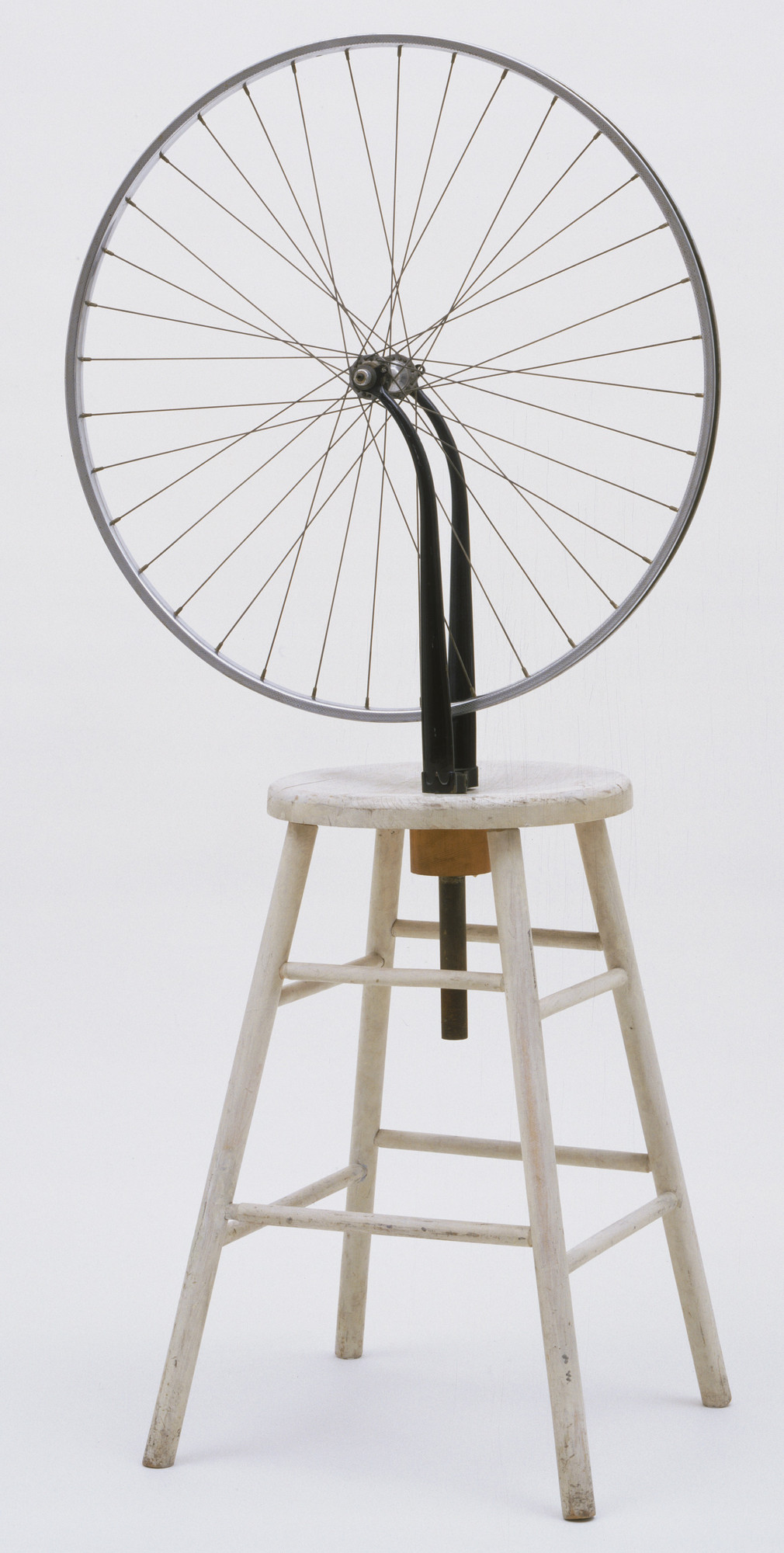
Sarah: Do not spin the wheel.
Phoebe: [Giggles]
Sarah: Phoebe, don’t spin the wheel.
Phoebe: Why?
Sarah: Because now Duchamp's not around to make another, and we need to protect it at all costs. It's precious to us.
Phoebe: It’s a bicycle in a stool!
Sarah: Hi, my name is Sarah. I work here at MoMA, and I’m here with my friend…
Phoebe: —Phoebe, and I’m ten years old.
Sarah: Phoebe, do you think this is art? Why or why not?
Phoebe: I guess you could call it art, but not like painted art. And it’s not sculpting. I call this confusion.
Sarah: How is this different from art you might expect to see in a museum?
Phoebe: A lot of art shows feelings through colors and shapes.
Sarah: So maybe it’s not as expressive—like we can’t get emotions from the colors or the marks.
Phoebe: Yeah.
Sarah: One of Duchamp’s goals was to avoid emotion in his artwork. And he really thought that he could move away from art being about beauty and instead art being something that made you think.
Phoebe: Definitely, when I see this, I have a lot of questions.
Sarah: When art is interesting, it has people debate—kind of like we’re talking right now.
Phoebe: And that’s a good thing. Art can be about beauty, but I don’t think art has to be beautiful. It could be ugly, it could be plain, it could be anything really.