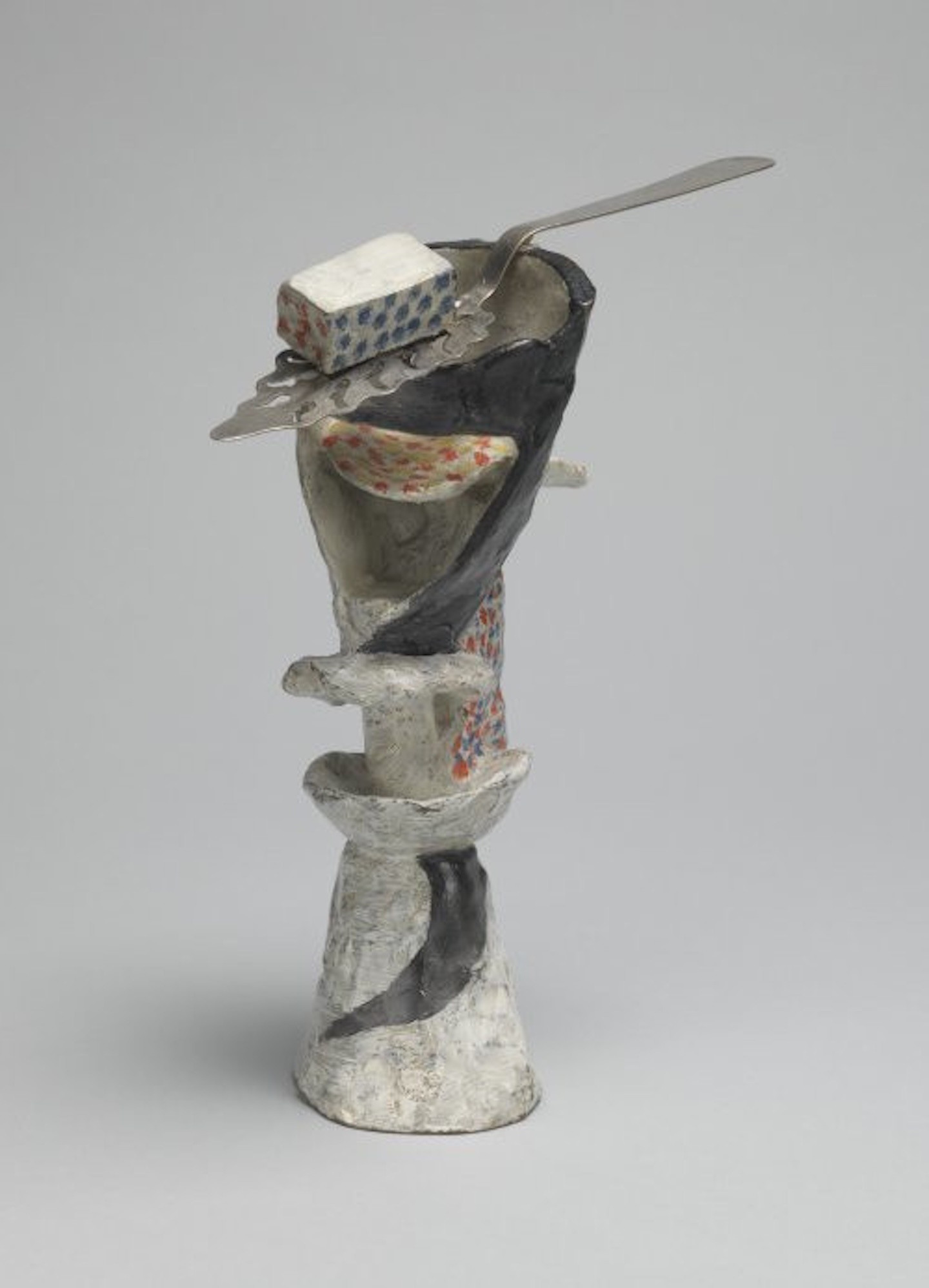
Narrator: Picasso made this sculpture, The Glass of Absinthe, in six unique versions. Absinthe is a licorice-flavored liqueur that was popular in turn-of-the-century Paris. Walk around the sculptures and compare them. Curator Ann Temkin:
Ann Temkin: You think of a glass as something that's pretty much the same all around. But here, as he opens this one up and sort of unpeels the interior of the glass, you have a very different experience of it from the left to the right or the back to the front.
The inside of the glass is a transparent liquid: absinthe. But of course, it's rendered, as is the glass, solidly and opaquely; and therefore, the whole idea of what is solid and liquid, what is transparent and opaque, is made blurry or confused.
It really blends painting and sculpture because he had these six versions cast and then chose to paint each one with a different set of colors. You can see how careful Picasso was to make each one a unique personality.
Glenn Lowry: Picasso added a real absinthe spoon to each of the six painted bronze sculptures. Conservator Lynda Zycherman:
Lynda Zycherman: They have piercings because when you prepare absinthe at the table, it's very bitter. You use a sugar cube on the spoon and you pour water over that. The sugar-water drips into the absinthe, which begins as a clear green liquid; but when you add water and sugar to it, it turns cloudy, milky white.
Ann Temkin: If this were really happening, the sugar cube would get dissolved. But of course a bronze sugar cube cannot be dissolved.
Narrator: Picasso made these sculptures in the spring of 1914. It is likely no coincidence that that same year the French government banned the consumption of absinthe.