Narrator: Curator Anne Umland:
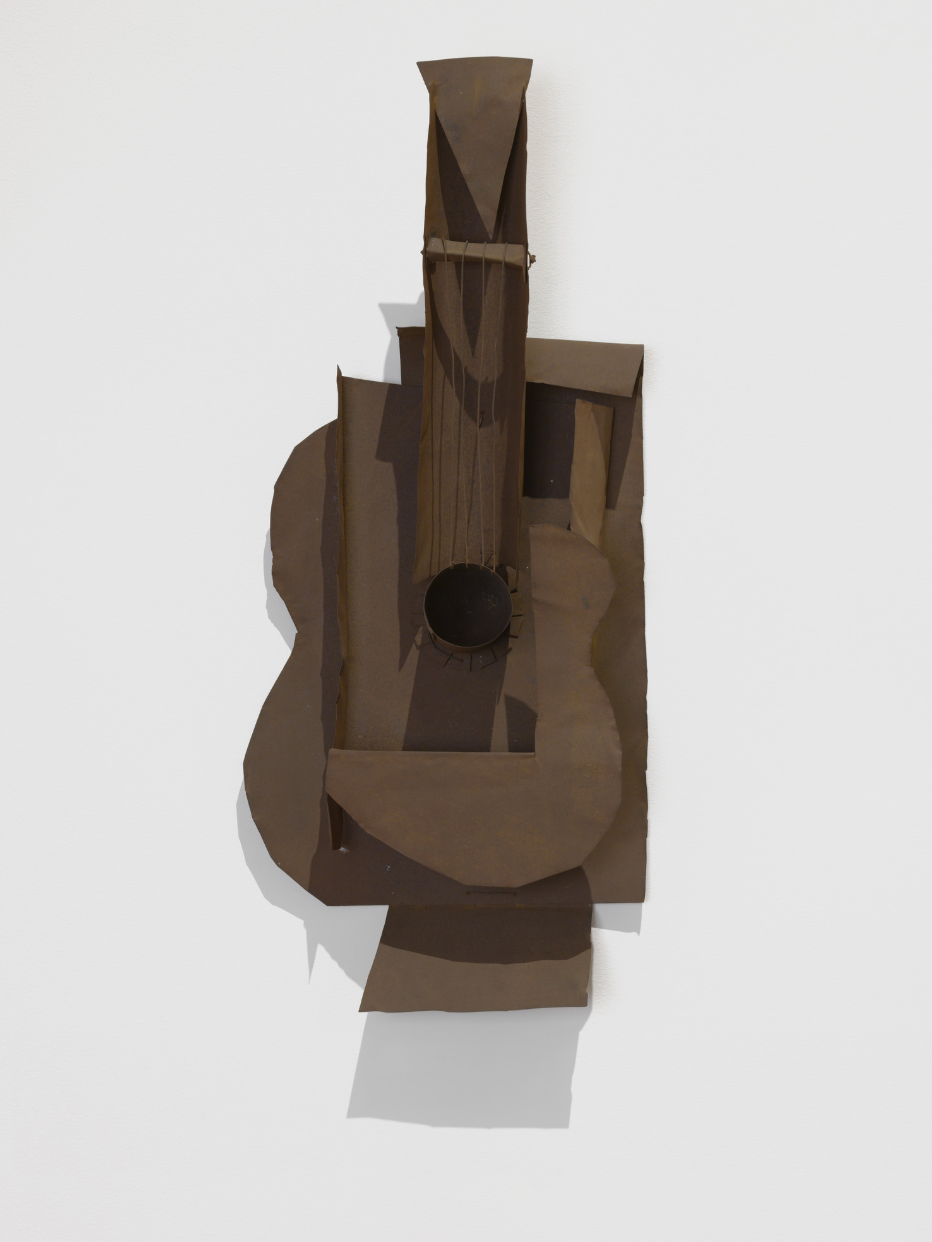
Anne Umland: Here we are standing in front of two guitars – one in cardboard, one in sheet metal – that, at the time they were made, upset just about every conventional notion of what a sculpture could be.
Sculpture up until this point had always been something that was about solids. Right? It was about masses, about carving or molding heavy, resistant materials like marble or like clay. And the cardboard guitar does away with all of that. One of its most primary materials is space. Picasso has opened up the interior of this instrument to our eyes.
Narrator: Conservator Lynda Zycherman:
Lynda Zycherman: The sound hole – which in a real guitar is the absence of material – projects outwards as a tube instead of just being a hole in a flat surface.
Narrator: Now, look more closely at the metal guitar:
Lynda Zycherman: It's loosely sewn together with wires used as stitching because Picasso was not trained as a metal sculptor and he did not know how to solder things together. It's very loose. When you pick it up, it looks like such a solid thing; but actually, it shifts in your hands.
Anne Umland: It's neither painting nor sculpture. It's a very new sort of object. Right around this time, figures pretty much vanish; and their surrogates or stand-ins become these guitars or bottles or glasses that have curves. They have positives, they have voids just like people's bodies do. Picasso is, I think, playing with the idea of how simple can a shape get, so that the curve on the left side of this guitar, for instance, will show up in pictures of the period positioned so that it reads as an ear, or bend it and you get buttocks.