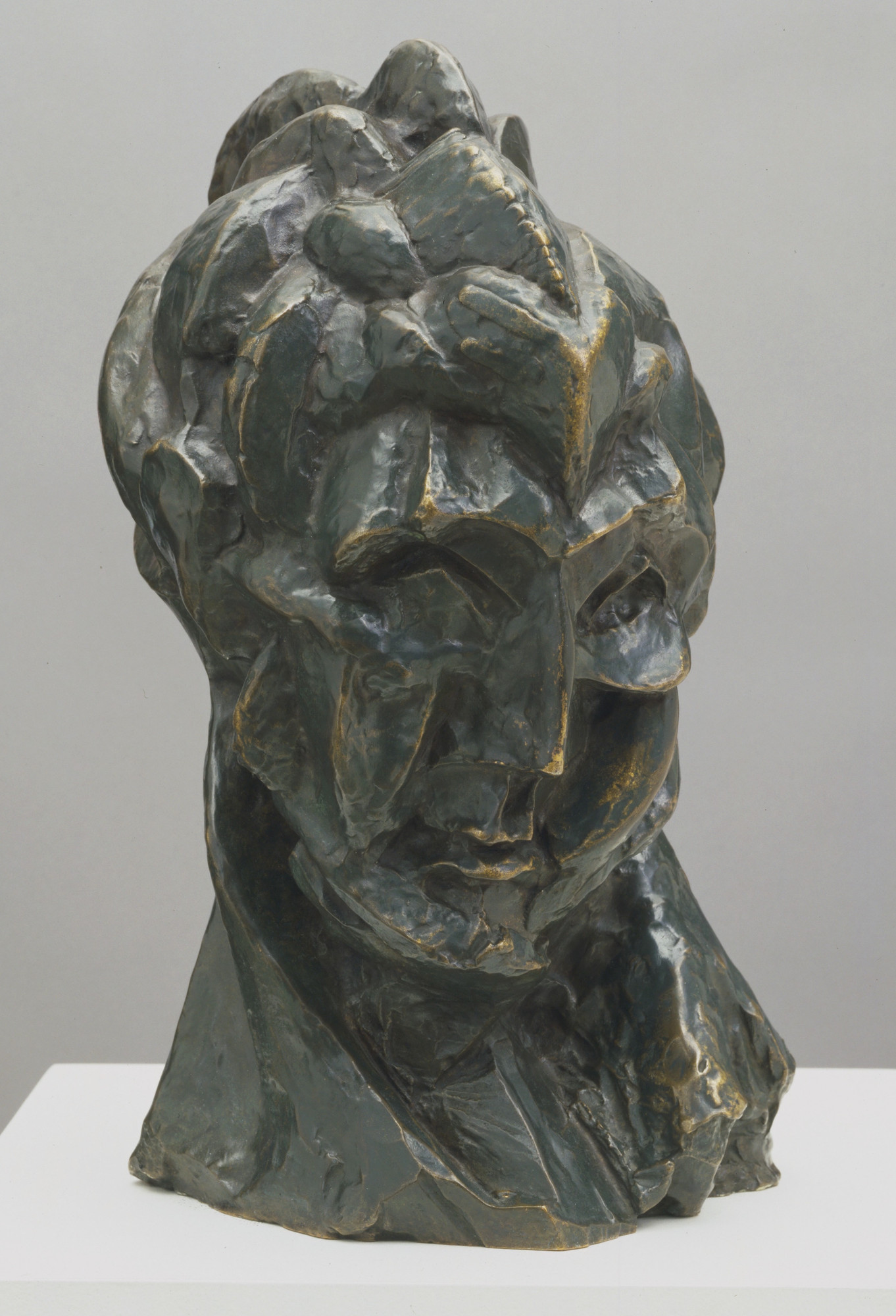
Narrator: Picasso created Head of a Woman in 1909. Just a few years earlier, he and fellow artist George Braque had revolutionized painting by inventing Cubism–they deconstructed their subjects and presented them as fractured forms viewed simultaneously from multiple perspectives. Here, Picasso translated his Cubist vision into sculpture. Ann Temkin is Chief Curator of Painting and Sculpture:
Ann Temkin: I think the way you see that most in this head of Fernande—his girlfriend at the time—is in the hair because the hair, for me, resembles practically the landscape or a townscape. We know that he made many Cubist studies of Fernande in painting that summer of 1909, when he was living in a little Spanish town called Horta. And when you look at her hair, you almost feel like you're looking at that little hill town, with these small units of form that, obviously, is not how anybody's head, fortunately, really looks but instead is a way of modeling a head so that different areas catch light differently. And the different facets give you a way to build that head together in your own brain instead of just passively receiving what you recognize as looking exactly like the kind of head you would see on the woman across the street from you.