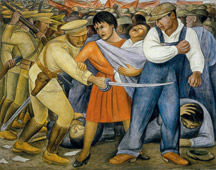
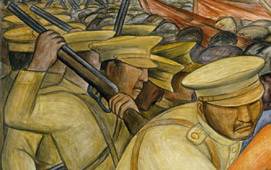
The Uprising
1931
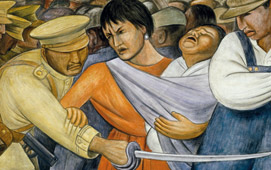
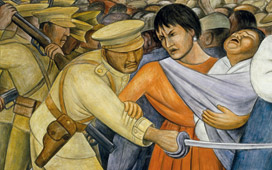
Fresco on reinforced cement in a galvanized-steel framework, 74 x 94 1/8" (188 x 239 cm). Private collection, Mexico. © 2011 Banco de México Diego Rivera & Frida Kahlo Museums Trust, México, D.F./Artists Rights Society (ARS), New York. Photograph by Rafael Doniz
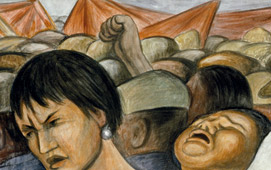
In The Uprising, a woman with a baby at her hip and a working man fend off an attack by a uniformed soldier. Behind them, a riotous crowd clashes with more soldiers, who force demonstrators to the ground. The location is unclear, though the figures’ skin tone implies that the scene is set in Mexico or another Latin American country. In the early 1930s, an era of widespread labor unrest, images of the violent repression of strikes would have resonated with both U.S. and Latin American audiences. The battle here stands as a potent symbol of universal class struggle.
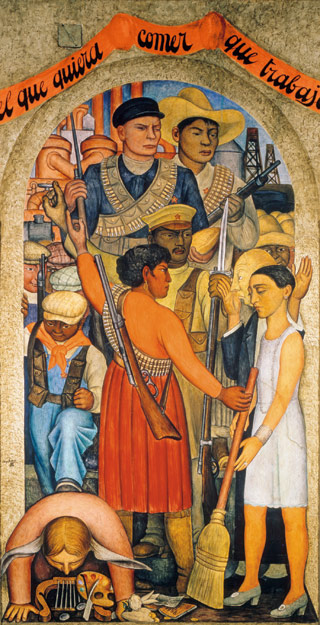
The red banners and clenched fist that rise above the crowd in The Uprising offer internationally comprehensible signs of workers’ resistance. Rivera traveled to Moscow in 1927 as a delegate of the Partido Comunista de México (Communist Party of Mexico) and stayed there for roughly six months. Upon his return, he increasingly employed urban industrial imagery to envision class revolution on an international scale. Swaths of red, hammers and sickles, red stars, and images of urban factories abound in the murals Rivera created at the Secretaría de Educación Pública in Mexico City after his trip.
Diego Rivera. Let Him Work Who Wants to Eat. 1928. Fresco, approx. 79 7/8 x 65" (203 x 165 cm). South wall, Patio de las Fiestas (Courtyard of Fiestas), third floor, Secretaría de Educación Pública, Mexico City. © 2011 Banco de México Diego Rivera & Frida Kahlo Museums Trust, México, D.F./Artists Rights Society (ARS), New York. Photograph by Schalkwijk/Art Resource, New York
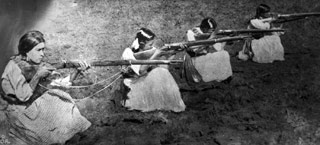
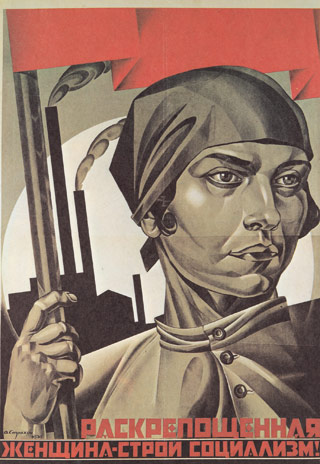
Precedents for the powerful female combatant at the center of The Uprising are found in both Soviet and Mexican images of women as active participants in insurrection. In the years before Rivera’s 1927–28 trip to Moscow, pictures of idealized female proletarians proliferated in Soviet propaganda. His figure also recalls the militancy of revolutionary soldaderas, female fighters in the Mexican Revolution who were made iconic through popular photographs of the era.
Female revolutionaries taking aim. c. 1917. Photographer unknown. Casasola Archive, Fototeca Nacional del Instituto Nacional de Antropología e Historia, Pachuca, Mexico. © (63945) CONACULTA. INAH-SINAFO-FN-Mexico
Adolf Strakhov (Ukrainian, 1896–1979). You Are a Free Woman—Help Build Socialism! 1926. Color lithograph, 35 7/8 x 25 1/4" (91 x 64 cm). Kharkov: Proletarii. Lenin Library, Moscow. Photograph courtesy The Museum of Modern Art, Department of Imaging Services (Thomas Griesel)
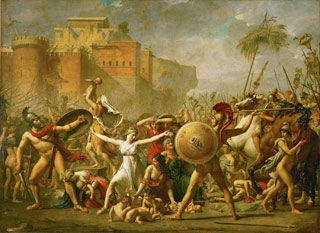
Rivera's composition, with a dynamic female protagonist at the center of a larger conflict, brings to mind Jacques-Louis David’s The Intervention of the Sabine Women (1799). Working after the French Revolution, David used classical mythology to create a passionate plea for reconciliation in the wake of the war; the woman in the foreground puts herself in harm’s way in hopes of stopping the fight. By contrast, Rivera’s modern woman is a partisan participant, willing to fight for herself and her family at all costs.
Jacques-Louis David (French, 1748–1825). The Intervention of the Sabine Women. 1799. Oil on canvas, 12' 7 5/8" x 17' 1 1/2" (3.85 x 5.22 m). Musée du Louvre, Paris, France. Photograph by Erich Lessing/Art Resource, New York
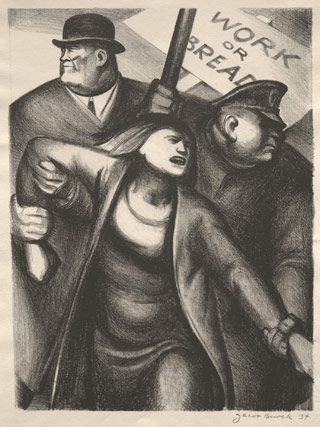
Rivera dressed the couple in the foreground of The Uprising in distinctly modern styles. The man wears the overalls and cap of an urban worker, and she sports fashions of the 1920s and 1930s: bobbed hair, earrings, a knee-length dress, and high heels. Their appearance indicates that this is a contemporary conflict. For left-leaning artists in New York, the frescoes Rivera made for The Museum of Modern Art provided a powerful model of modern, socially engaged art with content rooted in Marxism. Later in the 1930s comparable images of strikes by U.S. artists, specifically referencing the hunger and unemployment issues that plagued the country at the time, became increasingly commonplace.
Jacob Burck (American, 1904–1982). The Lord Provides. 1934. Lithograph. Image: 12 x 8 7/8" (30.3 x 22.6 cm); sheet: 15 3/4 x 11 7/16" (40 x 29.2 cm). The Cleveland Museum of Art. Gift of Mrs. Malcolm L. McBride 1944.329. © 2011 Conrad and Joseph Burck; photography © The Cleveland Museum of Art
At the time of Rivera’s show, commentary in the U.S. press characterized The Uprising as a “familiar” scene from the Mexican Revolution. In truth, labor strikes like the one pictured here were uncommon during the war. More likely, the panel alludes to more recent social upheaval in Mexico. From 1928 through 1934, a period known as the Maximato, General Plutarco Elías Calles controlled Mexico during the terms of several puppet presidents. Under his authoritarian rule, agrarian reforms initiated during the Revolution ceased and the Partido Comunista de México (Communist Party of Mexico) was outlawed.