Pneumatic Drilling
1931–1932
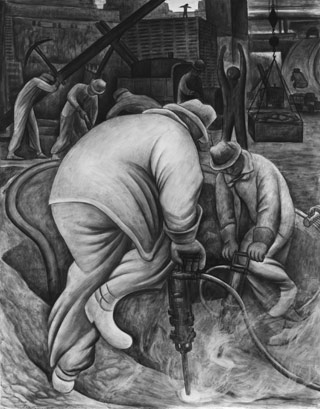
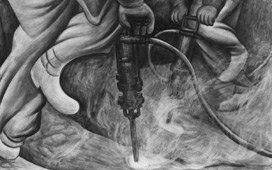
Fresco on reinforced cement in a galvanized-steel framework, approx. 94 x 74" (239 x 188 cm). Location unknown since 1977. Reproduced from a 1932 photograph by Peter A. Juley & Son. Photograph courtesy Peter A. Juley & Son Collection, Smithsonian American Art Museum (cat. no. J0005920)
The day after Rivera arrived in New York City, the New York Herald Tribune reported on his plans to “paint the rhythm of American workers.” The city was in the throes of one of the greatest construction drives of all time, made possible by the armies of surplus labor available during the Depression. The figures in the foreground here use a pneumatic drill and jackhammer to bore into Manhattan’s granite foundation. Rivera later identified this scene as depicting preparations for the construction of Rockefeller Center, which was still in its early stages when he arrived in New York.
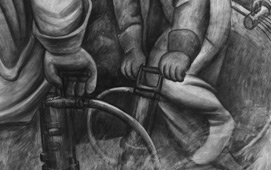
The tools held by the workers in Pneumatic Drilling function as prosthetic extensions of their bodies. Rivera viewed this alliance between man and machine as a kind of natural force, saying, “We are the catalysts that transform the raw materials of the earth into energy. We are a continuation of the geologic process.”
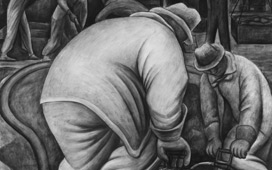
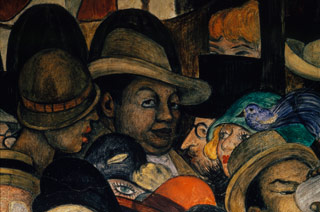
Rivera promoted an image of himself as a common worker; he often wore denim overalls and boasted that early in his career he earned the wages of a housepainter. He also frequently included inconspicuous images of himself in his murals. With this in mind, it is possible to view the rotund figure seen from the back in Pneumatic Drilling as a disguised self-portrait identifying the artist as a manual laborer.
Diego Rivera. Detail with self-portrait from Day of the Dead—City Fiesta. 1923–24. Fresco, approx. 13' 8 1/4" x 12' 3 5/8" (4.17 x 3.75 m). South wall, Patio de las Fiestas (Courtyard of Fiestas), first floor, Secretaría de Educación Pública, Mexico City. © 2011 Banco de México Diego Rivera & Frida Kahlo Museums Trust, México, D.F./Artists Rights Society (ARS), New York. Photograph by Schalkwijk/Art Resource, New York
While working on his portable murals at The Museum of Modern Art, Rivera made sketching excursions to construction sites throughout the city, including Rockefeller Center. The scale of the project—a multi-building complex that in its final state fills three city blocks—must have impressed Rivera and appealed to his faith in modernization’s potential for social transformation. The site’s excavation stage alone involved eight steam shovels, one hundred trucks, and more than two hundred men.
Diego Rivera. Sketches of New York construction sites. 1931–32. Ink, charcoal, and watercolor on paper. Each page: 5 1/8 x 6 3/4" (13 x 17 cm). Private collection. Photographs by Francisco Kochen
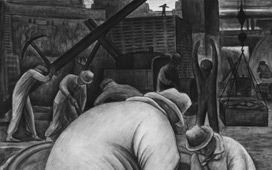
The New York Herald Tribune described Pneumatic Drilling as a “portrait of the activity of excavating for a building foundation, with men drilling, derricks heaving, and trucks going in and out of excavation.” Rockefeller Center’s head architect, Raymond Hood, planned for the site to extend not only precipitously upward by way of impressive skyscrapers, but also below ground. Rivera hints at this innovative design by focusing on construction workers digging deep into the earth. This portable mural also serves as a counterpoint to Lewis Hine’s renowned photographs documenting the dangers faced by construction workers balanced precariously in midair on the girders of new skyscrapers.
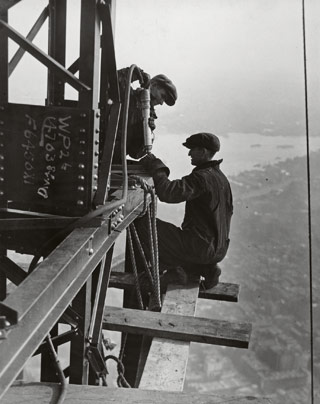
Lewis W. Hine (American, 1874–1940). Riveters Way Up on Empire State, from the series Empire State (Riveters). c. 1931. Gelatin silver print. Image: 9 1/2 x 7 5/8" (24.2 x 19.2 cm); overall: 10 x 8" (25.3 x 20.2 cm). Photograph courtesy George Eastman House, International Museum of Photography and Film, Rochester, New York
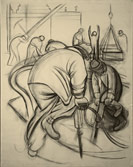
Charcoal on paper, 97 1/4 x 76 7/8" (247 x 195.2 cm). Museo Dolores Olmedo, Xochimilco, Mexico. © 2011 Banco de México Diego Rivera & Frida Kahlo Museums Trust, México, D.F./Artists Rights Society (ARS), New York. Photograph © Eumelia Hernández and Ricardo Alvarado; Instituto Nacional de Bellas Artes
The location of the portable mural Pneumatic Drilling is currently unknown. Our understanding of the work is based on existing photographs and this full-scale cartoon, which reveals Rivera’s attempts to capture the vibrating force of modern-day construction tools. Zigzagging lines lend the composition a sense of dynamism, and the feet of the worker on the right, seen in multiple positions, indicate the jolting reverberations of the jackhammer.
.jpg)
-AMod-RivDi-1408_R2.jpg)