Liberation of the Peon
1931
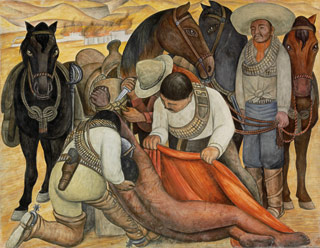
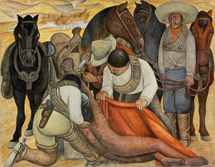
Fresco on reinforced cement in a galvanized-steel framework, 73 x 94 1/4" (185.4 x 239.4 cm). Philadelphia Museum of Art. Gift of Mr. and Mrs. Herbert Cameron Morris, 1943. © 2011 Banco de México Diego Rivera & Frida Kahlo Museums Trust, México, D.F./Artists Rights Society (ARS), New York
In Liberation of the Peon, Rivera developed a harrowing narrative of corporal punishment. A laborer, beaten and left to die, is cut down from a post by sympathetic revolutionary soldiers, who tend to his broken body. Peonage—a system of indentured servitude established by Spanish colonizers, under which natives were forced to work the land—persisted in Mexico into the 20th century. The mural offers the injustice of earlier social and economic conditions as a rationale for the Mexican Revolution.
Liberation of the Peon is based on a panel from Rivera’s mural cycle at the Secretaría de Educación Pública in Mexico City. There, the chilling scene captured in this mural panel is coupled with The Rural Schoolteacher, which touts recent efforts to expand state-run education programs and highlights the benefits of post-revolutionary reforms. Shown alone at The Museum of Modern Art, the meaning of Liberation of the Peon shifted to focus on the sacrifice inherent in revolutionary struggle.
Diego Rivera. Liberation of the Peon. 1923. Fresco, approx. 14' 4 3/8" x 11' 5" (4.38 x 3.48 m). South wall of the Patio del Trabajo (Courtyard of Labor), first floor, Secretaría de Educación Pública, Mexico City. © 2011 Banco de México Diego Rivera & Frida Kahlo Museums Trust, México, D.F./Artists Rights Society (ARS), New York. Photograph by Schalkwijk/Art Resource, New York
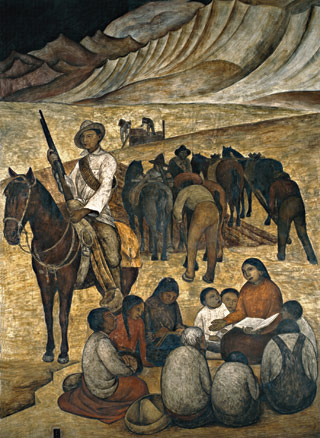
Diego Rivera. The Rural Schoolteacher. 1923. Fresco, approx. 14' 4 3/8" x 10' 8 3/4" (4.38 x 3.27 m). South wall of the Patio del Trabajo (Courtyard of Labor), first floor, Secretaría de Educación Pública, Mexico City. © 2011 Banco de México Diego Rivera & Frida Kahlo Museums Trust, México, D.F./Artists Rights Society (ARS), New York. Photograph by Rafael Doniz
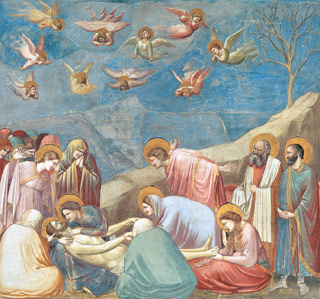
While its subject is secular, Liberation of the Peon evokes Christian imagery, specifically the lamentation over Christ’s body after his crucifixion. The composition draws heavily on Giotto’s Lamentation at the Capella degli Scrovegni in Padua, Italy, which Rivera had studied first-hand. He shared this strategy of transforming religious imagery into revolutionary narrative with many Mexican muralists during the movement’s early years.
Giotto di Bondone (Italian, c. 1267–1337). The Lamentation of Christ. c. 1305. Fresco. Panel approx. 78 3/4 x 72 3/4" (200 x 185 cm). Cappella degli Scrovegni, Padua, Italy. Photograph by Scala/Art Resource, New York
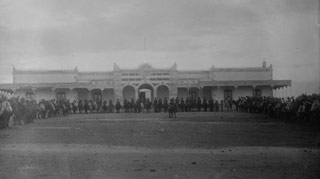
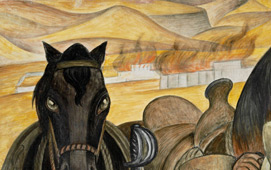
Before the Mexican Revolution, haciendas—vast agricultural estates owned by wealthy Mexicans or foreigners—dominated the country’s social and political landscape. Set ablaze by the rebels in the picture’s foreground, this estate, surrounded by a harsh desert landscape, appears to be located in the northern heartland of Mexico, where the Revolution was launched.
Revolutionary soldiers gathered at the headquarters of Francisco I. Madero, President of Mexico (1911–1913), at the Hacienda de San Diego in Chihuahua, Mexico. c. 1912. Photograph by the Bain News Service. The Library of Congress; Bain Collection
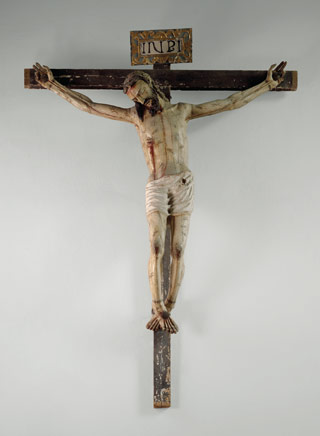
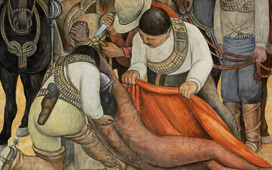
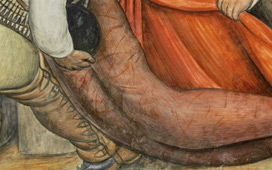
References to Mexican artistic traditions add to Liberation of the Peon’s visceral impact. Devotional imagery created during Mexico’s colonial period was often gory, emphasizing graphic violence and the wounds inflicted on Christ. In his portable mural, Rivera carefully described the individual whip-wounds that cover the peon’s broken body, underscoring the sacrifices made in the revolutionary process.
Anonymous. Crucified Christ. Mexican. 1550–1600. Polychromed cornstalk paste. Figure height 78 3/4" (200 cm); cross height 106 1/4" (270 cm). Templo de San Francisco, Tlaxcala, Mexico. Photograph by Gerardo Suter–Lourdes Almeida; image © The Metropolitan Museum of Art, New York
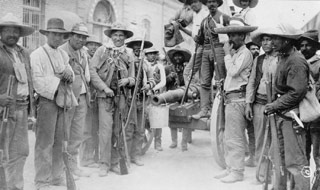
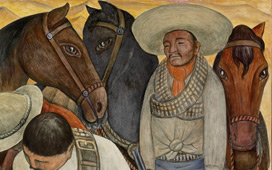
Rivera signals that the men who care for the peon’s body are revolutionaries by wrapping them in cartridge belts and equipping them with visible firearms. Comprised of mixed groups of rebels, many of whom were untrained, Mexican revolutionary soldiers lacked a single, easily recognizable uniform, and often fought in their usual work clothes.
Mexican revolutionaries in Juárez, Mexico. c. 1911. Photographer unknown. The Library of Congress
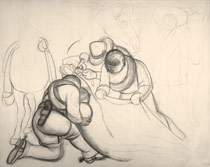
Charcoal and graphite on paper mounted on canvas, 75 3/4 x 95 3/4" (192.4 x 243.2 cm). The Museum of Fine Arts, Houston. Gift of Charles W. Tate in honor of Charles T. Newton Jr. at "One Great Night in November, 1997.” © 2011 Banco de México Diego Rivera & Frida Kahlo Museums Trust, México, D.F./Artists Rights Society (ARS), New York
Rivera used drawings like this cartoon for Liberation of the Peon to work out the compositions of his murals. In both study and fresco, he focused on the relationship between the figures in the group and the limp body of the peon. In order to facilitate transfer of this image, Rivera drew diagonal lines over the composition, with their intersection marking its center. These lines helped him to position the foreground figure, which is more completely finished than the rest of the drawing.