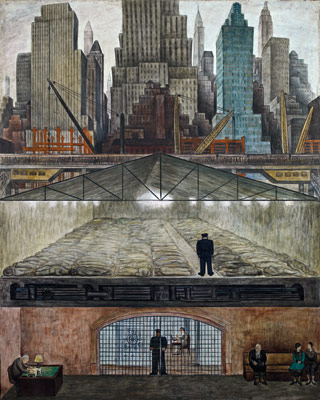
Frozen Assets
1931–32
Fresco on reinforced cement in a galvanized-steel framework, 94 1/8 x 74 3/16" (239 x 188.5 cm). Museo Dolores Olmedo, Xochimilco, Mexico. © 2011 Banco de México Diego Rivera & Frida Kahlo Museums Trust, México, D.F./Artists Rights Society (ARS), New York. Photograph © Eumelia Hernández and Ricardo Alvarado; Instituto Nacional de Bellas Artes
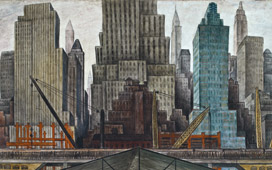
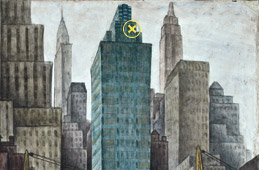
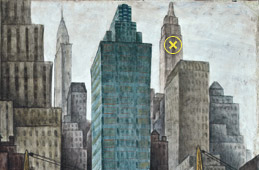
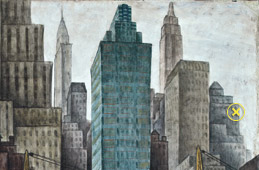
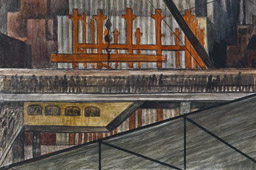
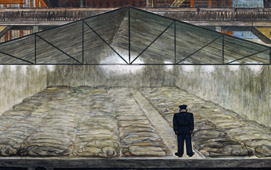
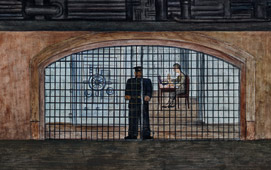
In Frozen Assets, Rivera coupled his appreciation for New York’s distinctive vertical architecture with a potent critique of the city's economic inequities. The panel’s upper register features a dramatic sequence of largely recognizable skyscrapers, most completed within a few years of Rivera’s arrival in New York. In the middle section, a steel-and-glass shed serves as a shelter for rows of sleeping men, pointing to the dispossessed labor that made such extraordinary growth possible during a period of economic turmoil. Below, a bank’s waiting room accommodates a guard, a clerk, and a trio of figures eager to inspect their mounting assets in the vault beyond. Rivera’s jarring vision of the city—in which the masses trudge to work, the homeless are warehoused, and the wealthy squirrel away their money—struck a chord in 1932, in the midst of the Great Depression.
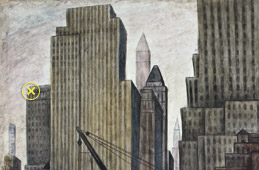
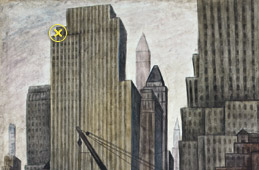
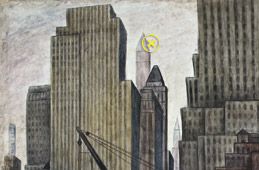
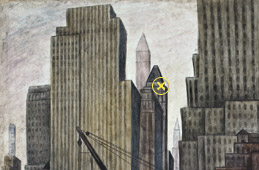
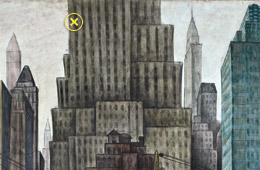
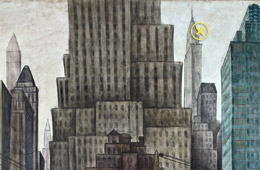
The skyline of Frozen Assets offers a pantheon of the moment’s newest architectural icons. Fueled by the labor made available by vast unemployment during the Depression, giant structures were built across the city at breakneck speed, rapidly transforming New York’s topography. Rivera departs from Manhattan’s true layout: this is a composite image, made by moving landmarks from their actual positions in the city’s grid to create a dense, almost uninterrupted sequence of towering modern buildings.
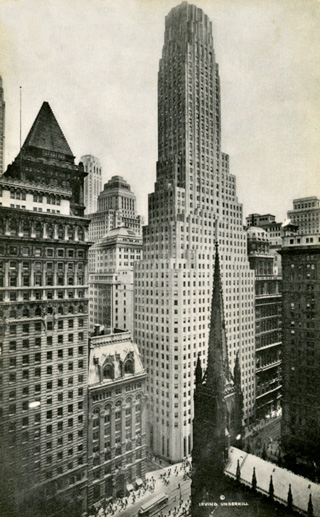
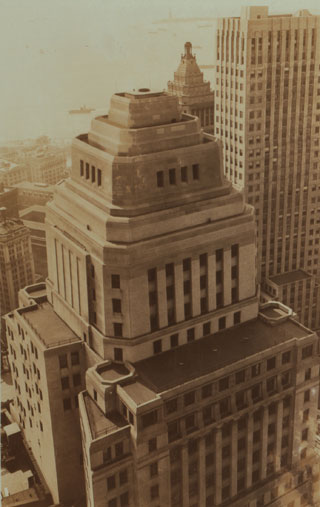
IRVING TRUST BUILDING
Voorhees, Gmelin, and Walker. One Wall Street. 1931
Irving Trust building. c. 1931. Photograph by Irving Underhill. Courtesy BNYMellon Archives, New York
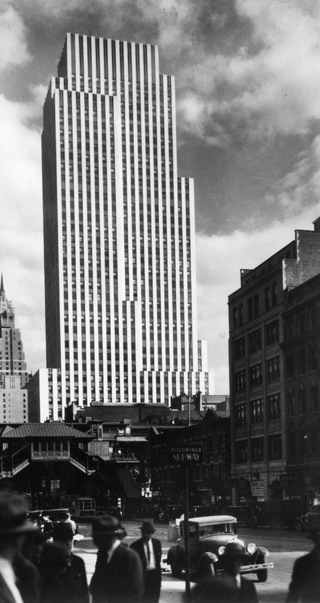
DAILY NEWS BUILDING
Raymond Hood and John Mead Howells. 220 East 42 Street. 1929
Daily News building. c. 1930. Unknown photographer. The Museum of Modern Art, Department of Architecture and Design. Photograph © The Museum of Modern Art, New York
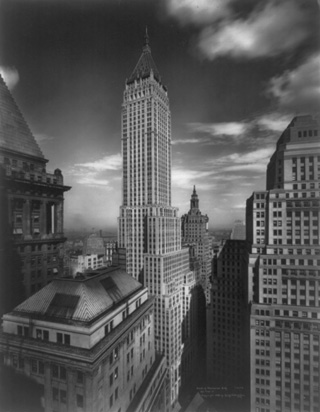
BANK OF MANHATTAN COMPANY BUILDING
H. Craig Severance and Yasuo Matsui. 40 Wall Street. 1930
Bank of Manhattan Company building. c. 1930. Photograph by Irving Underhill. The Library of Congress
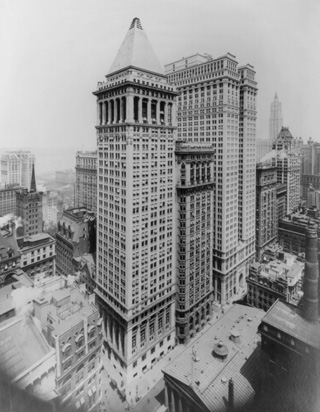
BANKERS TRUST BUILDING
Trowbridge & Livingston. 14 Wall Street. 1912
Bankers Trust building. c. 1915. Unknown photographer. The Library of Congress
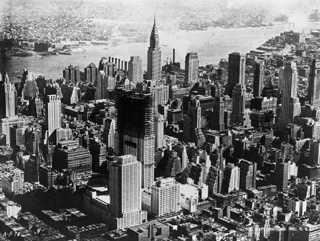
ROCKEFELLER CENTER
Complex of buildings between Fifth and Sixth avenues and 48th and 51st streets
Rockefeller Center under construction. 1932. Photograph by Hamilton M. Wright. The Library of Congress; New York World-Telegram and Sun Newspaper Photograph Collection
In July 1931 the architect Raymond Hood and his team broke ground on Rockefeller Center, at the time the largest building project ever funded wholly by private capital. The site, which took seven years to complete, was a vital source of employment in New York. During a moment when 64 percent of the city's construction workers were unemployed, the building of Rockefeller Center was second only to the undertakings of the Works Progress Administration in temporary job creation.
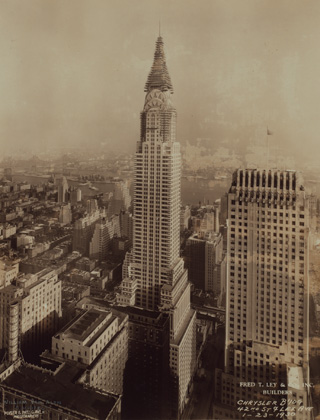
CHRYSLER BUILDING
William Van Alen. 405 Lexington Avenue. 1930
Chrysler building. 1930. Photograph by Peyser and Patzig from Photographic views of New York City, 1870’s–1970’s (1986). Milstein Division of United States History, Local History & Genealogy, The New York Public Library, Astor, Lenox and Tilden Foundations
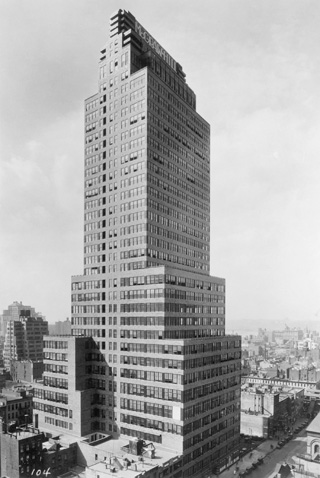
MCGRAW-HILL BUILDING
Raymond Hood with Godley & Fouilhoux. 330 West 42 St. 1931
McGraw-Hill building. c. 1931. Photograph from the exhibition album Modern Architecture: International Exhibition. The Museum of Modern Art Archives, New York. Photograph courtesy The Museum of Modern Art, Department of Imaging Services
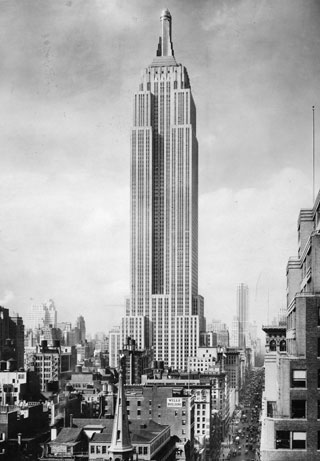
EMPIRE STATE BUILDING
Shreve, Lamb & Harmon. 350 Fifth Avenue. 1931
Empire State building. c. 1931. Unknown Photographer. The Museum of Modern Art, Department of Architecture and Design
EQUITABLE TRUST BUILDING
Trowbridge & Livingston. 15 Broad Street. 1928
Equitable Trust building. 1933. Photograph by Percy L. Sperr from Photographic views of New York City, 1870’s–1970’s (1986). Milstein Division of United States History, Local History & Genealogy, The New York Public Library, Astor, Lenox and Tilden Foundations
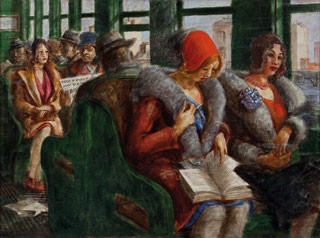
Reginald Marsh (American, 1898–1954). The El. c. 1928. Oil on canvas, 30 x 40" (76.2 x 101.6 cm). Whitney Museum of American Art, New York. Felicia Meyer Marsh Bequest 80.31.9. © 2011 Estate of Reginald Marsh/Art Students League, New York/Artists Rights Society (ARS), New York. Photograph courtesy Whitney Museum of Art, New York
At the time of Rivera's visit to New York, the city’s system of elevated trains was still operational. This is probably a stop on the Third Avenue line. Rivera’s passengers, an anonymous mass crowded onto a station platform, are dwarfed by the enormous buildings that rise behind them. His bleak vision contrasts with images of the city’s transit system by American artists like Reginald Marsh, who similarly pinpointed trains as a hallmark of urban life in the city. In images like The El (c. 1928), Marsh focuses on the spectacle that unfolds inside the train, offering a relatively picturesque view.
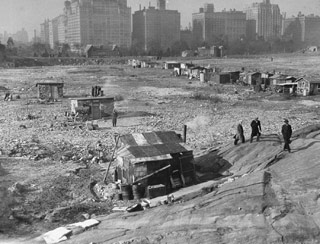
Shantytown in New York’s Central Park. 1933. Photograph by the New York Daily News. Courtesy New York Daily News via Getty Images
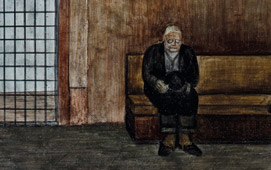
The central section of Frozen Assets pictures a steel-and-glass shed—identified by Fortune magazine as the Municipal Pier at East 25th Street—filled with sleeping men who are watched by a guard. The Depression’s impact on the city would have been immediately visible to Rivera in the winter of 1931–32: bread lines served tens of thousands of meals a day, roughly half of New York's manufacturing plants were closed, and makeshift shacks housed scores of newly homeless men and women throughout the city.
In 1931, The New Yorker reported that the bank vault found in this fresco panel's lower section was inspired by Rivera's trip to the Irving Trust building at One Wall Street, which at the time bragged that its underground repository was "the most impregnable ever constructed." Financial institutions figure prominently in this work's imagined skyline, creating a constellation of buildings that connect to the theme of hidden wealth.
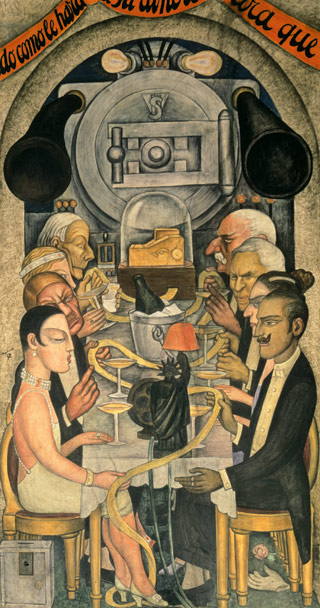
Diego Rivera. Wall Street Banquet. 1926. Fresco, approx. 80 3⁄4 x 61" (205 x 155 cm). North wall, Patio de las Fiestas (Courtyard of Fiestas), third floor, Secretaria de Educacion Pública, Mexico City. © 2011 Banco de México Diego Rivera & Frida Kahlo Museums Trust, México, D.F./Artists Rights Society (ARS), New York. Photograph by Schalkwijk/Art Resource, New York
Rivera seems to have included a sly jab at the Rockefellers—key backers of his show at MoMA and future patrons of his ill-fated mural at Rockefeller Center—in the lower register of Frozen Assets. The man waiting to examine his security box bears more than a passing likeness to John D. Rockefeller, Jr., and the craggy profile of the clerk on the far left brings to mind John D. Rockefeller, Sr. Years earlier, Rivera had used a portrait of the elder Rockefeller in a panel at the Secretaría de Educación Pública in Mexico that openly disparaged U.S. capitalism.