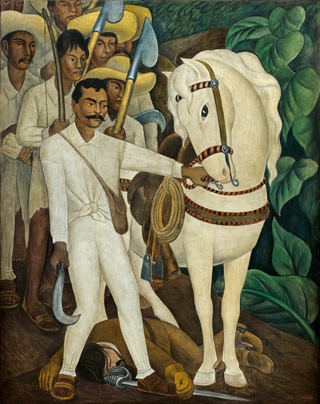
Agrarian Leader Zapata
1931
Fresco on reinforced cement in a galvanized-steel framework, 93 3/4 x 74" (238.1 x 188 cm). The Museum of Modern Art, New York. Abby Aldrich Rockefeller Fund. © 2011 Banco de México Diego Rivera & Frida Kahlo Museums Trust, México, D.F./Artists Rights Society (ARS), New York. Photograph courtesy The Museum of Modern Art, Department of Imaging Services (John Wronn)
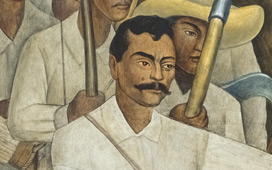
Emiliano Zapata, a champion of agrarian reform and a key protagonist in the Mexican Revolution, here leads a band of peasant rebels armed with makeshift weapons, including farming tools. With the bridle of a majestic white horse in his hand, Zapata stands triumphantly beside the dead body of a hacienda owner. Though Mexican and U.S. newspapers regularly vilified the revolutionary leader as a treacherous bandit, Rivera immortalized Zapata as a hero and glorified the victory of the Revolution in an image of violent but just vengeance.
Agrarian Leader Zapata is based on a panel from Rivera’s mural cycle at the Palacio de Cortés in Cuernavaca, the capital of the Mexican state of Morelos. A native of that same state, Zapata led campaigns for land reform, including an effort to reorganize the area’s sugar industry into a system of cooperatives. In Rivera’s image, the rebel wields the type of machete used to harvest sugar cane, a clear reference to Zapata’s revolutionary agenda and Morelos’s most important agricultural product.

Diego Rivera. South wall of the mural cycle History of the State of Morelos: Conquest and Revolution, with image of Emiliano Zapata. 1930. Fresco, approx. 19' 10 3/16" x 15' 9 3/4" (6.05 x 4.82 m). Palacio de Cortés, Museo Regional Cuauhnáhuac, Instituto Nacional de Antropología e Historia, Cuernavaca, Mexico. © 2011 Banco de México Diego Rivera & Frida Kahlo Museums Trust, México, D.F./Artists Rights Society (ARS), New York. Photograph © 2011 Eumelia Hernández, Ricardo Alvarado; Instituto Nacional de Bellas Artes
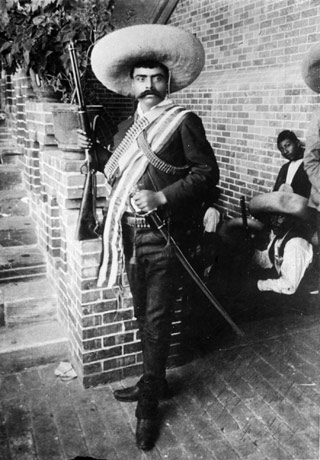
Dressed as a humble peasant in huaraches and a white cotton shirt and trousers, Rivera’s portrait of Zapata departs from portrayals propagated by popular press images and by the rebel himself. An expert horseman, Zapata consistently presented himself as a charro, a cowboy whose flamboyant dress—tight pants and a vest with silver ornamentation—signaled an elevated class status in Mexico. Rivera’s vision of Zapata as a humble peasant offers a sympathetic portrait of a folk hero tirelessly devoted to Mexico’s disenfranchised agrarian workers.
Emiliano Zapata at his headquarters in Cuernavaca. c. 1913. Photograph by Hugo Brehme. Casasola Archive, Fototeca Nacional del Instituto Nacional de Antropología e Historia, Pachuca, Mexico. © (186458) CONACULTA. INAH-SINAFO-FN-Mexico
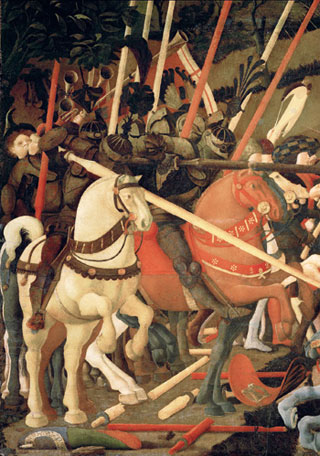
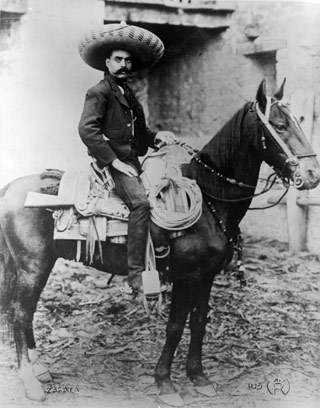
Rivera ennobles Mexican history—and Zapata—in this work by linking them to the grandeur of European artistic tradition. The steed, whose owner Zapata has just dragged from his saddle, shares the color and imposing presence of horses in Paolo Uccello’s early 15th-century painting The Battle of San Romano, which Rivera studied on a 1920–21 trip to Italy. Visual parities between Zapata and the horse in terms of scale and color have led commentators to assume the animal belongs to the revolutionary, whose actual horse was black.
Paolo Uccello (Italian, c. 1397–1475). The Battle of San Romano (detail). c. 1438. Tempera on wood. Full panel: 71 3/4" x 10' 5 1/2" (1.82 x 3.22 m). Galleria degli Uffizi, Florence, Italy. Photograph by Erich Lessing/Art Resource, New York
Emiliano Zapata on horseback. c. 1915. Photographer unknown. Casasola Archive, Fototeca Nacional del Instituto Nacional de Antropología e Historia, Pachuca, Mexico. © (186444) CONACULTA. INAH-SINAFO-FN-Mexico
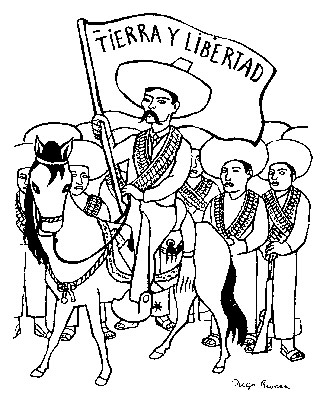
Rivera continually reinvented the image of Zapata for didactic purposes. He often drew upon photographs and images of the revolutionary that were distributed widely by press outlets, modernizing his mural practice by integrating these new media forms. Aimed at a broad audience of diverse ages, social and economic classes, and nationalities, Rivera’s portraits of the revolutionary leader appeared in a variety of media, ranging from his monumental mural cycles to prints and book illustrations.
Diego Rivera. Illustration of Emiliano Zapata on horseback, as reproduced in Manuel Velázquez Andrade, Fermín. Libro mexicano de lectura para primer año (Mexico City: Secretaría de Educación Pública, 1927). © 2011 Banco de México Diego Rivera & Frida Kahlo Museums Trust, México, D.F./Artists Rights Society (ARS), New York. Photograph courtesy Editorial RM
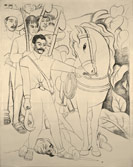
Charcoal on paper, 98 3/8 x 78" (250 x 198 cm). Private collection, Mexico. © 2011 Banco de México Diego Rivera & Frida Kahlo Museums Trust, México, D.F./Artists Rights Society (ARS), New York. Photograph © Eumelia Hernández and Ricardo Alvarado; Instituto Nacional de Bellas Artes
The surface of a fresco panel dries quickly, so the artist must have a clear vision of his or her composition before applying pigment to the wet plaster. Rivera developed his images on paper, then transferred them to or replicated them on the mural’s surface. He pinned precisely scaled cartoons, like this study, near his fresco panels to help determine the exact proportions of the final work. Here, bold strokes contrast with quick, sketch-like marks to create an image that corresponds to the finished fresco with great accuracy.
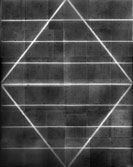
X-radiograph of Agrarian Leader Zapata, showing its metal framework. Image by Cynthia Albertson
Recent X-rays of Agrarian Leader Zapata reveal the internal skeleton of one of Rivera’s portable murals for the first time. A metal armature composed of horizontal and diagonal bars, iron mesh, and a rigid steel outer frame provides a torque-resistant support for multiple layers of cement and fresco mortar. This framework allowed Rivera to free his murals from the wall, but it certainly did not make them easy to move, with the largest weighing nearly a thousand pounds.
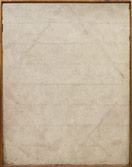
The back of Agrarian Leader Zapata, showing a layer of cementlike material over the panel’s metal structure. Image courtesy The Museum of Modern Art, Department of Imaging Services (Jonn Wronn)
Because of the time it takes to prepare fresco panels for painting, Rivera needed to set preparations in motion in advance of his arrival in New York, just six weeks before the opening of his exhibition. His assistants coordinated the fabrication of sturdy, slab-like backings for the fresco mortar—metal structures covered with cement. On the reverse side of Agrarian Leader Zapata, the arcing gestures used to trowel on the cement are in evidence, moving from right to left and top to bottom. The diamond shape and horizontal lines visible through the rough surface trace the panel’s inner metal framework.