 |
|
 |
|
Vertigo (1958)
Isn't Vertigo about the conflict between illusion and reality?
|
|
Oh, yes. I was interested by the basic situation, because it contained so much analogy to sex. Stewart's efforts to recreate the woman were, cinematically, exactly the same as though he were trying to undress the woman, instead of dressing her. He couldn't get the other woman out of his mind. Now, in the book, they didn't reveal that she was one and the same woman until the end of the story. I shocked Sam Taylor, who worked on it, when I said, "When Stewart comes upon this brunette girl, Sam, this is the time for us to blow the whole truth." He said, "Good God, why?" I told him, if we don't what is the rest of our story until we do reveal the truth. A man has picked up a brunette and sees in her the possibilities of resemblance to the other woman. Let's put ourselves in the minds of our audience here: "So you've got a brunette and you're going to change her." What story are we telling now? A man wants to make a girl over and then, at the very end, finds out it is the same woman. Maybe he kills her, or whatever. Here we are, back in our old situation: surprise or suspense. And we come to our old analogy of the bomb: you and I sit talking and there's a bomb in the room. We're having a very innocuous conversation about nothing. Boring. Doesn't mean a thing. Suddenly, boom! the bomb goes off and they're shocked--for fifteen seconds. Now you change it. Play the same scene, insert the bomb, show that the bomb is placed there, establish that it's going to go off at one o'clock--it's now a quarter of one, ten of one--show a clock on the wall, back to the same scene. Now our conversation becomes very vital, by its sheer nonsense. "Look under the table! You fool!" Now they're working for ten minutes, instead of being surprised for fifteen seconds. Now let's go back to Vertigo. If we don't let them know, they will speculate. They will get a very blurred impression as to what is going on. "Now," I said, "one of the fatal things, Sam, in all suspense is to have a mind that is confused. Otherwise the audience won't emote. Clarify, clarify, clarify. Don't let them say, "I don't know which woman that is, who's that?" So," I said, "we are going to take the bull by the horns and put it all in a flashback, bang! right then and there--show it's one and the same woman." Then, when Stewart comes to the hotel for her, the audience says, "Little does he know." Second, the girl's resistance in the earlier part of the film had no reason. Now you have the reason--she doesn't want to be uncovered. That's why she doesn't want the gray suit, doesn't want to go blond--because the moment she does, she's in for it. So now you've got extra values working for you. We play on his fetish in creating this dead woman, and he is so obsessed with the pride he has in making her over. Even when she comes back from the hairdresser, the blond hair is still down. And he says, "Put your hair up." She says, "No." He says, "Please." Now what is he saying to her? "You've taken everything off except your bra and your panties, please take those off." She says, "All right." She goes into the bathroom. He's only waiting to see a nude woman come out, ready to get in bed with. That's what the scene is. Now, as soon as she comes out, he sees a ghost--he sees the other woman. That's why I played her in a green light. You see, in the earlier part--which is purely in the mind of Stewart--when he is watching this girl go from place to place, when she is really faking, behaving like a woman of the past--in order to get this slightly subtle quality of a dreamlike nature although it was bright sunshine, I shot the film through a fog filter and I got a green effect--fog over bright sunshine. That's why, when she comes out of the bathroom, I played her in the green light. That's why I chose the Empire Hotel in Post Street--because it had a green neon sign outside the window. I wanted to establish that green light flashing all the time. So that when we need it, we've got it. I slid the soft, fog lens over, and as she came forward, for a moment he got the image of the past. Then as her face came up to him, I slipped the soft effect away, and he came back to reality. She had come back from the dead, and he felt it, and knew it, and probably was even bewildered--until he saw the locket--and then he knew he had been tricked.
|
|
| |
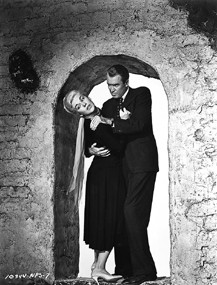
Vertigo. 1958 |
|
| North By Northwest (1959) |
It is. It's the American Thirty-Nine Steps--I'd thought about it for a long time. It's a fantasy. The whole film is epitomized in the title--there is no such thing as north-by-northwest on the compass. The area in which we get near to the free abstract in movie making is the free use of fantasy, which is what I deal in. I don't deal in that slice-of-life stuff. Only one sequence was missing from that picture: the assembly-line in Detroit. Never got that in. I wanted to have a dialogue scene--two men talking, walking along the assembly line--and behind them is a car being assembled. Starts with a bare frame and continues to be built. And the men talk on--their conversation should have a little bit to do with automobiles--and finally the car is loaded up with gas and one of the men drives it off. Well, I wanted to see the car finally come off the line, and they open the door and look in, and a dead body falls out. Also I wanted to get in a shot of Cary Grant hiding in Lincoln's nose and having a sneezing fit! |
|
| How did you get the idea for the plane sequence?
|
This comes under the heading of avoiding the clich�s. The clich� of that kind of scene is in The Third Man. Under a street lamp, in a medieval setting, black cat slithers by, somebody opens a blind and looks out, eerie music. Now, what is the antithesis of this? Nothing! No music, bright sunshine, and nothing. Now put a man in a business suit in this setting.
|
|
| Mason really doesn't act like a villain, does he?
|
No, I didn't make him do a dastardly thing in the whole picture. I split him into three in an effort to keep him from behaving like a heavy: there's Mason himself, who only had to nod. I gave him a rather saturnine looking secretary--there was the face of Mason. And the third man--Adam Williams--he was the brutality.
|
|
Psycho (1960)
Do you really consider Psycho an essentially humorous film?
|
Well, when I say humorous, I mean it's my humor that enabled me to tackle the outrageousness of it. If I were telling the same story seriously, I'd tell a case history and never treat it in terms of mystery or suspense. It would simply be what the psychiatrist relates at the end.
|
|
| In Psycho, aren't you really directing the audience more than the actors?
|
Yes. It's using pure cinema to cause the audience to emote. It was done by visual means designed in every possible way for an audience. That's why the murder in the bathroom is so violent, because as the film proceeds, there is less violence. But that scene was in the minds of the audience so strongly that one didn't have to do much more. I think that in Psycho there is no identification with the characters. There wasn't time to develop them and there was no need to. The audience goes through the paroxysms in the film without consciousness of Vera Miles or John Gavin. They're just characters that lead the audience through the final part of the picture. I wasn't interested in them. And you know, nobody ever mentions that they were ever in the film. It's rather sad for them. Can you imagine how the people in the front office would have cast the picture? They'd say, "Well, she gets killed off in the first reel, let's put anybody in there, and give Janet Leigh the second part with the love interest." Of course, this is idiot thinking. The whole point is to kill off the star, that is what makes it so unexpected. This was the basic reason for making the audience see it from the beginning. If they came in half-way through the picture, they would say, "When's Janet Leigh coming on?" You can't have blurred thinking in suspense.
|
|
| Didn't you experiment with TV techniques in Psycho?
|
It was made by a TV unit, but that was only a matter of economics really, speed and economy of shooting, achieved by minimizing the number of set-ups. We slowed up whenever it became really cinematic. The bathroom scene took seven days, whereas the psychiatrist's scene at the end was all done in one day.
|
|
| How much did Saul Bass contribute to the picture? |
Only the main title, the credits. He asked me if he could do one sequence in Psycho and I said yes. So he did a sequence on paper, little drawings of the detective going up the stairs before he is killed. One day on the picture, I was sick, and I called up and told the assistant to make those shots as Bass had planned them. There were about twenty of them and when I saw them, I said, "You can't use any of them." The sequence told his way would indicate that the detective is a menace. He's not. He is an innocent man, therefore the shot should be innocent. We don't have to work the audience up. We've done that. The mere fact that he's going up the stairs is enough. Keep it simple. No complications. One shot.
|
|
| Did you intend any moral implications in the picture?
|
I don't think you can take any moral stand because you're dealing with distorted people. You can't apply morality to insane persons.
|
|
| |

 |