 |
|
 |
|
Rope (1948)
Do you consider Rope one of your most experimental films, technically?
|
|
Only because I abandoned pure cinema in an effort to make the stage play mobile. With a flowing camera, the film played in its own time, there were no dissolves, no time-lapses in it, it was continuous action. And I thought it also ought to have a continuous flow of camera narrative as well. I think it was an error technically because one abandoned pure cinema for it. But when you take a stage play in one room, it is very hard to cut it up.
|
|
| |
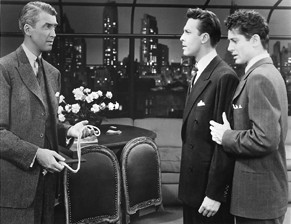
Rope. 1948 |
|
| Your approach to Rope was not comic as it was for Psycho? |
No, the nature of the crime was too horrible. There was no humor in that respect. |
|
Under Capricorn (1949)
This picture was not a success, but why do you think many French critics consider it one of your finest films?
|
Because they looked at it for what it was and not what people expected. Here you get a Hitchcock picture which is a costume-picture and not approached from a thriller or excitement point of view until towards the end. I remember some remark by a Hollywood critic who said, "We had to wait 105 minutes for the first thrill." They went in expecting something and didn't get it. That was the main fault with that picture. Also the casting was wrong. This was the lady-and-the groom story again. Bergman fell in love with the groom, Joe Cotten, and he got shipped to Australia as a convict and she followed him. It was her getting degraded for love--that was the main thing here. Cotten wasn't right. I wanted Burt Lancaster. It was compromise casting again. Also I used a fluid camera--mistakenly perhaps because it intensified the fact that it wasn't a thriller--it flowed too easily.
|
|
Stage Fright (1950)
Why do you dislike this picture?
|
Again, the lack of reality in one of the characters--the Jane Wyman part--should have been a pimply-faced girl. She just refused to be that and I was stuck with her. The other fault was that the menace wasn't strong enough. The menace came from Dietrich and her partner--they were the villains--and they had no menace in them because they were afraid. So what were you doing in that story? You were concealing the menace entirely. The values got confused. Also a lot of people complained because the opening flashback was a lie. Now why can't a man tell a lie? I don't know. But people complained, "AH, you cheated us on the flashback." Can't he be a liar? You see, if you break tradition, you are in trouble every time.
|
|
| Strangers on a Train (1951) |
Granger was miscast. Warners insisted I take him. It should have been a much stronger man. The stronger the man, the more frustrated he would have been in the situation.
|
|
| Isn't the irony of the picture that Walker actual does free Granger from his impossible wife?
|
Sure. Granger didn't pay back, did he? He didn't kill Walker's father. He ratted on Walker.
|
|
| How did you achieve that stunning carousel sequence?
|
This was a most complicated sequence. For rear-projection shooting there is a screen and behind it is an enormous projector throwing an image on the screen. On the studio floor is a narrow white line right in line with the projector lens and the lens of the camera must be right on that white line. That camera is not photographing the screen and what's on it, it is photographing light in certain colors, therefore the camera lens must be level and in line with the projector lens. Many of the shots on the merry-go-round were low camera set-ups. Therefore you can imagine the problem. The projector had to be put up on a high platform, pointing down, and the screen had to be exactly at right angles to the level-line from the lens. All the shots took nearly half a day to line up, for each set-up. We had to change the projector every time the angle changed. When the carousel broke, that was a miniature blown up on a big screen and we put live people in front of the screen. But I did the most dangerous thing I've ever done in that picture and I'll never, never do it again. When the little man crawled underneath the moving carousel--that was actual. If he had raised his head an inch, two inches--finish. My hands sweat now when I think of it--what a dreadful chance I took. I knew what I was doing then, you know, but I thought, "Oh, well, maybe he won't raise his head too high.
|
|
| Doesn't Granger chase after Walker mainly to expiate his own feelings of guilt about the murder of his wife?
|
Sure he does. He felt like killing her himself.
|
|
| I Confess (1953) |
There were two things wrong with I Confess. I didn't enjoy working with Clift because he was too obscure, and Anne Baxter was completely miscast. I imported a girl from Sweden--Anita Bjork, who played the lead in Miss Julie--I wanted an unknown. When you go to Quebec and a film star pops up, it's ridiculous. But Bjork arrived with an illegitimate child and a lover. And the thing came out and Warners said, "We can't use her." We had to ship her back. By this time I was a week away from Quebec. I got messages that we should take Baxter, that they didn't have anybody else. It was all wrong. I didn't believe her as a member of Quebec society. I wanted a foreign girl with an accent.
|
|
| How did you achieve the shimmering effect of the first flashback? |
That was done in slow motion. I slowed it up tremendously.
|
|
| Do you think Clift had already decided to become a priest before his return from the war? |
Yes. I think he'd already decided.
|
|
| Do you think they slept together during the storm? |
I hope so. Far be it from me as a Jesuit to encourage that kind of behavior.
|
|
| Do you think Clift was tempted with the idea of becoming a martyr? |
Yes, he was tempted by the idea. Of course, in the end, he was a martyr.
|
|
| Don't Clift and Baxter feel a strong sense of guilt because in a way they're glad that the man was murdered and therefore out of their hair? |
Yes, but he isn't really, because of their conscience. You know, killing is one thing, but it is not out of their conscience, not out of their mind.
|
|
| |

 |