 |
|
|
|
|
|
|
|
The subtle variation of color achieved by dyeing is a pure revelation in contemporary Japanese textiles. Dyers have an almost spiritual devotion to transforming yarn or cloth into extensions of their perceptions of earth, water, and sky through color.
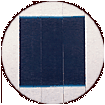
No other color is more associated with Japanese textiles than the deep blue of ai, or indigo. Hiroyuku Shindo was enraptured by the magical colors achieved from natural indigo and through his work he has helped to revive and transform this ancient craft. Shindigo Square Series 92-1 is composed of five narrow kimono-width handwoven hemp panels that have been dipped repeatedly in indigo. The intense color is a result of this repeated dipping rather than the time submerged in the dye.
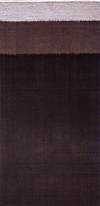
Jun Tomita uses the traditional dyeing technique of kasuri or ikat meaning to tie or to bind. Threads are bound and dyed and then woven according to a predetermined pattern. As Tomita handweaves, a blurring occurs at the junction of different colors, creating subtleties of colors within colors that are only revealed by close scrutiny.
|
|
|
|
|
|
|
|
|
|
|
Hiroyuki Shindo. Shindigo Square Series 92-1. 1992. Cotton and linen, 76 x 77" (193 x 195.6 cm). Collection The Saint Louis Art Museum, Friends Fund. Handwoven, gradation dyed with indigo
|
|
|
|
|
|
Jun Tomita. Kasuri Panel 151-1. 1993. Silk, hemp, and linen, 39 x 80" (99.7 x 203.9 cm). Collection Sheila Hicks. Handwoven, ikat dyed
|
|
|



