|
|
|
Meerlust was bought in 1757 by Johannes Albertus Mijburgh, who had come to the Cape from Hamburg, and has been in the Myburgh family ever since. Within four years of buying the farm Mijburgh possessed 35 slaves, 40 horses, 80 cattle, 800 sheep, and 40,000 vines. Sixteen years later he had 54 slaves, 90 horses, 150 cattle, 2,500 sheep, and 80,000 vines and by 1776 he also had seven children. With 60 slaves and 100,000 vines in 1782 he was one of the wealthiest farmers in the Cape.
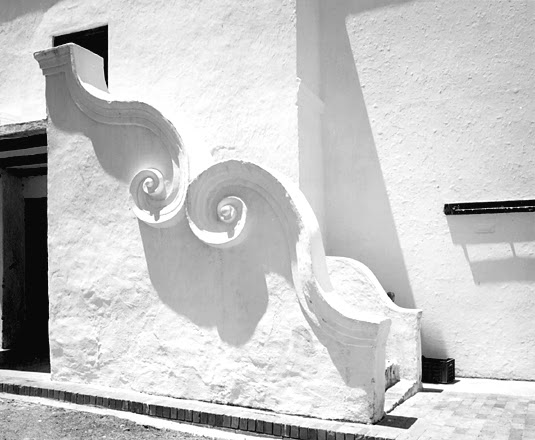
Thus when he added a center gable to his house in 1776 it did far more than keep rainwater off the front door. Meerlust's elegantly curved Cape Dutch gable, like many others of the period, was a gesture of conspicuous consumption, expressive of the wealth and fecundity of home and farm.The molding on this stairway, possibly sculpted in about 1781 when the storeroom it served was built, is in the classic concave-convex curves of many Cape gables, and was surely made with similar intent. Whose spirit and skills rendered it with such voluptuous purity we shall never know. We do know however that Meerlust was renowned for the abilities of its artisan slaves.
|