Learning Specialist, Emma Waldman: Now that we are in front of this very large painting, I want us to take a few steps back. After you've done that, I want you to take notice of what jumps out to you.
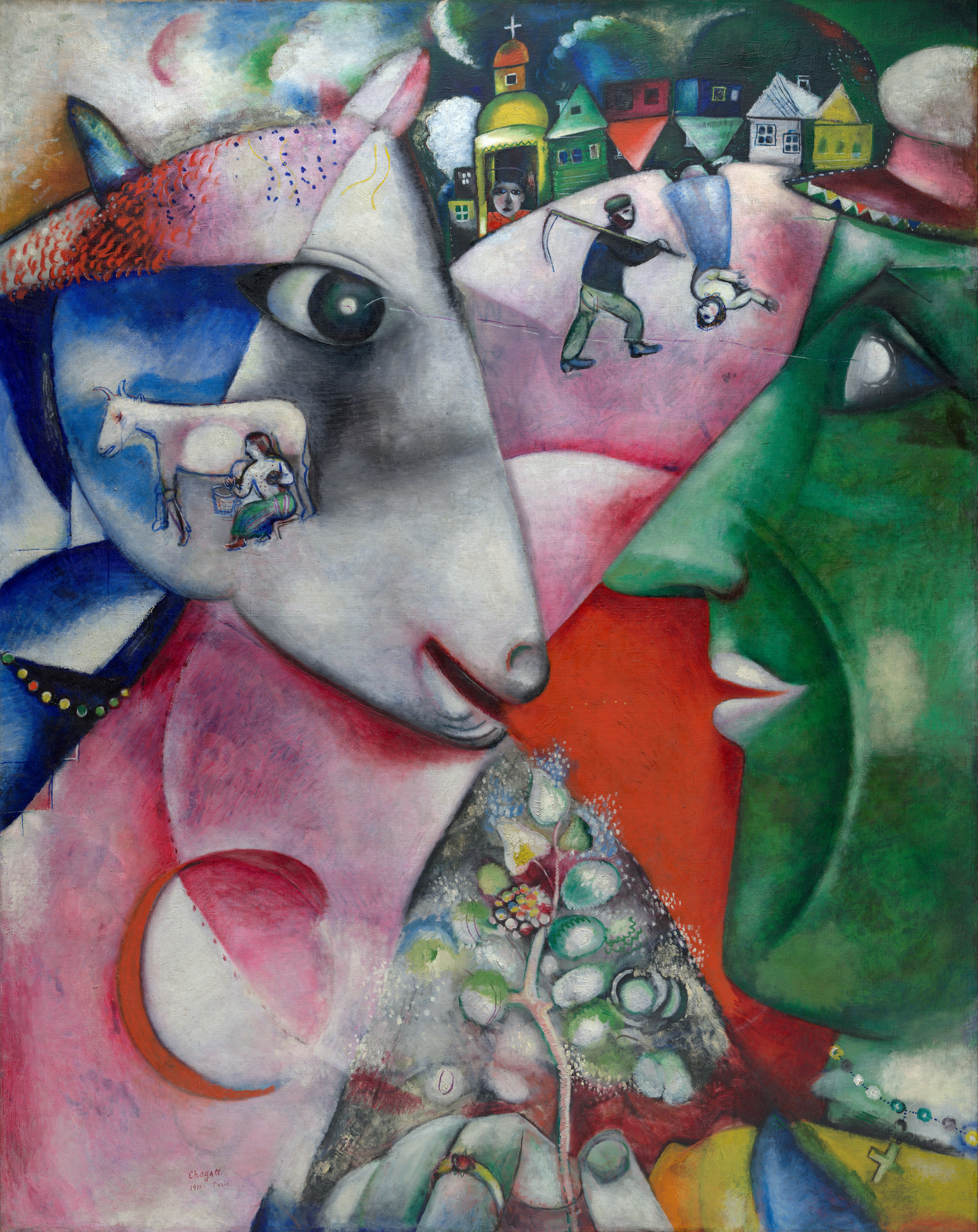
Curator, Anne Umland: I see what I take to be this big green profile of a man wearing this little red cap perched up on his head. And then directly across from him is this equally big profile of a white and blue cow.
Emma Waldman: Let's take a few steps closer to the painting now. What are some of these elements and details that you can start to see?
I start to see people, this second cow, with a person potentially milking. I'm starting to see some buildings, some homes, some additional details that I may not have seen from further away.
Anne Umland: One of the details I particularly love about this work is that if you look closely at those two eyes, you can see that the artist, Marc Chagall, has connected them by this very, very thin line.
Emma Waldman: The more time I spend, the more questions I have. I want to know what the story is to this painting. There's so many elements, but I wanna know how they connect to one another.
Anne Umland: Chagall made this work when he was around 24 years old. He had just moved to Paris the year before from what is today Belarus, but was then part of the Russian Empire. The title, I and the Village, suggests to me that he was still thinking about his faraway home and his memories of things that he might have seen there.
Emma Waldman: Marc Chagall grew up in a very small farming town with a rich Jewish culture and heritage. This painting has details he would’ve seen in his hometown, but also some of the Jewish cultural beliefs he grew up with, such as compassion towards animals and a strong connection to nature. As someone who is also Jewish, I can see part of my culture and my identity in this painting as well.