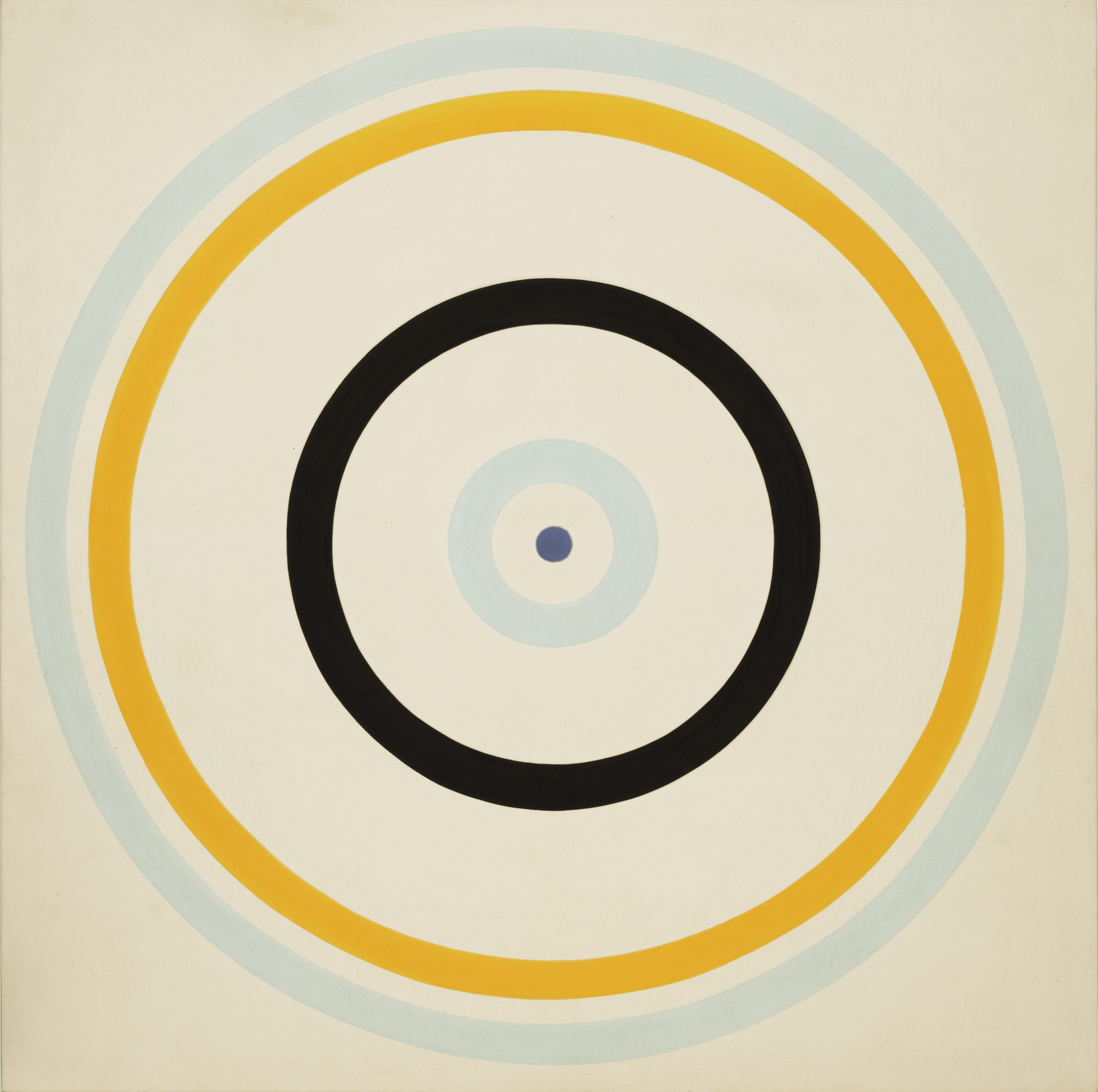
Learning Specialist, Carolina Malagamba: I wanna invite you to take some time to look at the painting, and notice where your eyes are drawn to.
Artist, Kenneth Noland: Color has pulses, and those pulses can lead you from one dimension to another dimension.
Carolina Malagamba: This is a painting by Kenneth Noland. He was super interested in color theory, the idea that by mixing and pairing colors, you can create different effects. Very warm colors advance towards us—for example, the yellow circle is what my eyes feel really drawn to. Other colors, like the blue circles, seem to move away from us.
Kenneth Noland would say that he wanted to remove his presence as much as possible from his art, that he didn’t want us to be able to see any brushstrokes or textures. Part of that meant using materials and techniques that depicted color in a way that is very flat and still.
The traditional way of working with canvas is that you prime it. You have a layer of this white paste that we call gesso, and what it does is that it makes the canvas nonabsorbent, which is what you want to create really sharp lines. However, this canvas is not primed. So we can notice that the edges of the circles are slightly blurred because the canvas is absorbing the paint. Also, he is using very diluted paint. This technique is also known as “soak-stain” technique, and it refers to the fact that the paint really is soaked into the canvas.
Kenneth Noland: And I could see into the colors by making the paint that way. A stain painting can. Cause you to look from to follow a color into another color to another color by the difference of transparency of warmth, coolness.