Learning Specialist, Carolina Malagamba: This work is a bit different from the others we’ve explored on this tour. It’s part of the Museum’s Architecture & Design collection. To learn more about it, I decided to ask my friend Paul Galloway, who works here at MoMA.
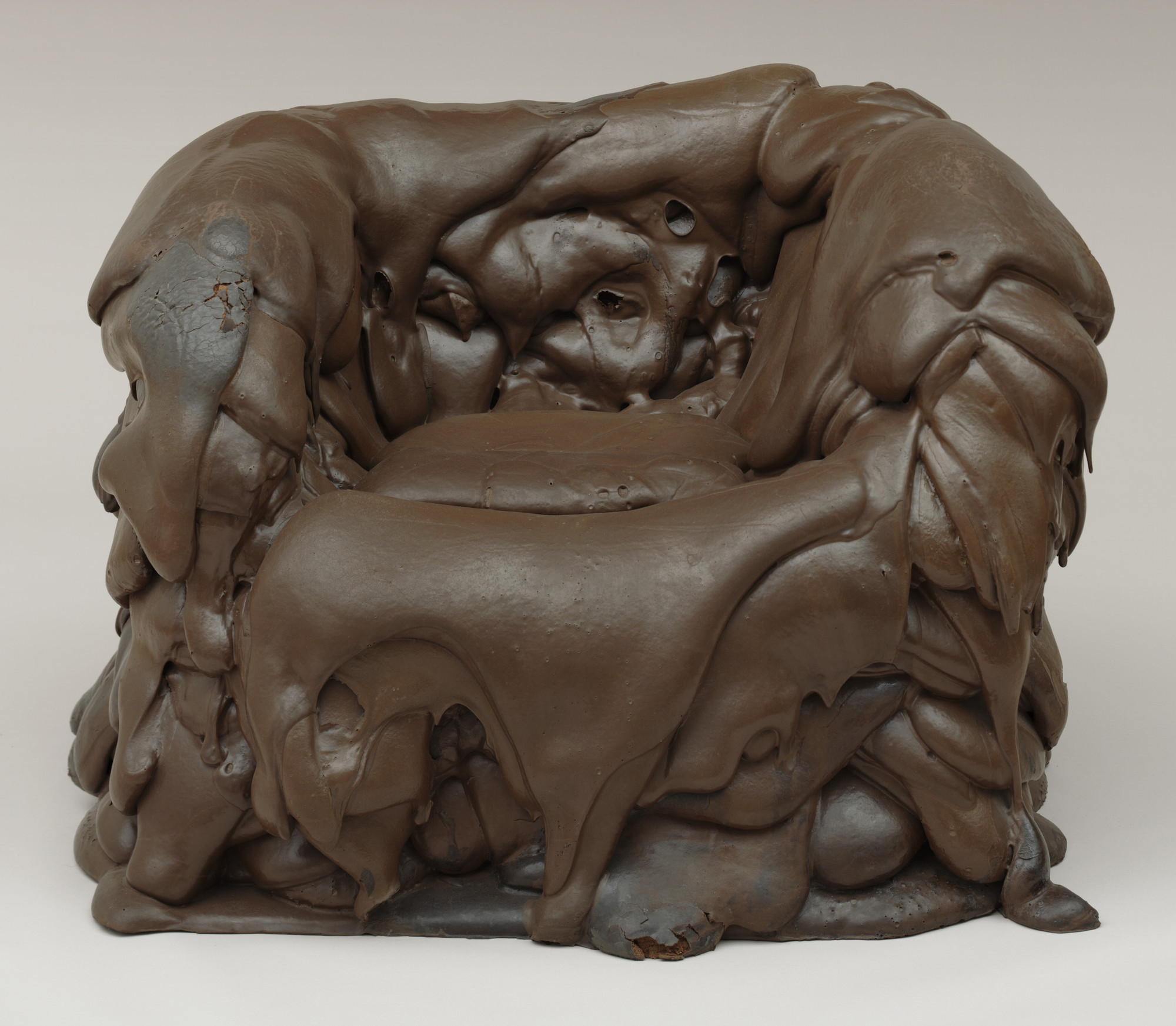
Collection Specialist, Paul Galloway: This was made in 1964, and it’s a very strange armchair by the Danish artist Gunnar Aagaard Andersen.
Carolina Malagamba: We have another special guest too: Paul’s son, August!
Paul Galloway: August, what was your first reaction when you saw this chair?
Teen, August Galloway: It’s brown. It looks very mushy, as if it’s melting. It reminded me of a giant puddle of mud or poop. Shaped into an armchair. I would definitely feel disturbed sitting in it.
Paul Galloway: Yeah, it definitely looks like it’s still in a liquid form.
August Galloway: What type of material do you think the designer used to make this? ‘Cause I don’t think it’s possible to get a solid material to shape this way.
Paul Galloway: So, the chair is made from something called poured polyurethane, a kind of plastic material that can be either rigid or flexible. It was invented in the 1930s and grew in popularity during World War II because it could replace rubber, which at the time was expensive and hard to obtain.
August Galloway: If he used a semi-liquified substance, it must have taken a long time to get it to shape into an armchair.
Paul Galloway: Yeah, to make this armchair, he worked in layers. He hand-poured the polyurethane foam, allowing parts of it to expand, and then repeated the process over and over again until he reached the final form of an armchair.
He couldn’t exactly control how the foam expanded or dripped or pooled, so a big part of this process was leaving things up to chance. Every chair he made was different.
Carolina Malagamba: If you had to make an armchair using only one material, what material would you use? What would be some of the challenges or benefits of the choice you made?