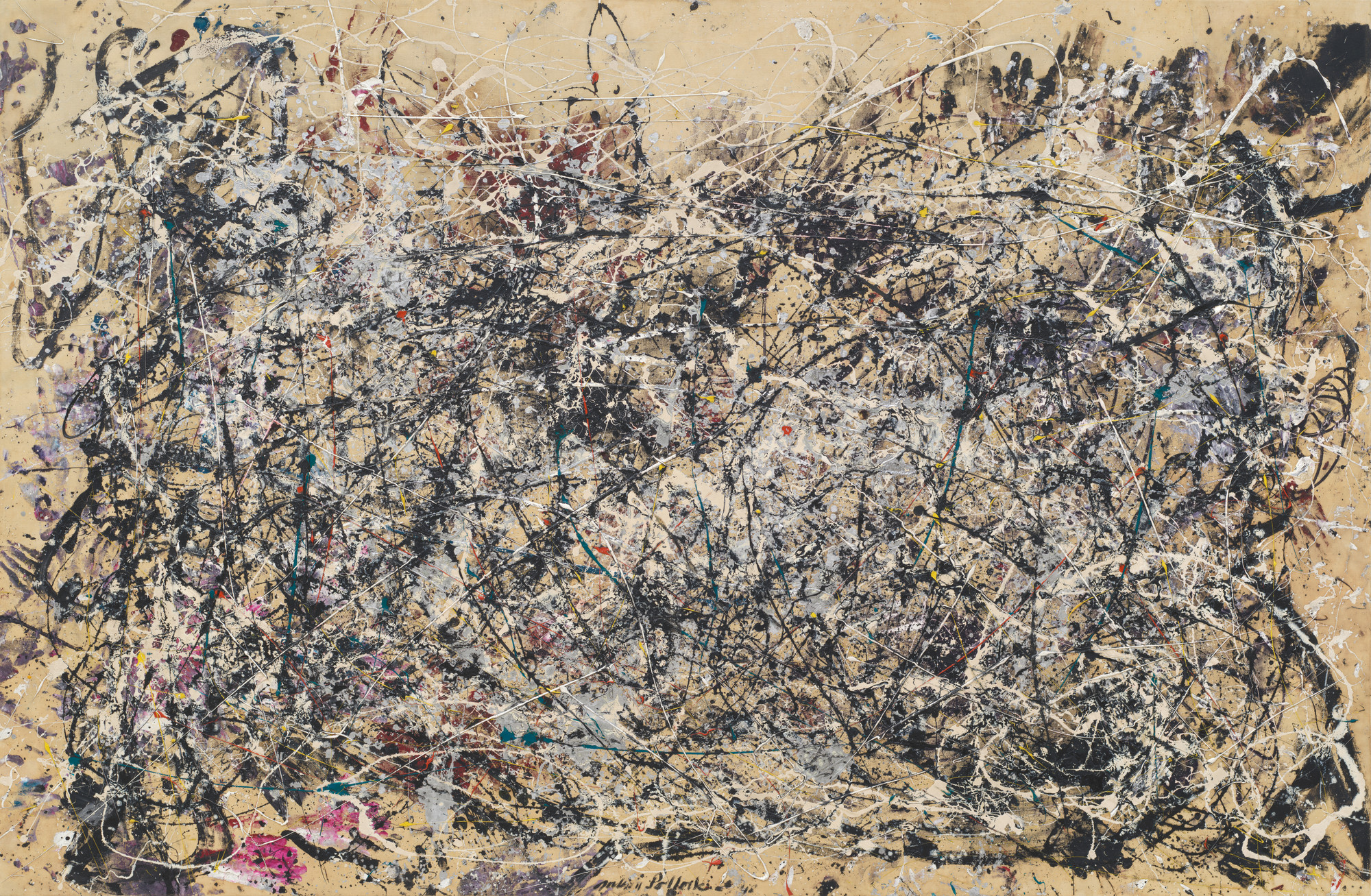
Learning Specialist, Carolina Malagamba: Take a second and just let your eyes wander over this very large canvas. One of my favorite ways to look at this piece is by choosing a strand and following it with my finger in the air to see where in the painting it might end.
This work was made by the artist Jackson Pollock.
Curator, Ann Temkin: Jackson Pollock is best known for what we have come to call his “drip paintings.” He had made for many years paintings on easels. And then, he decided that he was going to approach his work in an entirely new way. He would paint with canvases laid out on the floor.
Artist, Jackson Pollock: Having the canvas on the floor, I feel nearer, more a part of the painting. Sometimes I use a brush, but often prefer using a stick. Sometimes I pour the paint straight out of the can.
Carolina Malagamba: That’s Jackson Pollock speaking in 1950.
Jackson Pollock: Most of the paint I use is a liquid, flowing kind of paint. The brush doesn’t touch the surface of the canvas. It’s just above.
Ann Temkin: He would actually move his body around, above them, over them, and he would less drip than probably fling the paint onto the canvas with what is actually—we now recognize—an enormous amount of control. This was a very physical kind of painting.
Carolina Malagamba: Pollock was part of a movement where people were making art in new ways because, as he said:
Jackson Pollock: I want to express my feelings rather than illustrate them. It seems to me that the modern painter cannot express this age—the airplane, the atom bomb, the radio—in the old technique.
Carolina Malagamba: As we move on, I want you to pay attention to the motion and the gesture, and think about how that might represent the inner workings of a person.