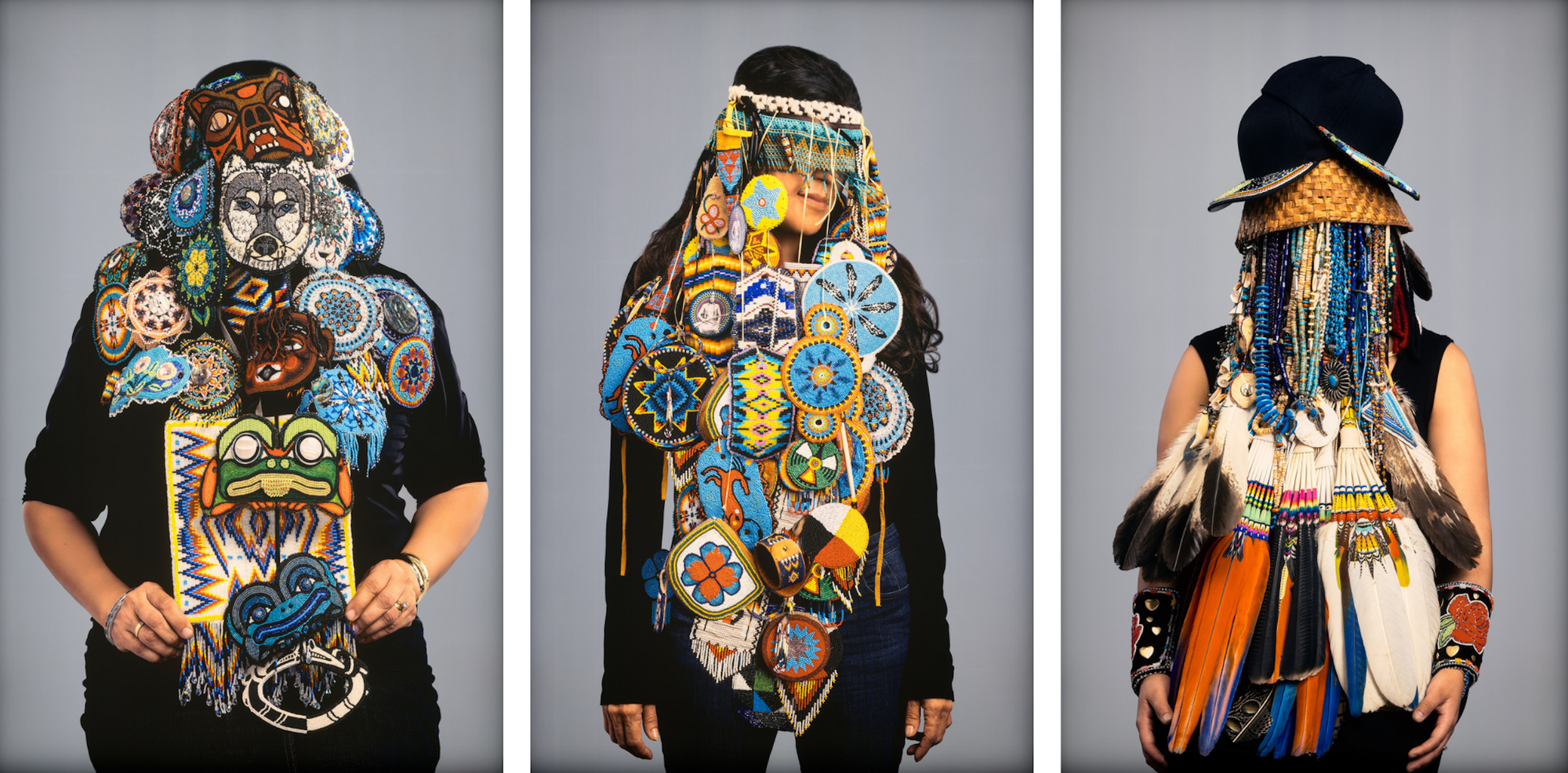
Learning Specialist, Marco Hermosillo-McCune: These three photographs were all made by the same artist.
Artist, Dana Claxton: My name is Dana Claxton, and these images are part of the Headdress series. I’ve taken handmade beadwork from several Indigenous nations and made these headdresses that are covering the face.
Marco Hermosillo-McCune: In Indigenous communities, headdresses are cultural items that are often worn for ceremonial occasions.
Dana Claxton: They’re not just to buy in a store and wear. They’re something that are bestowed upon you. They’re something that indicate your history.
Marco Hermosillo-McCune: Let’s look at each image more closely and learn how the artist made them.
Dana Claxton: Headdress - Connie, the sitter, whose name is Connie, they’re all beaded barrettes. Connie has made thousands of barrettes for people all over British Columbia.
Marco Hermosillo-McCune: In the middle, we have Dee.
Dana Claxton: I reconfigured some of my collection and my sister’s collection for Dee’s image. There’s Anishinaabe beadwork, there’s Cree, there’s Sioux, Lakota, some Okanagan work. There’s some work that Connie has made, some of her barrettes.
Marco Hermosillo-McCune: And then the last image on the right is Shadae.
Dana Claxton: Connie is Shadae’s auntie, when Shadae was a little girl, Connie made all Shadae’s regalia. Her wristlets are part of her regalia. Most of those things have been gifted to her, or she has made.
On her head, which is so great, there’s a few Salish and northwest coast woven cedar hats, and then on top of the hats are, of course, her beaded baseball caps.
Marco Hermosillo-McCune: Claxton wanted to show the beauty and bounty of Indigenous culture. But she also wanted to push back against some ideas that linger in society.
Dana Claxton: I’ve always also been interested in the frozen-in-time stereotype. Indigenous culture has never been static. It’s always shifted with every step that you take forward into the future. Those baseball caps to me always represent the future and the youth.