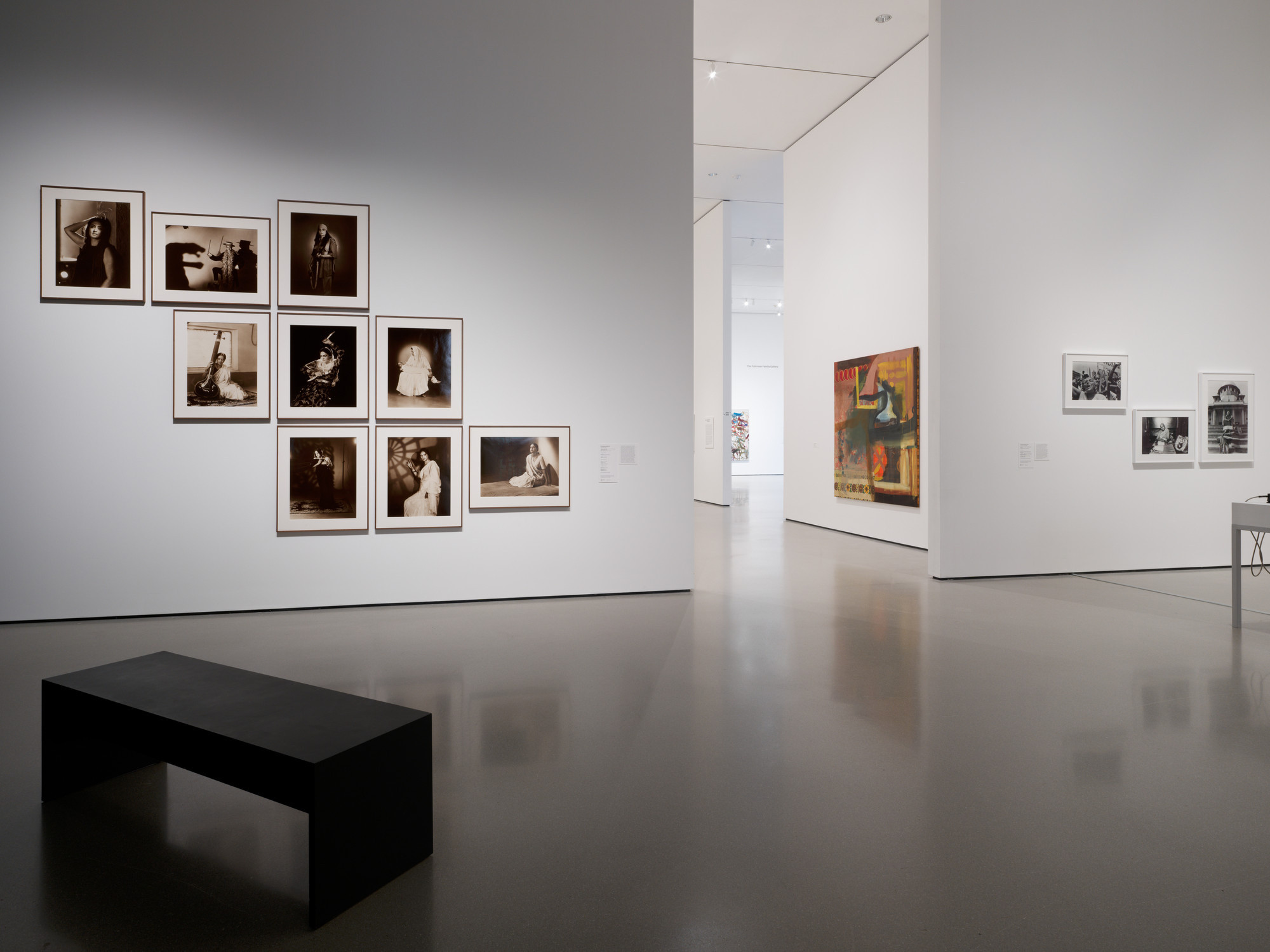
Learning Specialist, Marco Hermosillo: These works invite you to look at them closely. What connects them, and what elements are making each unique?
They are all black and white. I’m also noticing it seems to be the same woman in each of these images. But each one of these characters has very particular traits in the way that they’re dressed, the posture, the stage around them.
Artist, Pushpamala N: My name is Pushpamala N. I’m an Indian artist. And this is The Navarasa Suite.
The Navarasa actually means the nine moods. They are: Sringara, which is love; Hasya, which is comic; Adbhuta, which is wonderment; Bhibhatasa, which is revulsion; Bhayanaka, which is fear; Veera, which is brave; Raudra, which is angry; and Shanta means peace.
The way I create the mood, or expressions of emotions, is by the sets and the props and the lighting. It plays with fiction and truth. For example, some of them, it looks very ominous. That danger does not exist but because of the deep shadow and the slanting shapes, you feel it’s dangerous. There are a lot of other things that come into the image, for example, wires and bulbs. You immediately see the artifice of it.
Marco Hermosillo: Pushpamala was really inspired by the movies she grew up watching. She noticed that the women in these movies were represented through very simplistic stereotypes and archetypes.
Stereotypes are when we generalize a specific characteristic, and we apply it to an entire group of people. And archetypes are a kind of template that is used to quickly describe a character’s personality and motivations.
Pushpamala N: A lot of my work is about women’s narratives and the kind of stereotypes and archetypes of women. There’s a lovelorn heroine, and this kind of fearful woman against the wall. Woman with a dagger, this kind of revengeful woman. These images are repeated over and over again in culture.