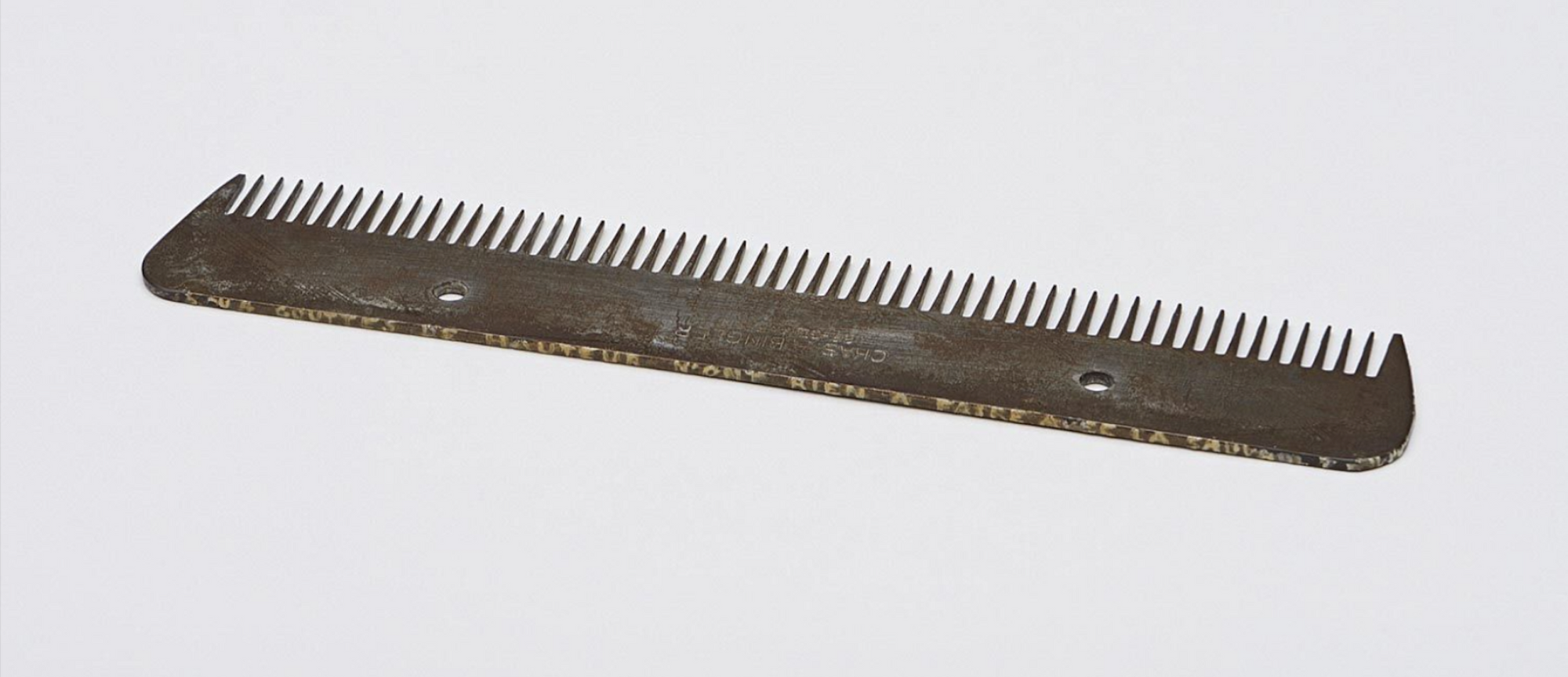
Artist, Marcel Duchamp: The readymade says, “Here it is, a thing that I call art. I didn’t even make it myself.” So it was a form of denying the possibility of defining art. It takes away the technical: colors, pencil, brushes. And when you take something that is not made by those technical instruments, you don’t know whether you should take it as a work of art, and that’s where the irony comes in.
Artist, Wade Guyton: The boiled-down understanding of the readymade is that anything can be an artwork.
Curator, Michelle Kuo: Instead of a work of art being something that you craft, readymade means the work of art can be something that is already made, and what you’re doing as an artist is to select the object.
Duchamp was very interested in the readymade as almost a chance encounter. He called the readymade a kind of rendezvous. And on Comb, which is a steel dog’s comb, he inscribes the exact hour and date of its choosing.
Artist, Jacqueline Humphries: Duchamp felt the boundaries which define art were arbitrary. He’s upending all these conventions which normally define art—that it’s something that’s rare, that it’s singular, there’s only one of them. He’s taking these common objects that are just kind of around and saying, “Oh, this is art,” turning everything upside down.
Archival audio from: A Conversation with Marcel Duchamp: from NBC’s Wisdom Series, 1956. New York, N.Y.: Films Media Group, [2010], ©1956