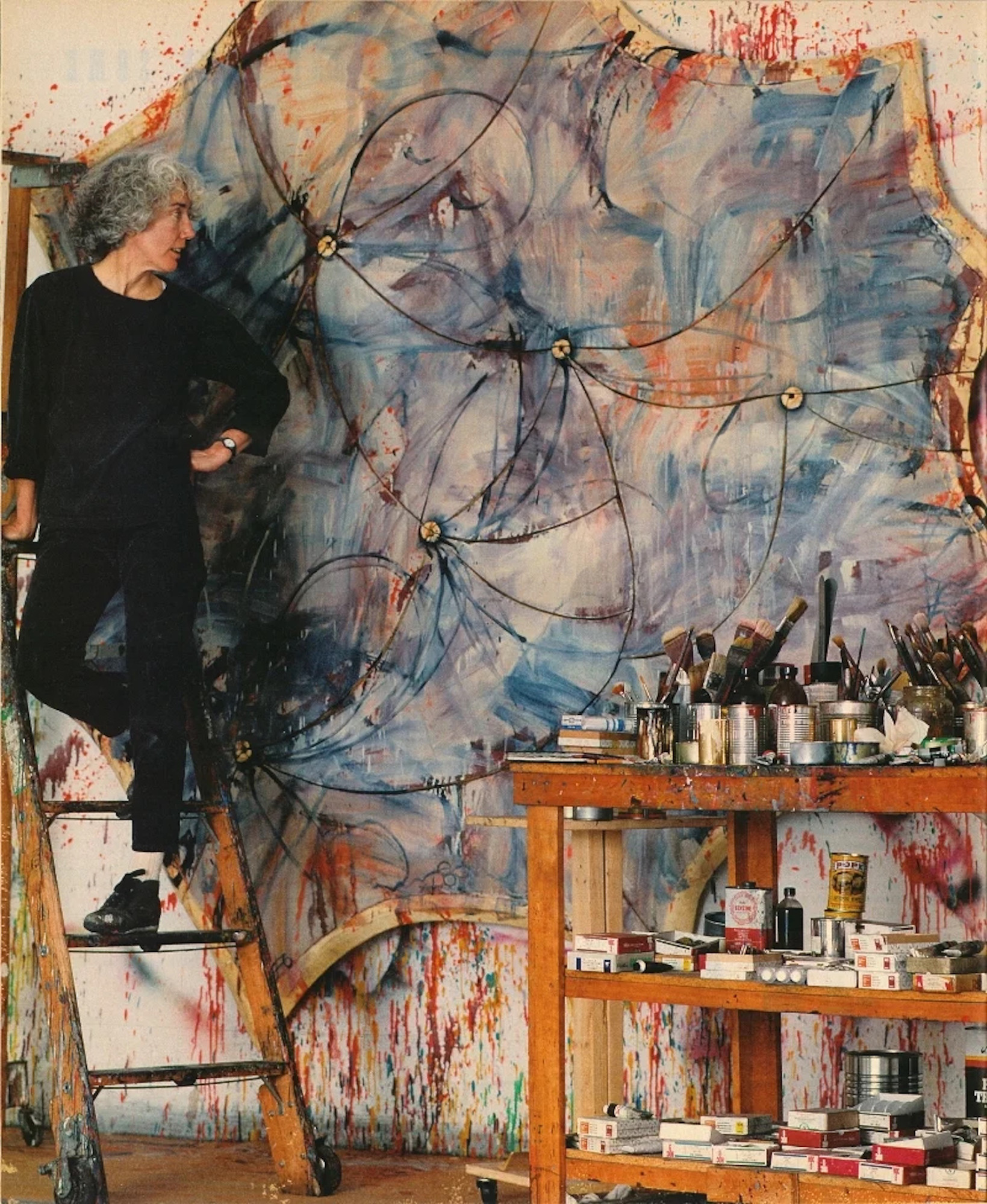
Artist, Elizabeth Murray: I'm a painter. And the simplest thing I can do, and the clearest thing I can do, and the thing I understand the best is painting.
Curator, Mia Matthias: This is Elizabeth Murray: Painters Progress. My name is Mia Matthias, and I'm an Assistant Curator in the Department of Painting and Sculpture at MoMA.
I think what I find compelling about Elizabeth Murray's practice is that she is the embodiment of pushing boundaries. She started out with these more traditional two-dimensional square or rectangular paintings. And then she created shapes on those canvases and tried to expand past the edge until, in the early 1980s, she shattered her canvases into multiple pieces. These shattered paintings don't fit into any neat mold. They can be categorized as reliefs, or as sculptures, or as paintings. They're everything at once.
As far as her imagery, I think there's this beautiful push and pull. So you might recognize something, but that thing seems to morph as you're looking at the work. She wants people to view everyday items as they've never seen them before.
Elizabeth Murray: I liked the idea of time and movement, and just a kinetic feeling. And I think that is all part of the narrative. The narrative is part of the form for me. There's a story there. But I don't really want to tell people what it is. I just want them to make up their stories.
Archival audio from: Elizabeth Murray and Dodie Kazanjian. Interview with Elizabeth Murray, 2005 June 7-July 20. Dodie Kazanjian papers, 1949-2025. Archives of American Art, Smithsonian Institution.