Artist, Charles Sheeler: I just wasn’t very much interested in the figure as subject matter. I’m interested in the manmade world— industrial subjects or a farm building.
Curatorial Assistant, Samuel Allen: That was the artist Charles Sheeler.
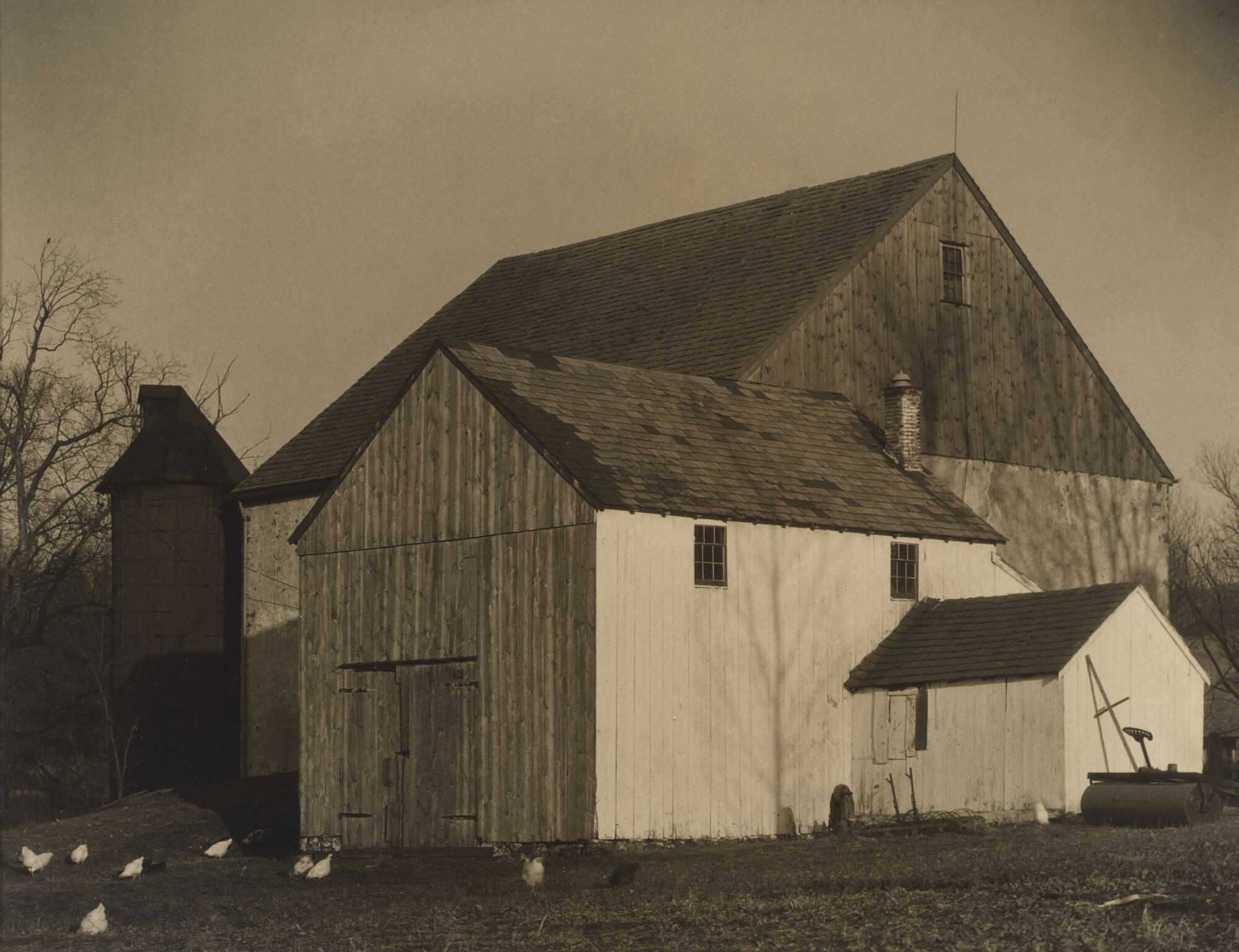
Sheeler started as a commercial photographer, hired by architects to document their projects. It’s really only in 1915, or thereabouts, that he starts working with photography as an art form. In this photograph, Sheeler’s gone out into the countryside in Bucks County, Pennsylvania, looking at 19th-century barns. One thing that Sheeler was really drawn to was that they were spaces of work.
Charles Sheeler: Community built the barns with utility in mind. They weren’t building a work of art. If it’s beautiful to some of us afterwards, it’s beautiful because its intention was very beautifully realized.
Samuel Allen: As a photographer, he’s finding ways to draw out the inherent abstraction that exists in the world by framing a picture in a particular way. And he’s positioning his camera so that these buildings recompose themselves into intersecting triangles, rectangles, and squares. You have some areas with clearly defined wood grain. These vertical lines—that’s the siding of these buildings. You have shingles. They both retain their identity as the things that they are, but they also become reduced to shapes and fields of texture and light or dark.
Charles Sheeler: I do like contrasts. I think that’s an important consideration for me. At times, I like a black coming right next to a white, like a pistol shot.
Archival audio from: Oral history interview with Charles Sheeler, 1959 June 18. Archives of American Art, Smithsonian Institution.