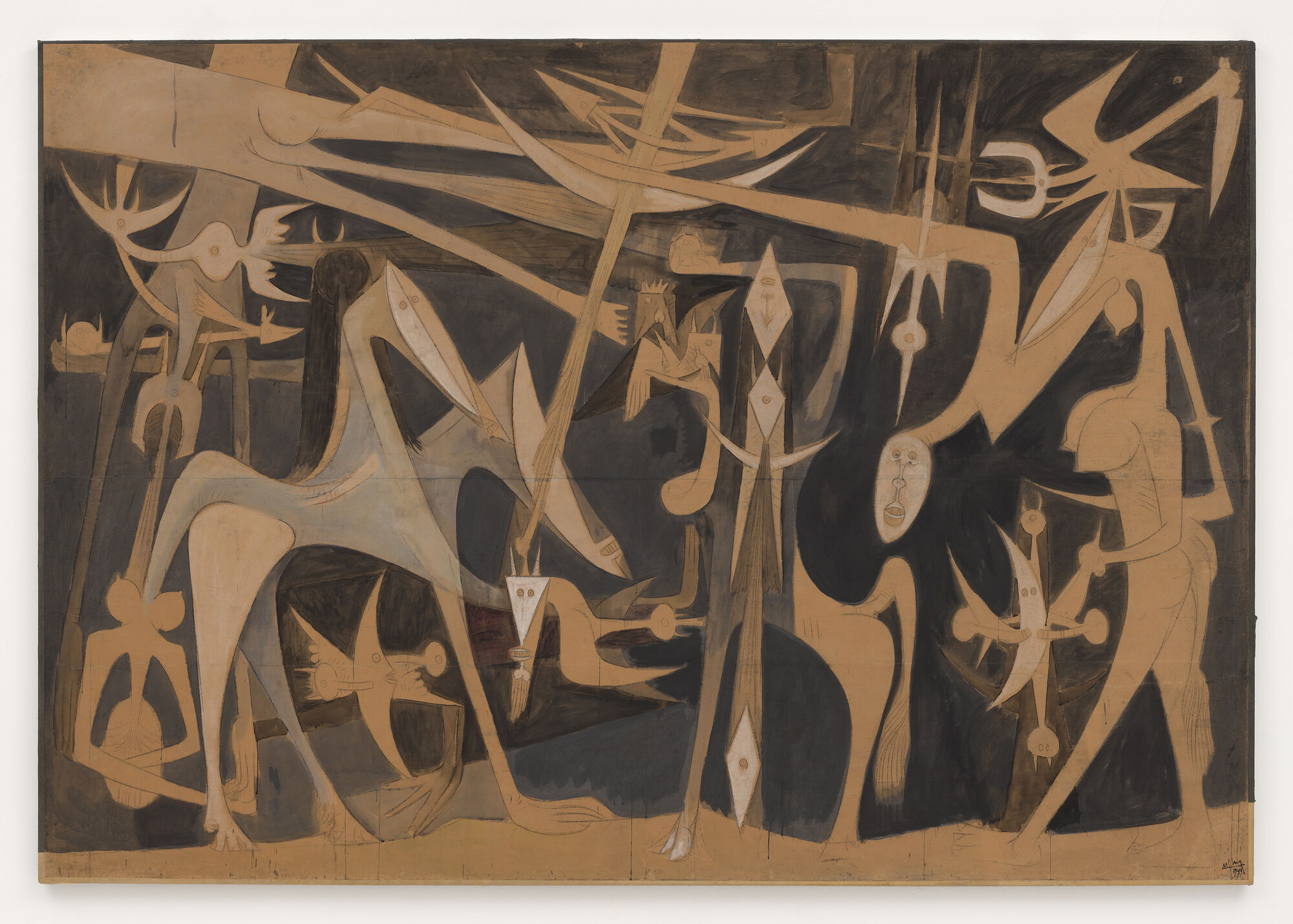
Narrator, Marlin Ramos: Grande Composition is Lam’s most monumental work on paper. And it was once used as the backdrop for the first public reading of a play by Aimé Césaire about the Haitian Revolution.
Collection Specialist, Kunbi Oni, and Curatorial Associate, Damasia Lacroze:
Collection Specialist, Kunbi Oni: One of the details that stands out to me here is the amount of action that he brings into it. The work is quite busy, and then you get to one section where a white face darts out from the darkest area of the canvas, and that just has so much drama.
Curatorial Associate, Damasia Lacroze: The scale, the way it was painted, you could really feel the motion in it. There's this speediness to it. Wifredo Lam used to work very quickly.
Kunbi Oni: This work was done on two large pieces of paper, which he then glued together and mounted on canvas.
Damasia Lacroze: Lam's use of paper began out of both necessity and practicality. It was inexpensive, easy to work with, and also easy to travel with.
Kunbi Oni: When you are working on paper, you typically will start with charcoal or pencil, and what he's done here is to leave those marks.
Damasia Lacroze: Lam then painted over the charcoal line with diluted oil paint. He would often return to the charcoal, layering between charcoal and paint. This approach can be seen all throughout Grande Composition, where you see the drips of paint, you see the outlines of charcoal. There's the raw paper, which is the brown negative space that he leaves bare in some instances.
Kunbi Oni: The shades of black emerge. There's these dark spots that cause you to pause and to look. I would encourage you to look closely because there's just a lot there, and really enjoy it.