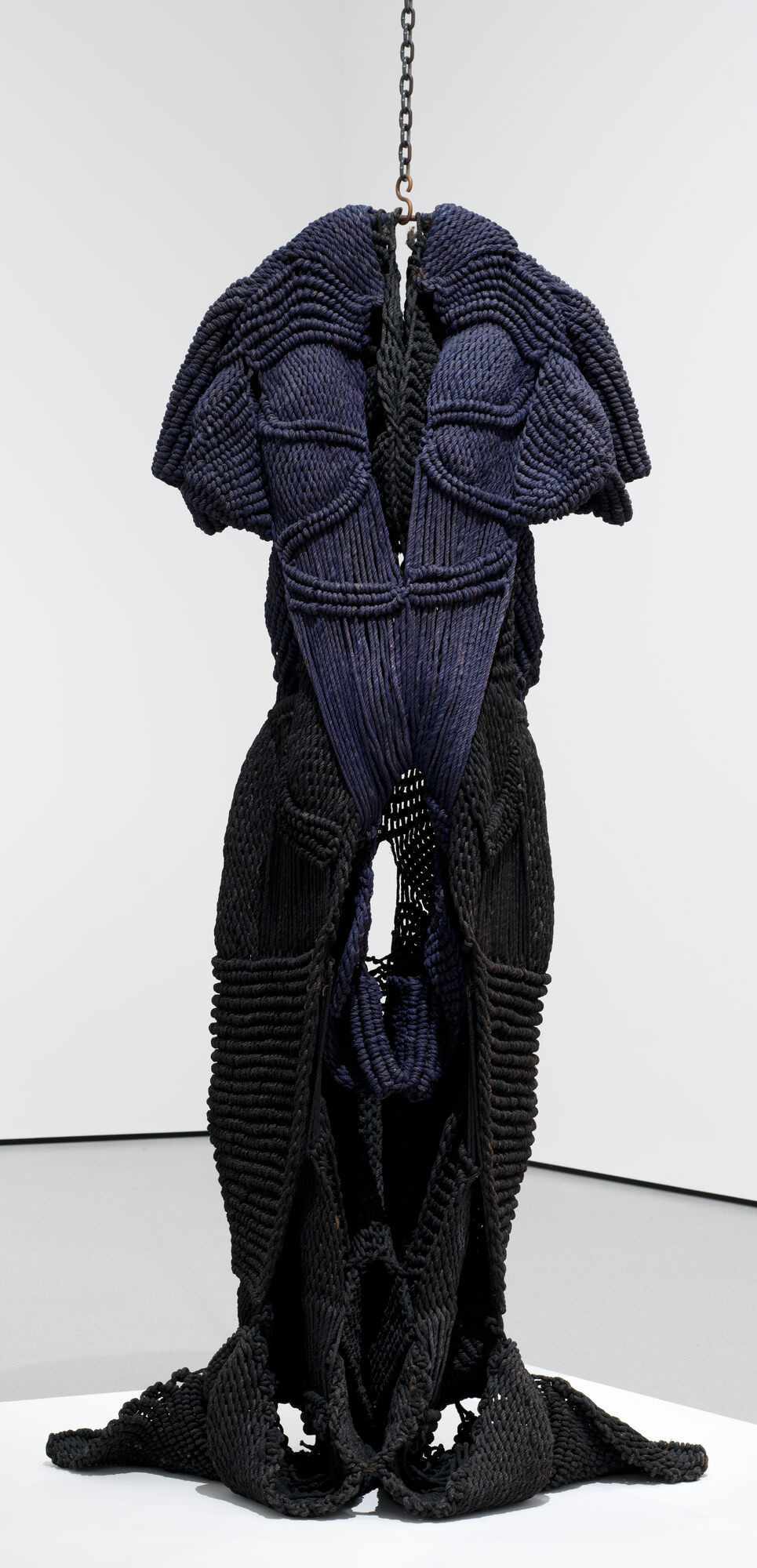
Curatorial Assistant, Margarita Lizcano Hernandez: Mrinalini Mukherjee was an Indian artist who started looking at various craft practices that she was surrounded with in India, but also that she saw through her extensive travels. The main material that she used is a very coarse fiber that’s normally used for ropes. So she would unbraid it, dye it, and then very painstakingly rebraid it, twist it, tuck it in, and then looping them across different armatures to create shapes that might evoke legs, breasts, faces.
The artist has described her work as being very physical. Here’s Mukherjee speaking in a 1994 interview.
Artist, Mrinalini Mukherjee: I have an idea of the type of image that I want, but then I let it sort of grow. Sometimes these things are much heavier than me. So, it’s almost like you’re wrestling with another person. I’m interested in the idea of presence. I like it when I finish something and I almost feel in awe of it.
Margarita Lizcano Hernandez: The title of the work is Yakshi. Yakshi is a forest goddess from Hindu, Jain, and other traditions. There are carvings of Yakshi in temples all across India, but Mukherjee didn’t follow the visual standards or the visual vernacular. She truly used her own image. Once she felt that the presence of whatever deity that she is trying to evoke in the work is alive, that’s when she stood back and said, “Okay, no more work left to be done here.”
There are these amazing photographs of her standing next to many of these works where they just tower over her. What a powerful woman, what a powerful artist. She seems like such a force to be reckoned with.