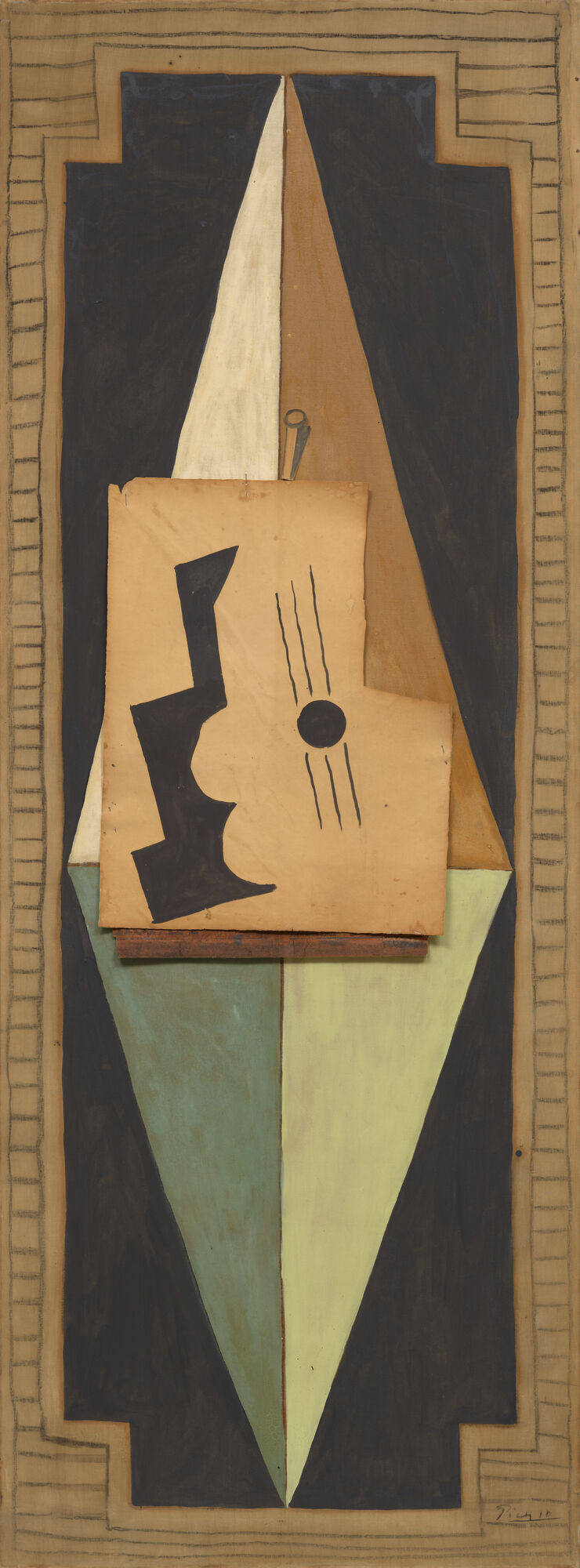
Curator, Anne Umland: This show takes a deep dive into a moment in Pablo Picasso’s long career. It looks at the works that he produced in a very unconventional studio in a garage in the town of Fontainebleau in France in the summer of 1921. This work dates to 1919, so before Fontainebleau, but this motif, the guitar, foreshadows the theme of music and performance that you’ll see in Fontainebleau.
Guitar is a collage. At its center, on this cutout sheet of paper, are painted a black dot with three lines above and below that. Those are Picasso’s signs for a guitar. It has strings and it has a round hole. The paper is mounted on top of a long, skinny diamond shape with multicolored panels.
Conservator, Erika Mosier: There’s a fake pin that seems to be holding the paper. But the paper is actually held by four straight pins. You see his sense of humor here. Below this guitar is another piece of paper—that’s newsprint, that’s very brown—and it acts as a shadow.
Conservator, Anny Aviram: I always saw that piece of paper was the support, almost like sitting on an easel.
Erika Mosier: Yes, it could be a table. It could be a shadow.
Anne Umland: Picasso is among the artists whose works have come to define Cubism, a new form of art pioneered in the second decade of the 20th century. And Cubism was this moment where there is an insistence that marks don’t have to be tied to some visual resemblance, that it’s the context that gives it meaning.