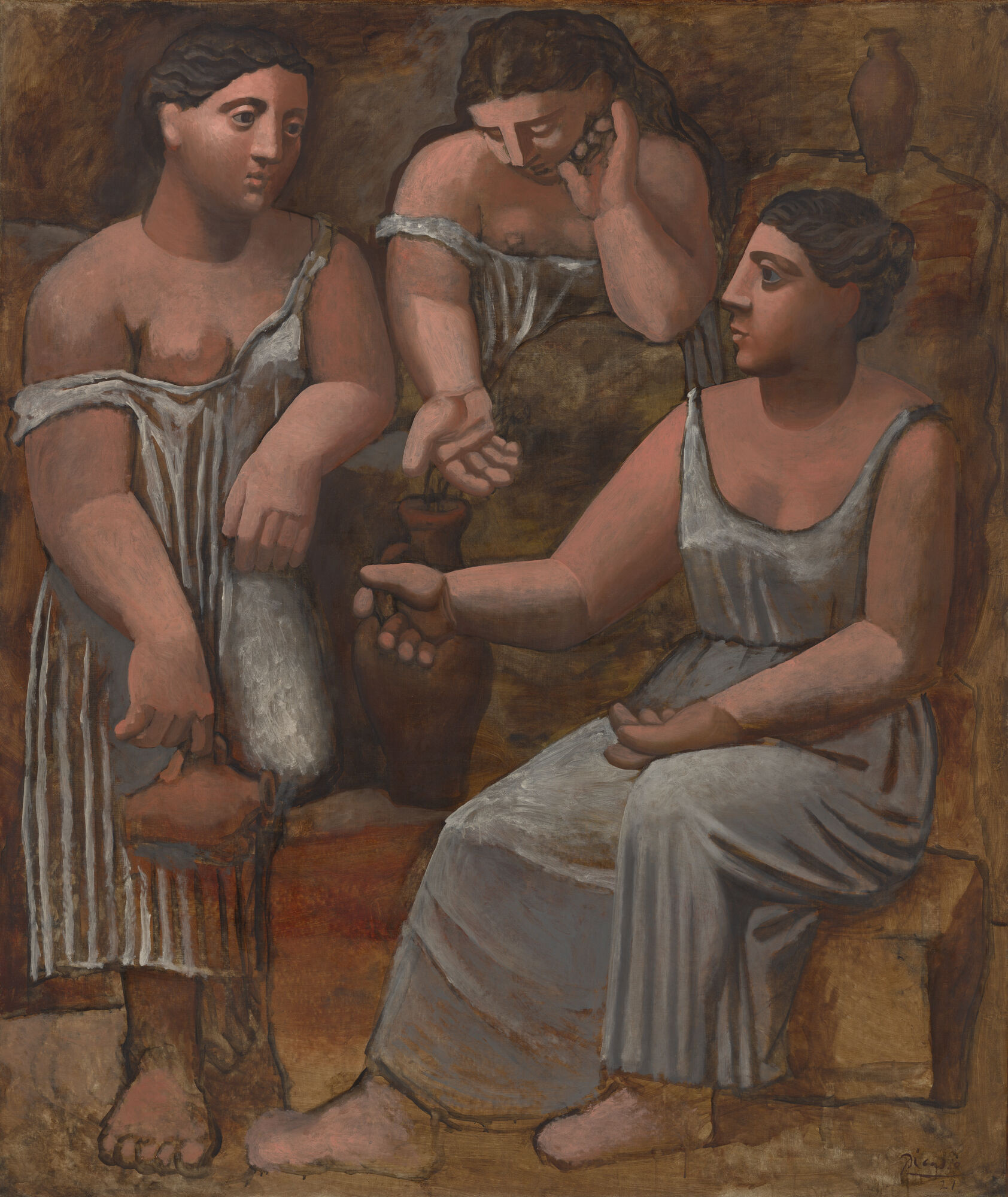
Narrator: The artist Pablo Picasso painted Three Women at the Spring in 1921, using oil on canvas. The painting measures about seven feet tall and five-and-a-half feet wide. In metric units, the work is about 204 centimeters tall and 174 centimeters wide.
In this large, vertically-oriented painting, three women gather around a spring of water in a rocky landscape. The women resemble ancient Greek or Roman statues, wearing grayish-white, sleeveless pleated tunics that fall to their ankles. Their skin is painted with earthy peach tones and their hair is dark brown. Their facial features are statuesque, with straight noses, heavy-lidded eyes, and small mouths. Together, their bodies form the shape of a pyramid.
Picasso has given each of the women thick, rounded bodies and limbs, so that they appear solid, weighty, and monumental. They fill almost the entire canvas. Apart from their gray gowns, the color palette is mostly warm, dominated by the women’s peach skin, as well as the oranges and browns that make up the roughly painted rocky background. Picasso uses thick, dark lines to outline many of the forms and features depicted. At the center of the canvas, a small stream of water trickles into a clay jug. The three women sit and lean around it.
For a more detailed description, continue listening.
Moving from left to right, let’s take a closer look at each of the women. On the left side of the painting, the first woman stands, her body filling the canvas from top to bottom. With dark eyes beneath thick brows, she wears a neutral facial expression. Her wavy hair is pulled back. Her gray gown hangs loose. The strap on her right shoulder has fallen, exposing her right breast. Her left arm and knee are bent, resting against heavy blocks protruding from the rocky landscape. Her right hand hangs at her sides, and a small earthenware jug dangles from her index finger, nearly brushing her bent knee. Her bare right foot, with its roughly defined toes, is firmly planted on the ground. Her gaze tilts to the right, and it is unclear if she is gazing into the distance or at the seated woman nearby.
Now let’s move to the second woman, who is at the top center of the painting. She leans her upper body over a rock which blocks her lower body from view. Using the rock as a support for her left elbow, she rests her cheek on the backs of her curled fingers. Her dark hair is long and loose, falling down her back. Like the first woman, her gown slips down her shoulder to reveal her right breast. She looks down at the upturned palm of her right hand, each thick finger clearly defined. A faint stream of water—suggested by painted black lines—runs down into the clay jug at the center of the canvas. The jug is nearly identical to the one held by the first woman, but is about twice its size and painted in a darker shade of red-brown.
The third woman sits upon a rocky step, turning her body and head toward the right to face the other two women. Her hair is pulled up and back so that her face, with its straight triangular nose, is seen in profile. Her left arm rests on her lap, and her right arm stretches out to clasp the handle of the jug collecting water beneath the spring. Her gown extends to her ankles and is cinched at the waist. Its pleats follow the curve of her seated legs, the fabric losing definition as it stretches out to cover her casually extended right leg. The woman’s peach-pink feet are roughly sketched-in, appearing blocky and unfinished.