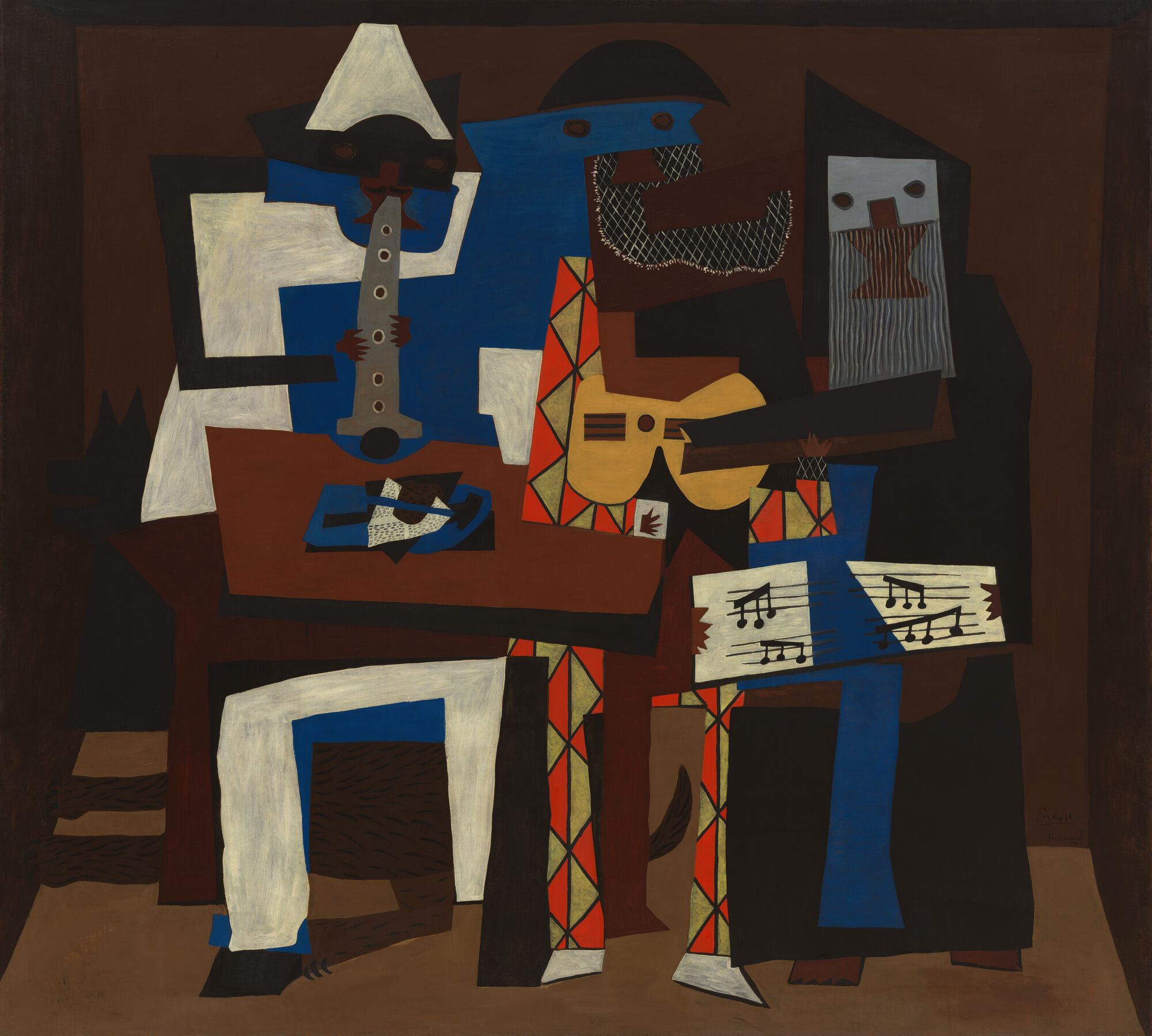
Narrator: The artist Pablo Picasso painted Three Musicians in 1921 using oil paint on canvas. The painting is about six-and-a-half feet wide and seven feet tall. In metric units, the painting measures 201 centimeters wide by 223 centimeters tall.
This square-shaped painting—only a few inches larger than a king-sized mattress—depicts a group of three costumed musicians holding instruments and sheet music. The setting is a bare, dark brown space—like the inside of a box or a stage set. The floor is a lighter brown color than the walls.
The three musicians occupy the majority of the canvas. They look out to the viewer as if mid-performance. The first two figures on the left are dressed as characters from commedia dell’arte, a form of Italian comic theater that was popular in Europe between the 1500s and 1700s. The figure on the far right is dressed as a monk.
None of the figures are painted naturalistically. Instead, Picasso renders them using flat, overlapping shapes. On some of these solid-colored geometric planes of brown, blue, grey, white and black, brushstrokes of paint remain visible.
For a more detailed description, continue listening.
Moving from left to right, let’s take a closer look at each musician. The figure on our far left represents Pierrot, a sad clown. He wears a cone-shaped white hat and a black eye mask. Fixed between his lips is a long grey clarinet. With the pointy fingers of his tiny brown, paw-like hands, Pierrot clutches the clarinet by its sides. His hands are disproportionately small in size compared to the rest of his body—a feature that all three musicians share.
Pierrot sits behind a brown table, the white square legs of his pants visible beneath. On top of the table is a stack of black, brown, blue, and white geometric shapes—objects the artist identified as a pipe, a package of tobacco, and a pouch.
Let’s turn now to the figure in the middle. He wears a red and gold diamond-patterned costume reminiscent of that worn by the trickster character called Harlequin. With his small hands, the Harlequin plays a guitar. The instrument has an ochre body with black and brown rectangles of varying sizes to represent the neck and strings. His face is like a puzzle: a large expanse of royal blue paint is punctured by two brown holes, creating an eye mask. The mask spreads to the left, covering various parts of the first figure’s face and body. Below it, a beard is suggested by a mesh of white criss-crossed lines against a rippling black shape, and bordered by white fuzzy brushstrokes. The Harlequin’s head is topped by a black semi-circle resembling a skullcap.
The figure on the far right is dressed as a monk in a long black hooded robe. His rectangular face peeks out from the garment’s diagonally pointed hood. It’s made up of a long gray block with slanted sides. It looks as if two holes have been cut for brown eyes with a square hole for a brown nose underneath.
The lower two-thirds of the rectangle is composed of a brown hourglass shape. Wavy vertical gray lines resemble a stylized beard over a mouth. Two tiny brown hands emerge from the black robe to hold a wide, rectangular page of sheet music. The white sheet faces the viewer to show black staffs and musical notes.
There’s another character who almost disappears into the painting’s dark brown background. At the bottom left, hidden on the floor behind the Pierrot’s legs, is a large brown dog with wiry black hair. It stretches out onto its stomach with its legs facing the left side of the canvas. The dog’s back legs with long black claws graze Pierrot’s foot. It’s small, curved, jaunty tail flicks upwards between the Harlequin’s legs.
About halfway up the left edge of the canvas, another shape hovers above the dog’s front paws. It is the black silhouette of a dog’s head with two pointy ears, a long snout, and an open mouth. This could either be the shadow of the first dog or another dog in the background.