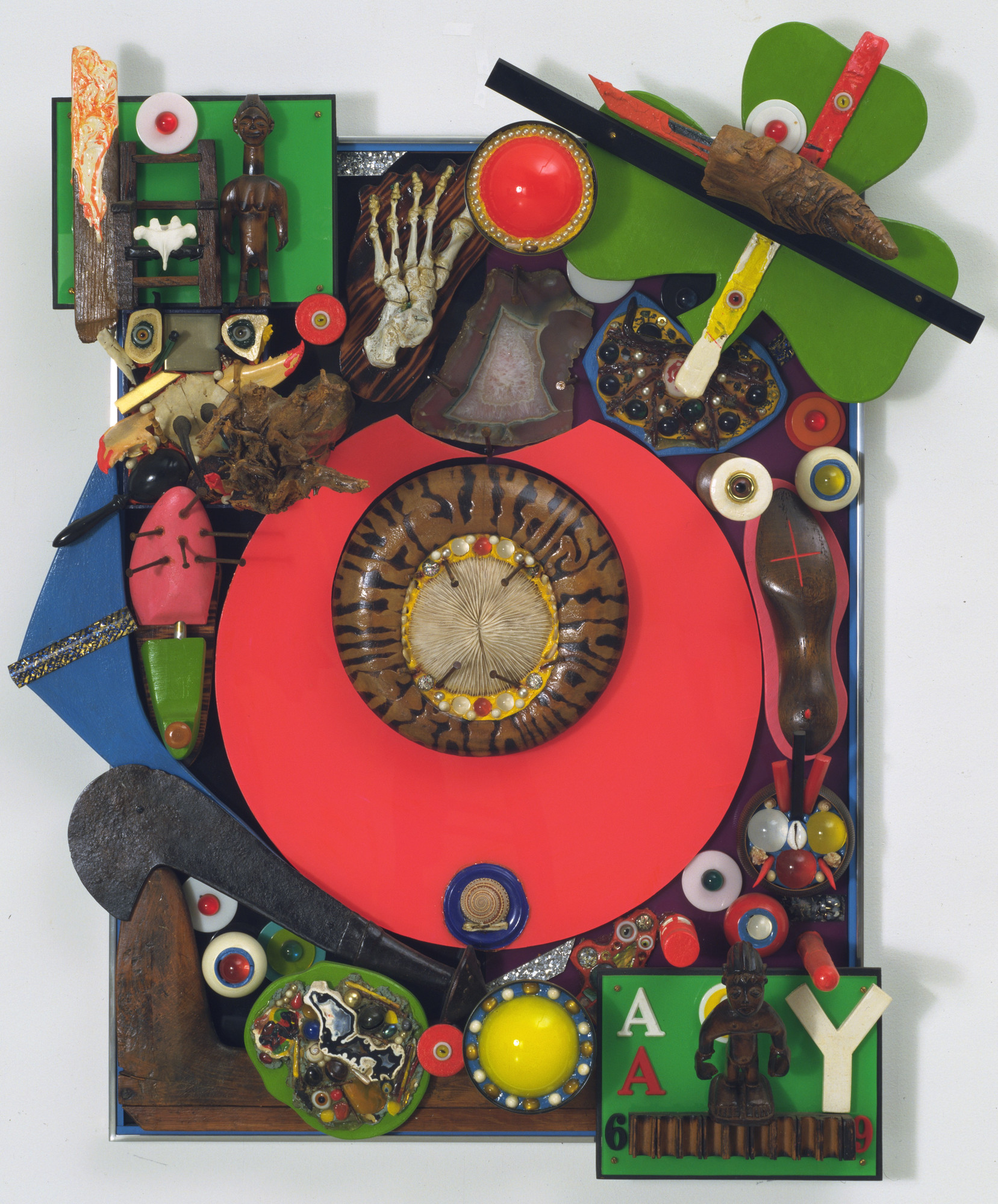
Educator, Francis Estrada: My name is Francis Estrada. I’m a visual artist and I work in School and Teacher programs in Education here at MoMA. You're looking at an artwork by Alfonso Ossorio, called Empty Chair or The Last Colonial.
Ossorio played around with a different subject matters that was personal to him—his sexuality, his religion, his spirituality, and also his connections to different art movements and different places.
He had gone through Catholic school in the Philippines. Then he had moved when he was young to Europe where he had studied, then moved to US in his adult life, and then moved back to the Philippines to help work on the church mural in Bacolad, in the central part of the Philippines. And he said, working in that church, it kind of brought up all these different ideas and all of these different themes of Catholicism that he had tried to explore in his work.
In this piece you see a couple of things that may look like crosses. But also, you have these figures. They’re not the figures that you would see in churches, but there’s something about it gives me the same kind of feelings. It makes me think about how, when the Spanish colonized the Philippines that they use religion as this colonization method.
I remember just going to relatives houses and there was a Catholic imagery on one side and on the other side, you’d have these wooden carved figures from the Northern part of the Philippines, but they all just kind of work together.
So he had always explored the themes of Catholicism, but on the other side of it, he also had explored gay sexuality.
In the Philippines we have healers called Babaylan and they say that the Babaylan are the intermediaries between the real and the spiritual world and the Babaylan are usually women. But there were also men who happened to be homosexual. And they said that, as a Babaylan, there’s an understanding of the world that you don’t have being heterosexual. It’s not about gender, it’s just about being and what the senses of being are supposed to be. And I’m not sure if he was exploring it, but it was just there. It was just a way of life.