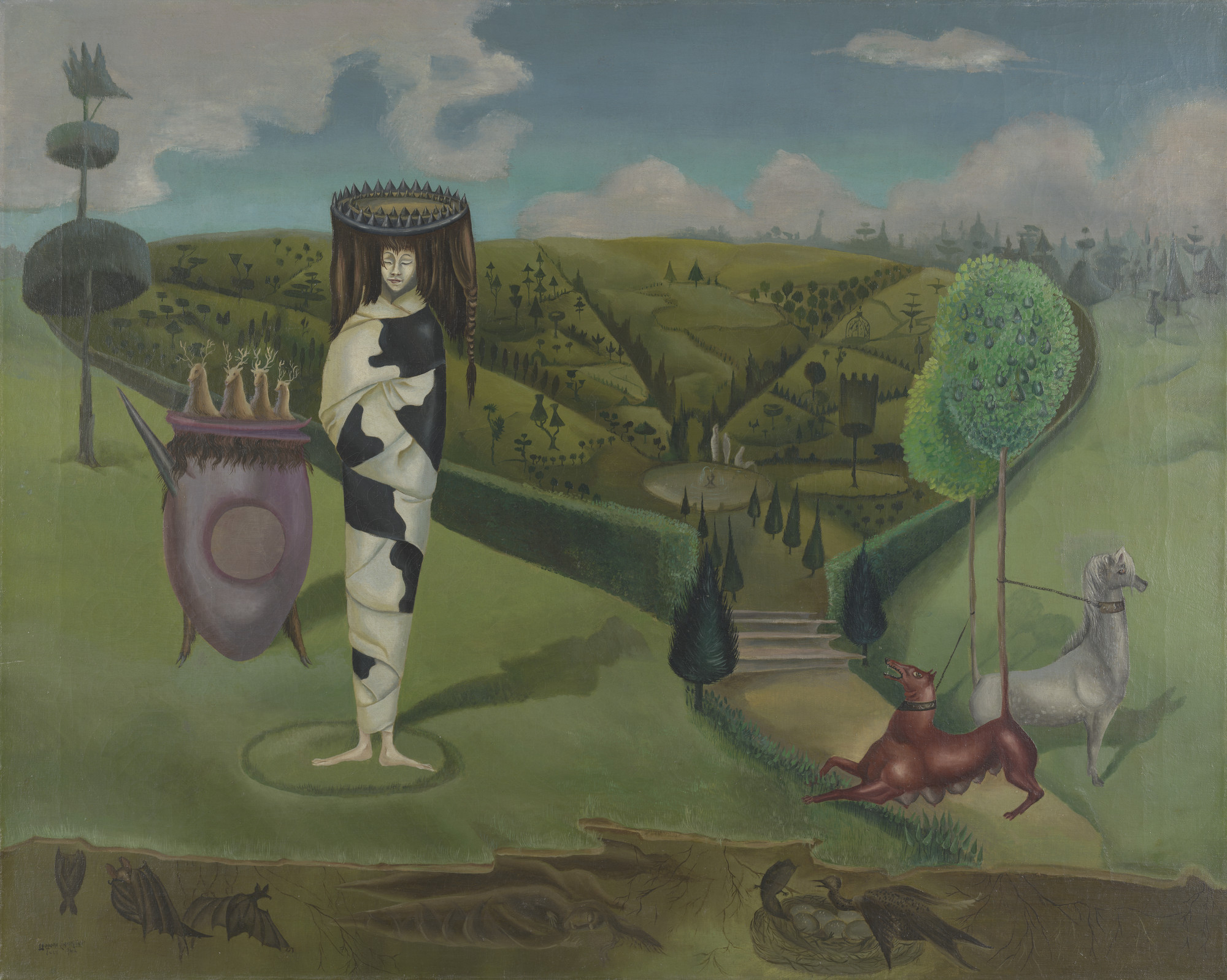
Narrator: The artist Leonora Carrington made Green Tea in 1942, using oil paint on canvas. A little larger than a standard-sized pillow, the work measures 24 inches high and 30 inches wide. In metric units, that’s about 61 centimeters high and 76 centimeters wide. The canvas is displayed in a simple wooden frame that has been painted black.
In this intimately-sized work, strange human, animal, and hybrid characters populate a manicured green landscape. These precisely-painted figures include: a white horse and a brown canine whose tails morph into trees; four deer heads with antlers emerging from a purple cauldron; and a female figure wrapped tightly in a cow-printed fabric. Beneath these figures' feet, Carrington has included a sliver of murky underground space populated by creatures like bats, vultures, and unknown cocooned forms. None of the characters interact with one another, which only heightens the painting’s sense of mystery.
Here’s curator Anne Umland.
Curator, Anne Umland: Often in Carrington's work, there are many autobiographical references. The landscape in the background, meticulously detailed, is often related to the countryside of England, where she grew up.
Narrator: The figure swaddled in cow-printed fabric has often been identified with the artist herself, with her garment representing a straitjacket. Before she made this picture, Carrington spent a period of time in a mental health facility. In a memoir, the artist wrote about the dreams she experienced at the time, some of which recall details in this painting:
Artist, Leonora Carrington (read by voice actor): I had gone down below the surface of reality. There, logic no longer functioned, but everything was illuminated…The beasts spoke to me with their eyes, and I understood…I was living in two different worlds. In one, I was Leonora, interned in an asylum. In the other, I was part of a great alchemical transformation.
Narrator: To explore the painting in more detail, continue listening.
We will organize this description into three sections: background, foreground, and underground.
The background occupies the upper half of the canvas, and is the part of the painting that appears furthest away from us. The topmost quarter consists of a blue sky partially obscured by fluffy white clouds. Along the right side of the sky’s horizon line, a cluster seems to rise from the landscape in rounded peaks like soft, white mountains. Beneath them, we find a forest of fantastical trees shrouded in a thin gray fog.
A green landscape anchors the painting’s center. To picture the shape, imagine a handheld dustpan with the wide mouth pointed away from you. A green, sloping landscape unfurls toward you, bordered on either side by trimmed rectangular hedges.
The rolling olive green landscape is divided into three triangular sections—each one a manicured field decorated with patchworks of tiny trees pruned into geometric shapes. These sections narrow as they move inward, stopping just before the dustpan’s handle. Here, they coalesce at a circular pool with a fountain. Three mysterious mummy-like figures stand nearby, wrapped head-to-toe in white cloth.
Beyond the pool, a path lined by cone-shaped trees represents the dustpan’s handle. The path leads to an opening where the hedged borders do not meet. Instead, a short flight of grey steps brings us out of the sloping landscape and into the painting’s foreground.
The foreground takes up about a quarter of the canvas and consists of a far-reaching green lawn. Strange objects and figures dot the lawn, and because of their larger size, this section of the painting feels closer to us. We’ll describe the five main figures and objects on the lawn, starting on the left side of the canvas and moving towards the right.
A topiary, or an ornamental plant, extends almost halfway down the painting’s left side, its position making it look like it’s toward the back of the lawn. The tree has a tall, very thin trunk, and its foliage is trimmed into three sections. The bottom section resembles a large hoop skirt, and the middle one is like a drum. The top section is the smallest of all. Its shape suggests the profile of a bird’s head with a spiky, multi-feathered crest.
The second figure in the foreground is to the right of the fancy tree. This object resembles a purple, egg-shaped cauldron that balances on two thin, hairy animal legs with cloven feet. A metallic-looking spike emerges from the cauldron’s left side, its pointy tip aimed at the upper left corner. Hanging down from the cauldron’s upper rim is a fringe of wavy hair. Peeking out from the cauldron’s mouth, we find the small heads of four deer-like animals with antlers.
To the right of the cauldron is a human figure often thought to represent Carrington herself. The figure is quite large—her height is more than half that of the entire painting—but the tornado-shaped shadow she casts is smaller. Her pale, bare feet point outwards as if in a ballet dancer’s first position, and a ring of dark grass encircles her.
From ankles to neck, the figure’s body is wrapped tightly in a black-and-white cow-print fabric that constricts her arms and legs. Her face is white, with delicate features and closed eyes. She is also wearing a large circular headdress with a flat top ringed in spikes and thick drapes of brown hair falling like curtains to frame her face.
Now let’s move to the right side of the painting, where a short winding pathway bisects the lawn. Here, we find our final two figures in the foreground: a canine-like creature and a horse, both with sprouting trees where their tails should be. Let’s begin with the canine.
The canine has a muscular and powerful-looking body with a smooth, reddish-brown pelt. It is shown in profile, front and back legs straddling the unpaved walkway on the lawn. Five large, pendulous teats hang down from its underside, recalling the famous legend of the she-wolf in Ancient Rome. The creature’s tail points straight up, transformed into the straight, slender trunk of a tree with an oval bush of green foliage and blue, teardrop-shaped fruit.
The canine’s head points to the left, and appears to be mid-bark, mouth hung open to reveal pointy white teeth. Around its neck, the canine wears a collar with a thin chain connected to the trunk of a different tree--this one sprouting from the tail of a pale grey horse.
Also shown in profile, the grey horse faces the painting’s right edge. Its exaggerated proportions combine a long, thick neck and short muzzle with a stocky body and stout legs. White freckles dot the belly, and a luxurious mane of silky grey hair crowns its head. The horse also wears a collar, which is chained to the fruit tree growing from the canine’s tail.
Also shown in profile, the grey horse faces the painting’s right edge. Its exaggerated proportions combine a long, thick neck and short muzzle with a stocky body and stout legs. White freckles dot the belly, and a luxurious mane of silky grey hair crowns its head. The horse also wears a collar, which is chained to the fruit tree growing from the canine’s tail.
With so many unusual elements, Carrington’s painting has a dreamlike quality that connects it to Surrealism. In fact, Carrington was associated with this early 20th-century artistic movement that was interested in exploring the subconscious. Here is curator Anne Umland once more.
Anne Umland: I think the most fun part of this picture is when you look down along the lower edge, and you begin to think of how interested the Surrealists were in things that lurk beneath the surface, right? Our hidden desires, our wildest nightmares, and Carrington has intimated all that by detailing this rather fantastic, monster-filled, bat-filled, cadaver-filled universe right beneath the edge of this bright sunny green scene above.