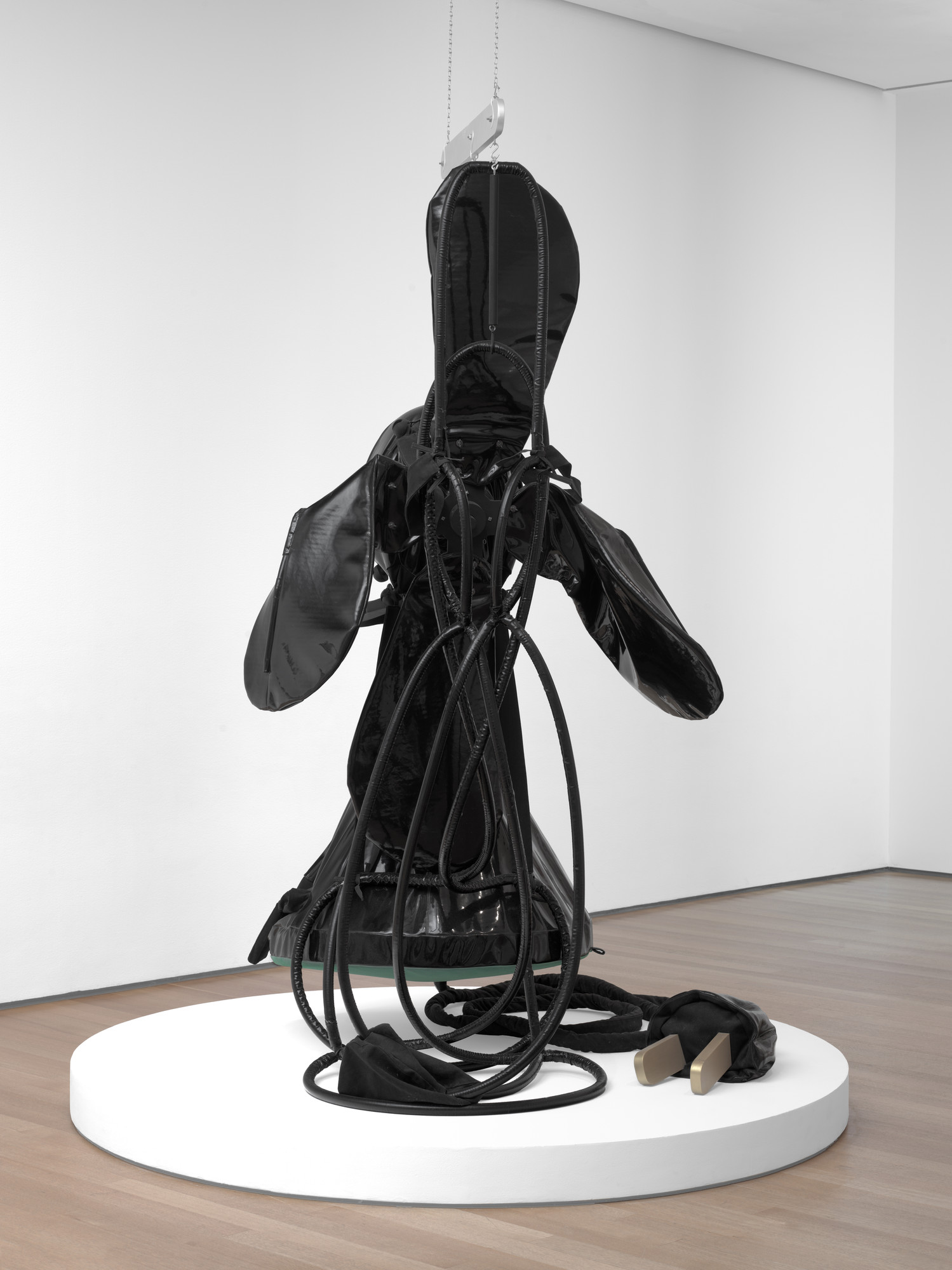
Narrator: The artist Claes Oldenburg made Giant Soft Fan between 1966 and 1967, using vinyl filled with foam rubber, wood, metal, and plastic tubing. About the height of a basketball hoop, the work measures approximately 10 feet high, 5 feet wide, and 5 feet deep. In metric units, that’s approximately 3 meters high, 1.5 meters wide, and 1.5 meters deep.
The sculpture resembles a giant tabletop electric fan with four blades. But instead of being rigid, the form is soft, squishy, and limp—almost as if it were melting. When making this sculpture, Oldenburg was partly inspired by the oppressive heat of New York City summers.
Here’s curator Anne Umland.
Curator, Anne Umland: He thought of the fan first as a monumental sculpture placed on Staten Island, so blowing breeze up the bay. And later on, he thought about it as a replacement for the Statue of Liberty, “guaranteeing,” he said, workers on lower Manhattan a steady breeze.
Narrator: Oldenburg’s fan is suspended from the gallery ceiling by three thin chains, so that the bottom of the fan hovers a foot above a round, low platform set on the gallery floor.
During the early 1960s, Oldenburg became known for creating large-scale soft sculptures that replicated everyday objects. He usually began by making a model of the real-life object. Then, he made a pattern consisting of flat shapes, which he traced onto vinyl. Next, he cut out the vinyl shapes and had them sewn together before finally stuffing the sewn pieces with moldable materials.
When we examine the base of the fan, some of that process becomes apparent. It’s shaped like a traffic cone, with many vertical seams in contrasting white stitching. If we were to touch the vinyl surface, it would feel smooth. But also rubbery and squeezable, as Oldenburg has loosely stuffed the vinyl with foam rubber.
The sculpture has two different electrical-style cords. The first emerges from a hole in the base. It’s wrapped in black fabric and rests in a loose coil on the platform below the fan. The cord ends with a soft, squishy-looking plug—about the size of a basketball—with two wooden prongs painted matte gold. The sculpture’s second cord is much longer, and its function is less clear. Attached to the fan at multiple points, it forms a series of loops that seem to spill from the ceiling. Some loops hang from the apparatus that suspends the sculpture, while others rest on the platform.
If we position ourselves in “front” of the sculpture, we face the four blades that would rotate on a working fan. But here, the blades resemble gigantic cartoony shoe soles, with the narrower, heel-end attached to an armature at the fan’s center. The four blades point in four directions: up, down, left, and right.
The blade that points straight up is attached by a thin chain to the apparatus that suspends the fan from the ceiling. In contrast, the blades that point left and right have a slight droop, like a dog’s floppy ears. And from this frontal perspective, the blade that points down is almost indistinguishable from the sculpture’s cone-shaped base.
For some, the overall shape and impression of Oldenburg’s fan is suggestive of a human body. To get a better understanding of that, we might try taking on its pose, imagining or moving our bodies as we are able.
First, hold your arms out straight at your sides, so that they’re parallel to the floor. Then, bend your elbows and let your wrists relax, so that the lower part of your arms droop. These are the fan blades pointing left and right. Your head is like the blade that points upward. Look forward and jut out your chin while also letting your spine sag to mimic the overall droop and forward-leaning posture of the sculpture.
Now let’s hear some final thoughts from Anne Umland about Giant Soft Fan.
Anne Umland: I think of the Statue of Liberty frozen in place, absolutely vertical, arm uplifted, situated on a platform, versus this schlumpy, wonderful sort of fan whose rotary blades drip down, and I instantly grasp what it is that Oldenburg did that was just so absolutely radical, unconventional, redefined our whole very notion of what sculpture is.