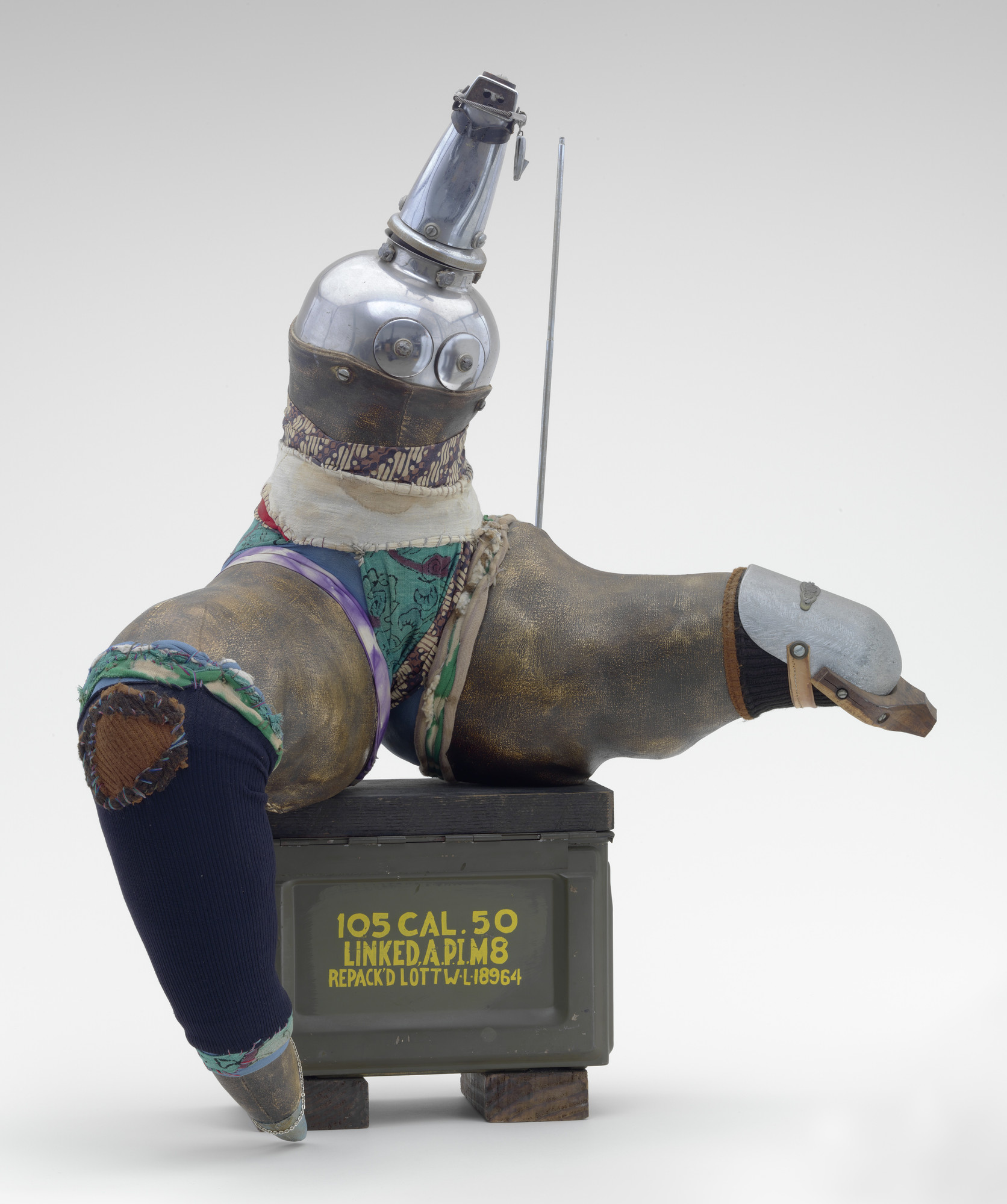
Narrator: The artist John Outterbridge made the sculpture Broken Dance as part of his Ethnic Heritage Series. He worked on it sometime between 1978 and 1982, combining materials like stainless steel, wood, leather, sewn cloth, and an ammunition box. The work is 34 inches high, 29 inches wide, and 33 inches deep. In metric units, that’s about 86 centimeters high, 74 centimeters wide, and 84 centimeters deep. It is displayed on a square white pedestal about the height of a standing adult, allowing us to view it from all sides.
Here’s how John Outterbridge described this work:
Artist, John Outterbridge: Broken Dance is a ballerina on an old World War II 50-caliber ammunition box...with one leg missing. But with the strength, the posture, seemingly, the dance would continue.
Narrator: The sculpture resembles a smaller-than-life-size seated torso with no arms. It balances atop a salvaged ammunition box with a radio antenna attached to it. A pair of doll-like legs emerges from the torso, splayed open into a taut stretch. Both legs have hefty thighs made from stuffed leather, but one leg ends at the knee while the other features a muscular calf and a pointed toe. The torso is wrapped in handmade garments resembling a dancer’s leotard and a legwarmer. But as we move above the waist, the figure turns more abstract, made from industrial-looking pieces of stainless steel.
Outterbridge found the inspiration for his series of doll sculptures after becoming a father.
John Outterbridge: The doll series is a direct result of my daughter’s excitement about dolls as a little girl. And I started to understand that, not until recent times, was the doll a toy. But it was something that was the personification of a culture.
The series itself was called the Ethnic Heritage Group. They were works that spoke somewhat of the slave era. I just wanted to talk to my daughter about some things regarding that part of our heritage and American history.
Narrator: Outterbridge grew up in North Carolina, where he was exposed to the practice of recycling materials. His mother was a seamstress who often turned fabric scraps into clothes and dolls, and his father owned a salvage business. These early experiences went on to inform artworks like Broken Dance, which Outterbridge made entirely out of salvaged materials.
For a more detailed description of the sculpture, continue listening.
We will begin our description at the base of the sculpture and work our way up, focusing on what is considered to be the front side—or rather, the place where the legs face toward us. For simplicity, we’ll also refer to the figure as “the dancer.”
The dancer is perched atop an olive green metal carton of ammunition, approximately the size of a shoebox. The front side of the box displays yellow stenciled letters and numbers indicating it originally held 105 cartridges of .50 calibre ammunition. Attached to the ammunition carton’s back right corner is a thin metal radio antenna about the size of two 12-inch rulers.
Now let’s describe the seated dancer and her clothing. We invite you to mimic her pose by moving your body as you are able or imagining yourself doing so.
First, picture yourself on a hard, shallow seat—this is the lid of the ammunition box. Your sturdy thighs rest on the cold metal, spread open so that they're wider than your hips. Normally, the cold metal might feel sharp against your skin, but your legs are made of smooth, mottled brown leather that has been sewn together and stuffed. They’re stuffed very full, making them feel quite firm to the touch.
Your right leg bends at the knee, and your right calf bulges as you arc and flex your foot, squeezing your toes together to form a sharp point. A legwarmer covers you from the ankle up to and above your knee. It is a dark blue, ribbed fabric, with upper and lower bindings made from colorful textiles in loose twists. A round brown patch covers your knee, sewn onto the legwarmer with large visible stitches. Your pointed toe wears a pale blue ballet-like slipper adorned with a thin silver chain.
Turning our attention to the other leg, the upper half of your thigh rests squarely on the ammunition box and extends out to the left. This left leg has no calf, ending instead at the bent knee. Strapped to your lower thigh is a makeshift knee pad consisting of a rounded metal plate that cups your knee. It finishes with a pointed wooden block resembling the squarish toe box on a ballet dancer’s pointe shoe.
Now, let's move up to the dancer’s top half. Imagine your torso bending forward slightly at the waist. You wear a form-fitting garment, something like a leotard without the top half covering your chest. The garment is a patchwork of patterned and solid cloth scraps in shades of blue, purple, green, and brown. Some of the patterned textiles feature bold, graphic prints with intricate designs. Torn and twisted rags form the rough hems digging into your inner thighs. The garment ends high up on your waist, where two overlapping bands of fabric encircle your core.
Above the waist, a section of brown leather implies the upper half of the torso. Yet, there are no parts to suggest arms. And the farther up we travel, the more abstracted our dancer becomes.
Atop the torso, we find an improvised construction of stainless steel parts, including a cone-shaped tube stacked atop a silver sphere that’s been cut in half. It is unclear what body parts the artist is referencing here, but combined together, these scraps resemble a bottleneck shape. The sliced sphere is like the sloping shoulders on a beer bottle, while the cone-shaped tube represents the neck. Outterbridge has affixed two flat metal circles with rivets to the center front of the half sphere. Sitting side-by-side, they might recall eyes. But they're positioned approximately where the dancer's chest would be, so could they also be breasts?
Outterbridge first began collecting discarded materials following the Watts Rebellion, a six-day protest against police brutality in the historically Black neighborhood of Watts in Los Angeles. He envisioned this “broken dancer” as a symbol of resilience.
John Outterbridge: I think, for me, it said a lot about how the human spirit has the potential to take flight far beyond the reality and the insanity of war and poverty. The spirit surpasses all of that. The whole spirit and the force of dance was what I tried to get in that piece.