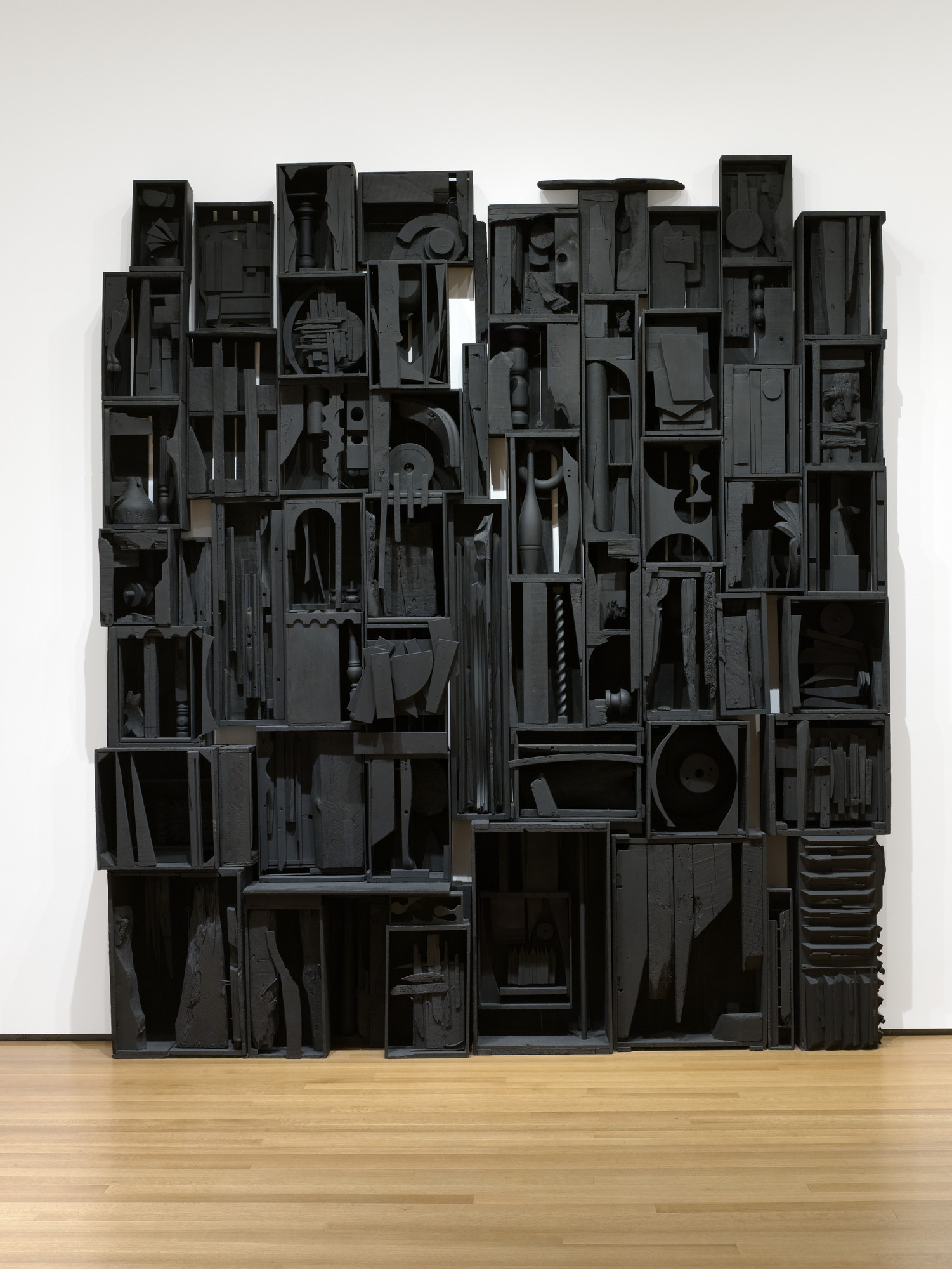
Narrator: The artist Louise Nevelson made the sculpture Sky Cathedral in 1958, using painted wood. The work is very large, measuring about 11 feet high, 10 feet wide, and 18 inches deep. In metric units, that’s about 3 meters high, 3 meters wide, and 45 centimeters deep.
This work brings together a vast array of wooden boxes and shapes to create a complex and almost architectural structure. Here’s how curator Ann Temkin describes the work:
Curator, Ann Temkin: This sculpture has almost 60 compartments in it, each of which combine and contain different found pieces of wood. All of it is painted black, creating what has often been described as a wall of sculpture. You somehow have to enter into the space that’s been created.
Narrator: We’ll begin by describing the form and structure of the work.
Imagine about 60 variously-sized wooden crates stacked and piled to create an irregular grid. Though each crate is a different height, they are roughly arranged into nine columns and seven rows. Each column has about six or seven vertically-stacked boxes, with its opening pointing toward us to reveal their contents. Additionally, the crates at the bottom of each column tend to be larger than the ones near the top, lending a sense of solidness and stability to the work.
The overall structure towers over us—it’s about as tall and as wide as a small backyard shed. But because it’s only one crate deep, it’s very shallow, protruding 18 inches from the gallery wall, or about half an arm’s length.
To create this work, Nevelson began by nailing all the pieces of wood together. If we get close, we notice tiny nailheads and pointed ends sticking out here and there. Once the structure was complete, she would paint the entire thing black.
Nevelson’s sculpture is not unlike a wall of storage cubbies one might find in a home or classroom. Each cubby or compartment contains a different assortment of pieces of wood, in all different shapes and sizes. Some pieces look like irregular scraps of raw wood. Others seem to be elements of furniture or architecture. For example, there’s a fragment of a chair’s curved leg. Another piece resembles a spiral-like pole. And another seems to be a bowling pin.
Let’s hear from the artist on how she sourced these wooden elements.
Artist, Louise Nevelson: I found lumber on the street that had nails in it and some nail holes in it. And different forms and different shapes. And I just nailed them together, and I knew that this was art, and I began to learn more about the technique, learn more about the forms, and went right on.
Narrator: If we could run our hands across the work’s surface, we would feel flat planes and rounded edges, rough sections and smooth ones, and pieces that overlap, as well as empty places where there are gaps between the scraps. The top of the work is not level. If we were to stand on a ladder and run our hands across the top, we would feel varied shapes at slightly different heights, sort of like a boxy skyline.
Now, let’s talk about color. Every piece of wood that makes up the work is painted a uniform matte black. But when the gallery lights shine down from above, they cast shadows and highlights that define and differentiate the various shapes and textures. Sections of the compartments that are empty or more deeply recessed are in shadow, appearing as a very deep, dark black. Whereas the wood pieces closer to the exterior of the compartments—and to us—appear lighter in color, almost like a dark grey. In some places, there are gaps between the compartments, so that slivers of white wall peek through.
Nevelson grew up in a family of lumber dealers, and she said the following about her use of wood:
Louise Nevelson: No one was using wood at the time in sculpture. But that did not have any influence on me because it was as natural for me to go to wood then, as it was for me to take a glass of water and drink it.