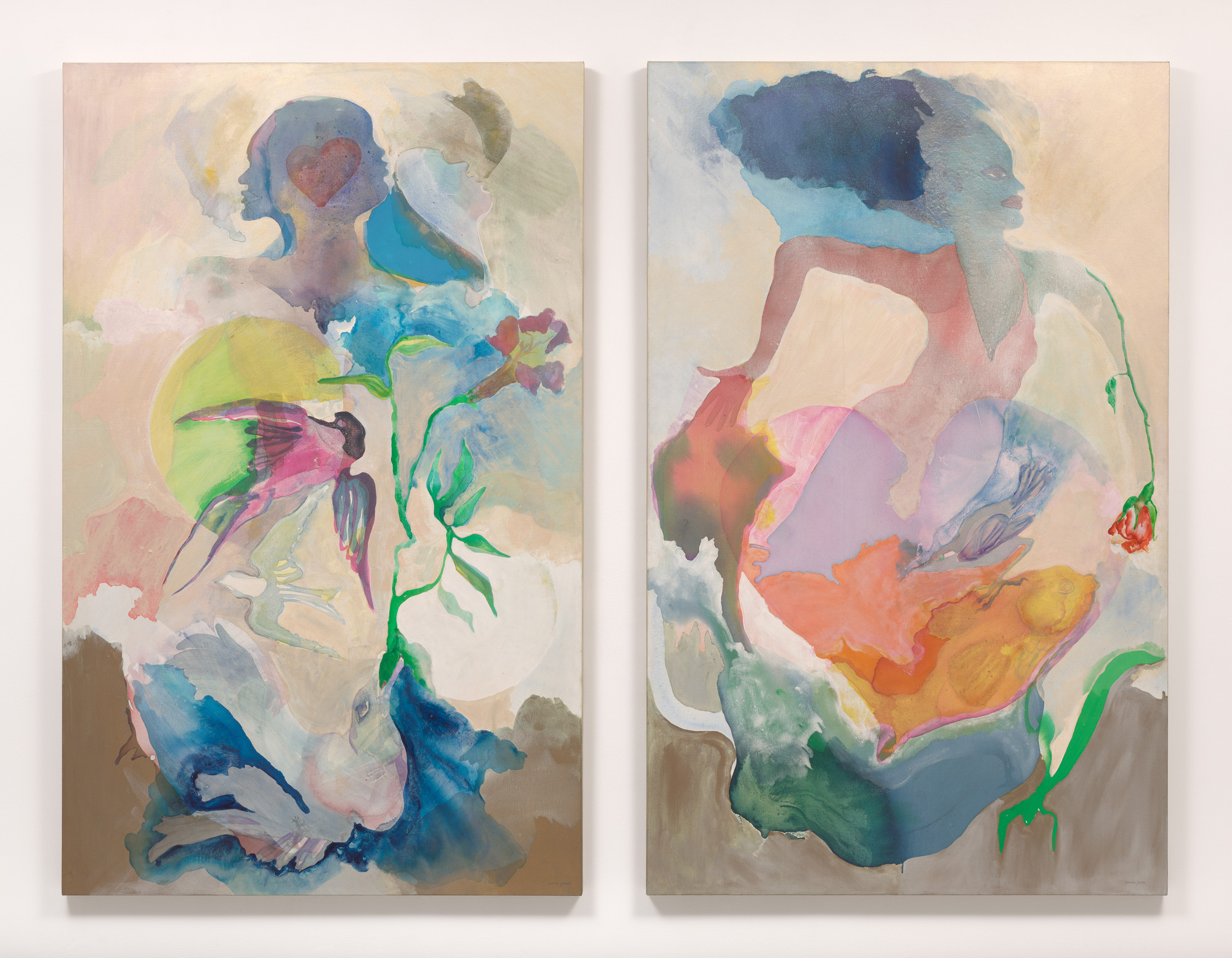
Narrator: The American artist Suzanne Jackson made Wind and Water in 1975, using acrylic paint and pencil on canvas. The painting is a diptych, meaning it is made of two canvases hung side-by-side. Each measures 97 inches tall and 60 inches wide. In metric units, each canvas is 264 centimeters tall and 152 centimeters wide. The work is quite large: each canvas is over eight feet tall, and as wide as a queen-size bed.
The panels are colorful and expressively painted, blending loosely detailed figures with abstract shapes and forms. At the top of each canvas, we encounter one or more faces in profile. But as we travel down, these human figures give way to elements of the natural world: birds, flowers, water, the sun. Some forms are distinct, while others are much more amorphous. At times, figurative elements—like a woman’s hand—morph into splashes of color.
According to artist Suzanne Jackson, these paintings were partly influenced by the setting where she made them. Here she is, describing her process:
Artist, Suzanne Jackson: I had a new studio, 5,000 square feet, in Los Angeles in 1973. So I was able to work very large. I could even dance while I was painting, and that’s a part of it as well. And because I was a dancer, I think there’s a great deal of movement in the paintings.
Narrator: At first glance, the acrylic paint looks more like watercolor: it’s applied freely, as though it were mixed with lots of water, so that the colors and forms flow, spread, bloom, and overlap on the canvas.
Jackson’s palette is colorful, with bright blues, greens, pinks, oranges, and yellows. But some sections are more muted. The background of the upper two-thirds is filled with a slightly iridescent pinkish-beige wash, and the mountain-like forms at the bottom third of each canvas are grey-brown.
The closer we get to the paintings, the more we notice their complexity: small flecks of color, dripping lines of paint, and mottled layers of brushstrokes. In several areas, the paint washes overlap and pool, creating pockets of dense colors, swirls of dusky pigments, and oozing stains. There are also areas where pencil outlines show through the transparent paint.
Here’s Jackson once more, describing the materials used for this work.
Suzanne Jackson: The color is gentle, but it’s also vibrant. This is also early acrylic painting, which means that…there were fewer choices of hues in the pigments, and the colors are muddy. All we knew is that you could thin the paint with water. So even though these look very thin, there’s just layering and layering of pigment, and sometimes there are over 100-150 layers of colors.
Narrator: To hear a more detailed description of the two panels that make up this diptych, continue listening.
We’ll begin with the left panel, moving from top to bottom. Imagine the panel is divided roughly into top, middle, and bottom thirds.
At the center of the top third, a translucent, bluish-purple wash of paint takes the shape of two overlapping human heads in profile—like a single head with one set of facial features facing left and another facing right. At the center of these two overlapping heads is a red heart.
Moving just to the right, there is another head in profile, just barely grazing the overlapping ones. Its nose points toward the upper right corner of the canvas, and a grayish-olive puff appears to emerge from the mouth. A swipe of turquoise presses against the back of the figure’s head, almost like a sweep of hair.
Moving down into the middle third, the neck attached to the overlapping heads bleeds into a watery, bright blue puddle. To its left, a round, yellow-green, circular form resembling a sun serves as the backdrop to a purple and magenta bird in flight. It heads right, with trailing, swallow-like tails and outspread wings. Just below this first bird, we find a second, much fainter bird flying in the opposite direction—this one painted in muted shades of blue and yellow. To the right of the two birds, a bright green plant sprouts a trumpet-shaped hibiscus flower with dusky-pink petals and yellow pistils. Leaves pepper the plant’s slender stems as it snakes down into the painting’s bottom third.
Here, we encounter a dark, watery blue section, which seems to trickle from the base of the flowering plant above. It swirls down the right side, pooling across the bottom edge before reaching back up toward the left side of the canvas. Nestled within the blue semi-circle shape is some kind of grayish-pink waterbird, who seems to hold the hibiscus plant in its upturned beak. Surrounding the water and bird, brown peaks resembling mountains fill the bottom left and right corners.
Next, we’ll describe the right panel, dividing it into thirds and moving from top to bottom.
The top third is dominated by the figure of a woman, pictured from the waist up in a reddish-pink dress with a V-shaped neckline. Her bluish face is in profile, facing our right. She has thick pink lips, dark eyes, and her hair is like a big smudge of indigo, reaching to the left, almost halfway across the canvas.
Let’s try mimicking her pose.
Start by letting your arms rest down your sides. Slowly move your left arm outward until it’s held just slightly away from your side. Imagine that just past the shoulder, your arm begins to dissolve, transforming into a single, long-stemmed rose, pointing downward so that the red rose is where your hand is.
To embody her right arm, start by bending your elbow to create a 90-degree angle so that your upper arm is pushed away from your side and your forearm dangles in the air. Turn your palm forward so the thumb points right and spread your fingers. Now, imagine a fluid blot of bright salmon-pink, with green and purple stains around the edges. It spreads out from your palm and drips down towards the floor.
With this blot of color, we are now in the middle third of the canvas. It is dominated by a large, translucent, candy-pink heart, which overlaps with the woman’s dissolved lower body and fills almost the entire width of the composition. Inside the heart, there’s a spindly-legged bird painted in blue. The bird’s feet seem to perch on top of a large goldfish, who swims up the heart’s lower right edge.
Finally, we reach the lower third of the canvas. Below the heart is a section of teal and blue, like a pool of water. The goldfish mentioned previously appears to leap out of this pool, which rests between brown mountain peaks. In the bottom right corner of the panel, the roots of a single green plant are embedded in the mountainous area, and a long leaf or stalk slithers up toward the painting’s right edge.
Suzanne Jackson: This painting, Wind and Water, was a really early commission— by the musician, Sonny Bono. Sonny and Cher were well-known singers during the ’60s and ’70s. And…he wanted a big painting for his house, but he wanted a diptych.
While I was painting it, I was thinking about those elements that I love, that I grew up with in Fairbanks, Alaska, where nature is all around. You see those huge mountains. We had so many birds in our yard.
There’s still a great deal of looseness in the washes around the figures because I’m more interested in the spirit of these figures and animals. Creatures all together as one.
I was still very young when I was painting these. I was also doing research and learning a great deal about African art and symbolism. Across oceans, across continents, we have been a part of nature since the beginning. In my work, even now, I want to say there is a great deal of love and beauty in Blackness. There is nature within us.