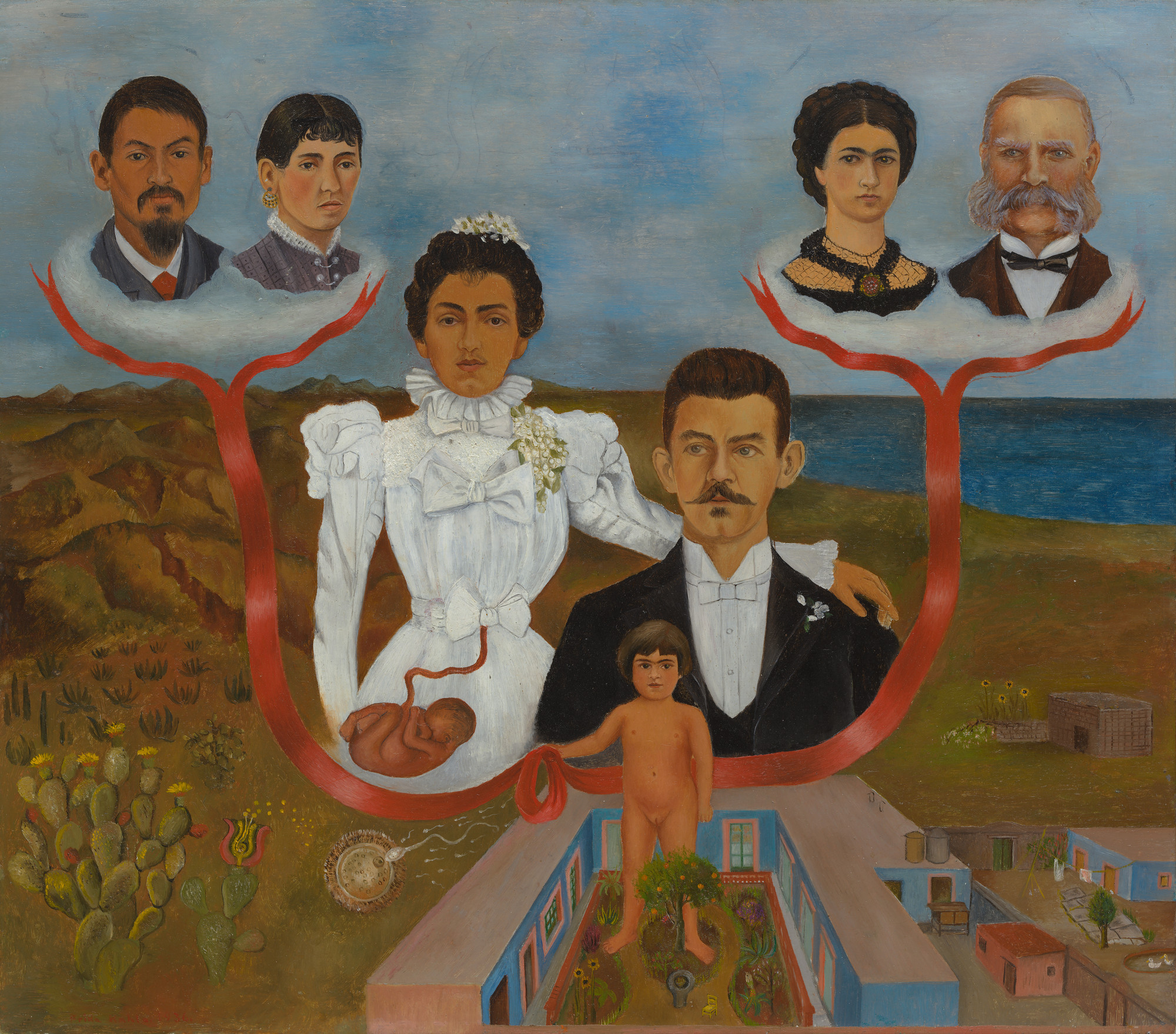
Narrator: Mexican artist Frida Kahlo made My Grandparents, My Parents, and I in 1936 using oil paint and tempera on zinc. It measures about 12 inches high by 14 inches wide. In metric units, the work is 31 centimeters high by 35 centimeters wide.
Set within a dark brown wooden frame, this nearly square painting is a portrait of Frida Kahlo’s family, paying tribute to her Mexican and German ancestry. It shows a young Kahlo with her two parents and four grandparents, all set against a Mexican landscape. The artist adopts the form of retablos, small devotional paintings made on metallic plates. The paint sits flat on the smooth metal surface, but reveals brushstrokes and accumulations of paint in select areas.
At the bottom of the painting, we encounter a representation of Frida Kahlo as a young child. She is naked, standing in the inner courtyard of her family home and holding a long red ribbon in her right hand. This ribbon unfurls behind her to the left and right, traveling up along the painting’s sides before diverging into smaller segments, like branches on a family tree.
Directly behind and above Kahlo, we find a portrait of her parents set against greenish-brown hills. On the right, Kahlo’s father appears seated and is shown from the chest up. To the left, his wife stands, an arm draped over his shoulder. She is depicted from the hip up in a white wedding dress. A big bow cinches at the waist, and from it emerges an umbilical cord attached to a fetus. Below these two figures, we encounter a separate vignette of a sperm fertilizing a human egg cell.
The red ribbon traces alongside Kahlo’s parents, continuing upwards, where it splits into thinner bands that frame portrait busts of Kahlo’s grandparents. Her maternal grandparents are in the upper left corner, and her paternal grandparents in the upper right corner—all of them set against a blue sky populated by thin clouds.
The family portrait is painted with naturalistic detail, but each figure appears out of proportion to the others and their surrounding landscape. Kahlo is pictured full-length, but smaller relative to her parents, who are the largest figures in the composition and shown from the torso up. Kahlo’s grandparents are medium-sized, but are shown only from the shoulders up.
For a more detailed description, continue listening.
Looking at the painting overall, Kahlo and her family are pictured against a Mexican landscape with an arid vista of mountains, canyons, and desert. The horizon line is set at the top third of the canvas, dividing the gray-blue sky from the brown-green earth. On the left side of the painting, a cactus-filled desert gives way to barren mountains in the background. On the right side, a small gray blocky structure takes root in a green field, just off the shore of a smooth, deep blue sea in the background.
Kahlo has rendered the landscape with as much precision as the prominent figures occupying the majority of the canvas. We’ll describe both elements in detail, beginning at the bottom of the painting where a young Frida Kahlo stands at the center.
She is depicted as a naked toddler in the courtyard of a blue house with salmon-colored window and door frames. This house has been identified as La Casa Azul, her family home. Kahlo faces us with big brown eyes beneath her signature unibrow and a slight smile. Her skin is a warm shade of orange-brown, and her chocolate brown hair is styled in a short bob that falls around her ears. Bangs sweep across her forehead, parting in the middle. Although she is relatively small in the painting—only about 4 inches high—her body is twice the height of the house, which is shaped like an open square.
Scholar Adriana Zavala has studied the place Kahlo depicts here.
Scholar, Adriana Zavala: What is really so captivating is the intimacy with which Frida represents the family home. This was a home that was roughly a square, takes up about a city block, and in the very center of the home was a private garden for the family to enjoy the outdoors. All of the rooms—the living room, the dining room, the bedrooms, and the kitchen—were arranged around this interior garden.
She really takes us into the garden so that we can see an orange tree, a little cluster of sunflowers, other plants that might be roses. We also see some cactus plants. We see a little tiny painted yellow wooden chair, and a pre-Columbian object, which is a ball court ring, which is just in the foreground of the garden space in the composition.
Narrator: To the right of the house, there is a fenced-in backyard with small one-story structures, laundry drying in the breeze, and a duck pond.
On the left side, and in the lower left section of the painting, Kahlo depicts the Mexican landscape and a scientific illustration of a white sperm penetrating a yellow egg cell.
Adriana Zavala: Also, we see the arid central Mexican plateau, which is where Mexico City is. We see the iconic Opuntia cactus, known as the paddle cactus or nopal cactus, which is one of the emblems of the nation of Mexico.
There’s two of them, actually: one that’s multi-paddled and has yellow flowers, and then one lone plant that has just four paddles. But it has a much larger flower that Kahlo has bisected in the manner of botanical illustration. It’s a red flower. And then she’s shown us the sort of interior pistils of the flower that are yellow.
That flower is releasing pollen in the wind, and that pollen is just about to come into contact with the egg cell that is being fertilized. If we interpret that egg cell as Frida before she became the fetus, then what she’s communicating to us is that she is in her essence of the Mexican landscape.
Narrator: Let’s move up to the middle third of the painting, where a portrait of Kahlo’s parents anchors the center. It reproduces a photograph taken on the couple’s wedding day in 1898. On the left, Kahlo’s mother wears a Victorian-style white dress with a pleated high collar, long sleeves, and voluminous ruffles decorated with lace, bows, and a corsage of white flowers. She looks directly at us, with dark brown eyes and slightly pursed lips. Her skin is rendered with shades of umber and tan. Her dark hair is pulled into an updo with flowers at the crown.
A bow wraps around her waist, and from it emerges an umbilical cord connected to a reddish-brown fetus, its curled shape nestled into the right side of her hip. The mother’s left arm extends to our right, resting gently on her husband’s shoulder. He is dressed in a black tuxedo with a white collared shirt, white bow tie, and a bundle of small white flowers pinned to his lapel. He faces forward, but his gaze skews left, as if looking at something beyond the frame. He has lighter medium-beige skin, blue eyes, and chestnut brown hair.
At the top of the painting, Kahlo’s grandparents appear as portrait busts rising from a nest of white clouds.
The upper left corner is populated by Kahlo’s maternal grandparents—her grandfather on the left, and grandmother on the right. Her grandfather has the darkest complexion of all the figures, with umber-orange skin. His dark brown hair matches his downturned mustache, pointy goatee, and arched brows. He wears a dark gray suit jacket over a white collared shirt and red tie.
Kahlo’s maternal grandmother is pictured in a three-quarter profile facing the right side of the painting. She has a somber expression with slightly downturned lips, dark eyes, and straight brows. Her hair is tied back, and short curly bangs graze the top of her forehead. She wears a high-neck gray dress with a narrow white ruffled lace collar and large circular gold earrings. Her skin tone is rendered with light beige and hints of peach.
Now, let’s shift our attention to the painting’s upper right corner. Here, Kahlo’s paternal grandparents are shown with grandmother on the left, and grandfather on the right. Her grandmother has light beige skin. She wears a high-collared black lace dress with a reddish-yellow brooch. Her brown hair is swept into a braided updo that arcs across the top of her head like a crown. And a unibrow tops her dark, close-set eyes, which look to our left, though her body is turned right.
Her husband, Kahlo’s paternal grandfather, is shown straight on. He wears a brown suit jacket and vest with a white collared shirt and thin black bow tie. His wispy, light gray hair is combed back, contrasting with his thick and bushy brows, mustache, and sideburns. The facial hair obscures his lips and jaws. He has light oatmeal-colored skin with rosy cheeks and aquamarine blue eyes.
When Kahlo made this painting in 1936, she had just returned from a four-year stay in the United States.
Adriana Zavala: This is also the period of intense fascism in Western Europe and the rise of fascism and the Nazi party in Germany, and Kahlo would’ve felt this intensely. Her father was a Hungarian-German immigrant to Mexico City. We know that, in particular moments, Kahlo claimed that her father was Jewish.
One of the interpretations of this painting is that it is inspired by the Nuremberg race laws. There were books about the importance of tracing your genealogy in order to prove your blood purity. The way that this worked is that you had to demonstrate that your grandparents were German and that they were not Jews or other ethnic communities or mixtures.
Kahlo being Kahlo—and she was one of the world’s great disruptors—she is here proudly proclaiming precisely the opposite of what these genealogies were supposed to prove. She is celebrating her mixedness. And the way that Mexican society is constituted in a multiracial, multiethnic way.