Narrator: The artist Betye Saar made Black Girl’s Window in 1969, using a wide range of materials: a wooden window frame, paint, cut-and-pasted printed and painted papers, a daguerreotype, a lenticular print, and a plastic figurine. The work is nearly 36 inches high, 18 inches wide, and 1-and-a-half inches deep. In metric units, it is about 91 centimeters high, 46 centimeters wide, and 4 centimeters deep.
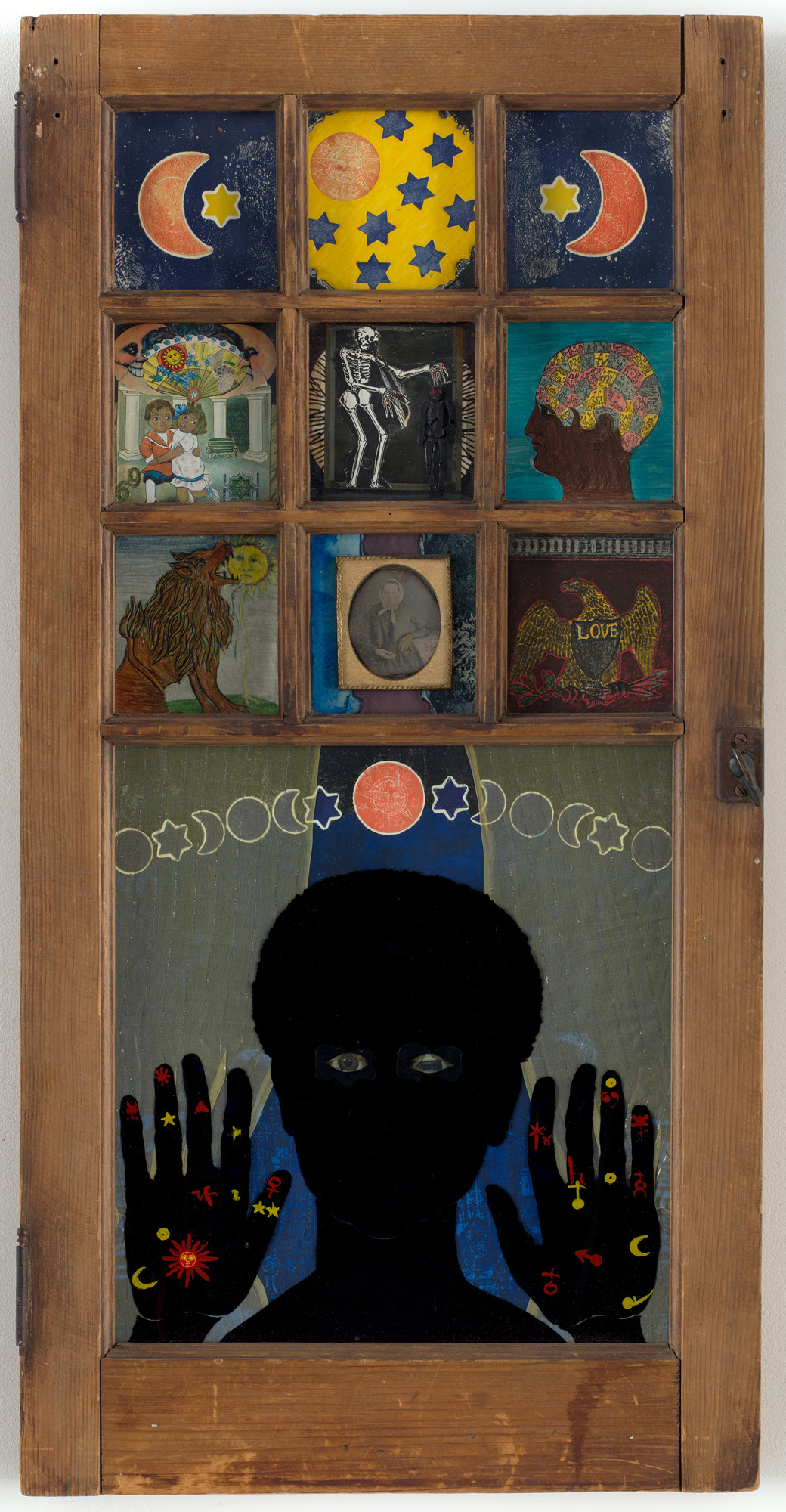
This work consists of a salvaged window frame made of weathered grayish-brown wood. In the space where panes of glass would have been, Saar has inserted pictures and found objects.
The top half of the window frame is a grid of nine squares, each about four by four inches and separated by narrow wooden moldings. The bottom half of the window frame is a single pane, slightly over a foot square.
Let’s first explore this larger, lower pane. In it, we find the Black girl of the artwork’s title. She is framed between two gray curtains made from a gauzy fabric. The curtains part in the middle, revealing a deep blue background.
The girl is a bit smaller than life sized. Her head, shoulders, and hands appear as a black silhouette in the foreground. She has a short, rounded Afro, and her hands are raised beside her face. Her fingers are slightly apart, as though pressed flat up against the glass. The girl’s eyes are her only visible facial feature. They were made using a lenticular printing technique that makes the image look different depending on the viewing angle. As a result, the eyes appear to move as we change perspective.
The girl’s palms and fingers are dotted with several small symbols, including crescent moons and five-pointed stars in yellow, astrological signs in red, and a fiery sun using both colors.
Arcing over her head is a row of six-pointed stars, half-moons, and full moons outlined in white. In the middle of this sequence is a pale red disk directly above the top of the girl’s head. The disc is inscribed with faint white lines depicting a sun with a human face.
Now let’s move to the top half, which consists of a grid of nine smaller window panes. We’ll start our exploration with the bottom row of squares and move upwards.
The leftmost pane of the bottom row contains a medieval-looking drawing of a lion biting a sunflower with a face and tall yellow stem. This image may be a reference to the artist’s astrological sign: Leo.
The center pane holds a rectangular frame of worn gold with an oval-shaped window. The frame displays a faded photo of a seated woman with a scarf wrapped around her head and knotted at her chin. It is set against a background of blue, purple, black, and white.
The pane on the right side shows an American heraldic eagle clutching an olive branch and arrows with its talons. The front of its breast is covered by a shield embellished with the word “LOVE.”
Moving upwards to the middle row in the grid, we again see three square panes. In the leftmost square, we find an image, perhaps cut out from a children’s book, of a brown-skinned boy and girl, dressed in red, blue, and white. The two children clasp each other as though they’re dancing. A yellow smiling sun beams down upon them.
The center pane is populated by two skeletons. One is a white line drawing from a Tarot card; the other is a small black plastic figurine.
In the rightmost pane, a man’s head faces to our left in profile. The dome of his head is filled with organic shapes in pastel hues of pink, blue, and yellow. These are the mappings of phrenology. Phrenology was a practice from the 1800s, involving the detailed study of the shape and size of the human skull. It was falsely believed to determine character and mental abilities.
The top row of panes contains more six-pointed stars, crescent moons, and a sun. They’re painted in red, yellow, and purplish-blue. The red sun, located in the middle pane, has a human face and resembles the sun found just over the girl’s head.
Now we'll explore this work with the artist.
Artist, Betye Saar: Black Girl’s Window I suppose it's like a diary of my life.
One day I found an old window, and I thought how would my prints look in a window?
I started out with the sky. I really love the sky—I love the moon and the stars and the sun. And in the next few panes were about my life. The one with the couple dancing, this is an image from a greeting card from the 1920s, 1930s. I was born in 1926, and so this is a picture of my family, my father and my mother dancing. And unfortunately, during that first few years, my father passed. He had an infection and the hospital in Pasadena was segregated and he had to drive to a county hospital, which was the only kind of medical care black people had. The next picture is of death, which is the way I interpret his passing. I find it curious at this time that it's in the center of the window, but because he had such a rude way of dying, I had issues with racism and with with segregation. To go back to the other pane, The lion with a sun in his mouth - I happen to be a Leo and the sun is my planet. The next pane over is the daguerreotype of a woman. It's to symbolize my unknown ancestry on my mother's side - her mother was white, but her father was a Native American and Black. And this is about love, so love is a bird - it comes and goes, it flies away, it stays.
And above that is a phrenology chart of all the areas of the brain. On the bottom part of Black Girl’s Window, it shows my silhouette and my hands are pressed against the panes of the glass. On the hands are the different symbols and signs of astrology and one hand is for what my life will be, and the other hand is what my life really was.
That's Black Girl’s Window. It's about life, and about death.