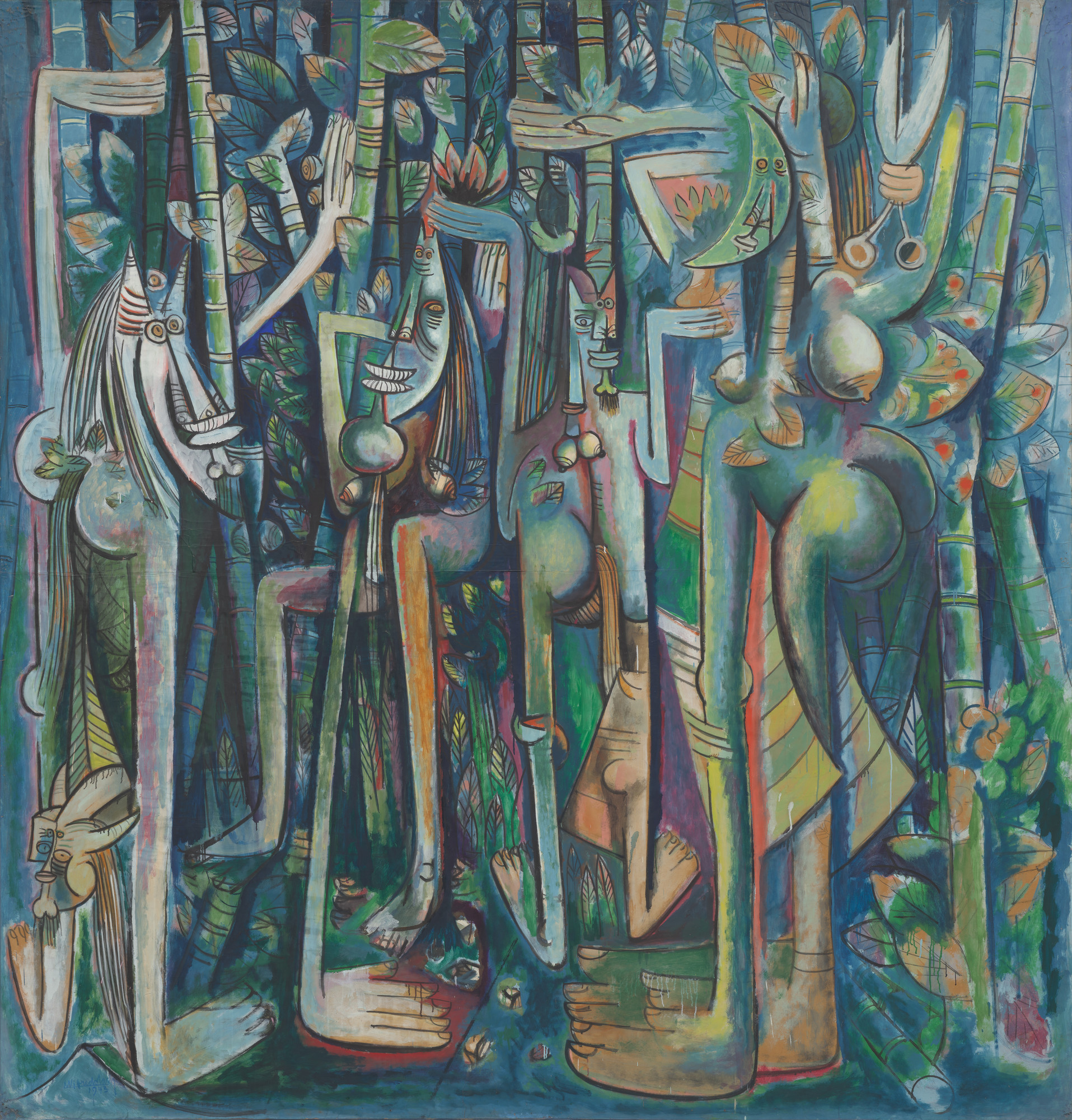
Narrator 1: The Cuban artist Wifredo Lam painted The Jungle, or La Jungla in Spanish, between 1942 and 1943. He used oil and charcoal on paper mounted on canvas. It measures about eight feet high and seven-and-a-half feet wide. In metric units, the work is about 240 centimeters high and 230 centimeters wide.
Narrator 2: This large, nearly-square painting is densely crowded with stylized figures and plants. The Jungle evoked by the work’s title and setting refers to the history of enslaved African peoples in Cuba practicing their religions in hidden settings such as the woods.
Everything in this composition is emphatically vertical. Tall leafy stalks of sugarcane form a dense backdrop beginning at the bottom of the canvas and cropped off by the top edge. The sugar cane is tall and thin with notches wrapped around the cylindrical trunks. Appearing behind and between the stalks are four elongated animal-human hybrid figures, inspired by Afro-Cuban religious beliefs.
The four figures are spaced evenly across the width of the canvas. Their mask-like faces turn toward us, their oversized feet and hands are planted firmly on the ground. Their long, thin limbs resemble the surrounding sugar cane stalks, and their bodies even sprout a few leaves.
The figures and vegetation are painted in the same style and color palette, primarily in greens and blues with yellow and rusty orange highlights. Many of their forms are defined by dark outlines, making it difficult to discern the bodies within the densely crowded and shallow space. The overall composition is marked by a transition from dark to light, with shadowy contours enveloping the left half before giving way to a lighter blue on the right.
We will now describe the figures from left to right. The figure on the far left has no torso. Instead, long straight legs support their buttocks and mask-like head. The head resembles that of a horse, with two pointed ears and a long muzzle with white lips hovering three quarters of the way down. The figure’s long, cascading hair merges with a horse-like tail that sprouts from their backside, its base crowned by an arrangement of green leaves. The figure raises both arms above their head, wrists bent forward to touch the foliage with their hands. A single eye peers from between the figure’s ears. And another mask-like face resembling a four-eyed goat appears down by the figure’s foot.
Moving toward the center of the canvas, the second of the four figures is seated. They have a crescent-shaped face with white lips, a bulbous chin, and three orange eyes—two clustered at the top of their forehead and another to the right of their nose. Below their face, two breasts point in different directions. The figure’s long bent legs extend to the ground. Two arms sprout from the figure’s side. One tucks behind the figure’s head while the other extends down to the ground, pressing down into the earth.
To the right, is a third figure with a cat-like face. They have pointy ears. Color divides the figure’s face into two uneven sections—the left side is blue with one eye, two sets of lips, and a green cleft chin; while the upper right side is orange with two eyes. A pair of lemon-shaped breasts juts from what appears to be their backside. This pose is suggested by a dark vertical line that could be their spine, and also by the fact that the figure’s tail, calves, and one buttock are shown pointed toward the viewer, as if walking away from us. The figure’s arms are held high, with palms facing up toward the top of the canvas, holding colorful vegetation.
At the far right side, is the largest of the four figures. They have a green crescent- shaped face with two eyes, a nose, and mouth. Their long neck leads down to a thick, horizontally-oriented torso with an upturned back. Their bulbous buttocks jut out toward our right, and their long limbs are solidly planted on the ground. A limb extends up to the right of their head, holding up a pair of shears. It is unclear whether the hand belongs to this figure, or to another obscured by the vegetation. At the bottom right corner of the canvas, just to the right of the figure’s feet, a stalk of freshly-cut sugar cane litters the ground.