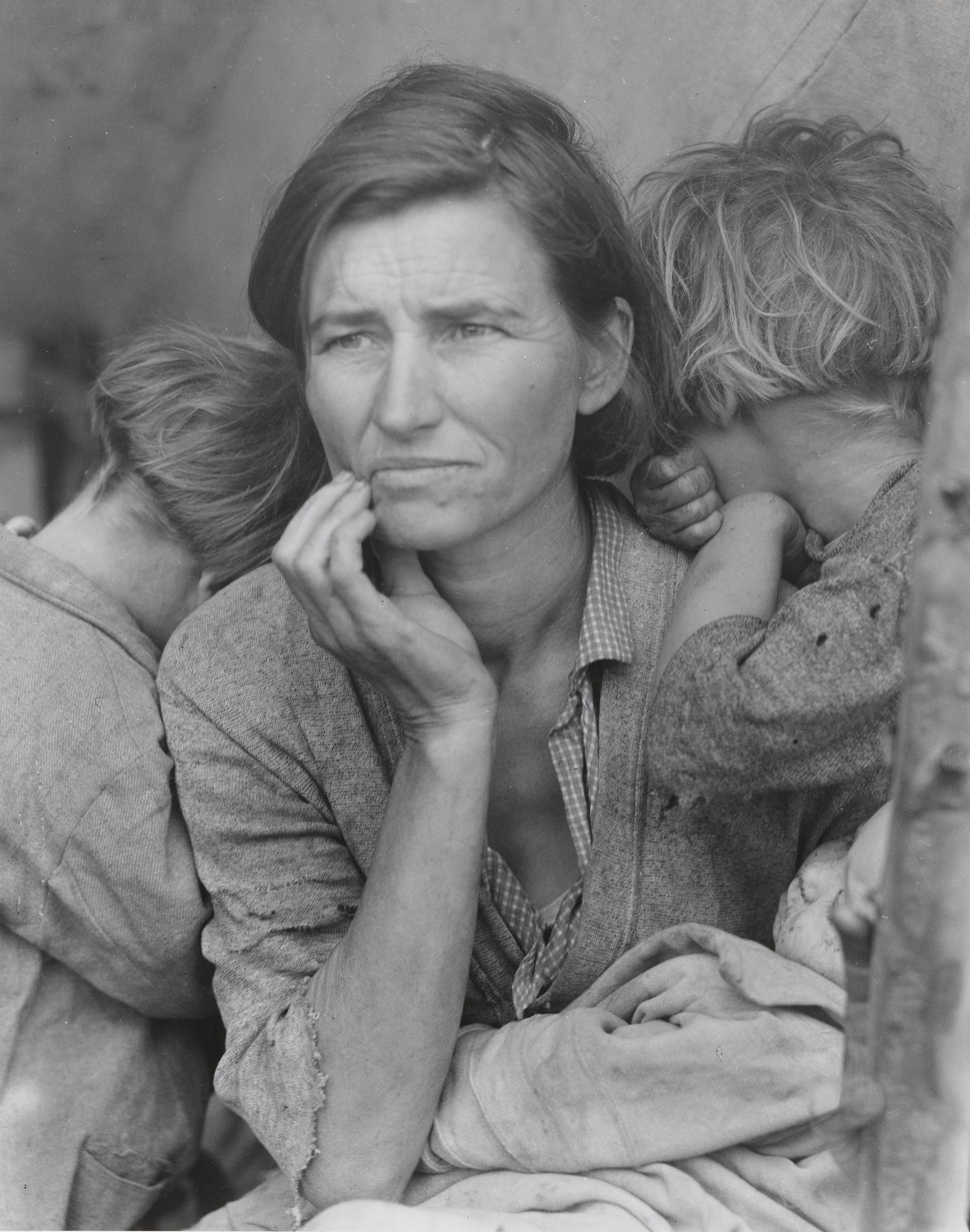
Narrator: The photographer Dorothea Lange made Migrant Mother, Nipomo California in 1936. The work was printed on gelatin silver print paper in 1949. It is nearly 12 inches high and 9 inches wide. In metric units, it is about 28 centimeters high and 22 centimeters wide.
A woman fills the center of this black and white photograph. She holds an infant in her arms. Two other children lean against her, one on each shoulder. The positioning of this group loosely forms a pyramid with the mother’s head at the apex. The scene is tightly cropped so we only see a bit of gray tent canvas above them. A tent pole runs vertically along the right edge of the frame. It is slightly out of focus because it’s closer to us. Lange photographed this family while documenting the plight of migrant workers during the Great Depression in the United States.
Now we’ll describe the work in closer detail, beginning with the mother. Her mouth is set in a straight line, and her brow is furrowed. Creases at the corners of her eyes and around her mouth and forehead give her a weathered appearance. She gazes into the distance, not at the camera. From her expression, it appears she is weary and concerned. Because of her light skin tone, at the time this photograph was published, she was described as a woman of European descent. However, she was later revealed to be a Cherokee woman from Oklahoma.
She leans slightly forward, with her right elbow, on our left, propped on her lap. Her fingers press lightly into the lower part of her right cheek along her jaw. Her hair is dark. She wears a lightweight, textured cardigan whose ragged sleeve unravels at the cuff. Her sweater covers a gingham collared shirt that is open at the neck.
Her two daughter’s faces are hidden as they huddle close to their mother’s body. The daughter on our left is visible from the waist up, and is partly obscured behind the woman’s shoulder. The child’s head, with short straight cropped hair, is tucked into her mother, showing the back of her neck. She wears a rumpled light-colored jacket.
The daughter on our right is also mostly out of frame. She drapes her arms over her mother’s shoulder and rests her head on her wrists. Her right hand is balled into a loose fist, and we see her visibly dirty knuckles. Her short hair is tousled, and her face is tucked into her mother’s shoulder. She wears a heathered wool shirt that has some small holes in the sleeve. Beneath her left elbow rests the head of an infant.
The infant lies in the mother’s lap, almost fully swaddled in a dirty blanket. Only a small portion of the baby’s face is visible. Their pale skin is smeared with dark patches that could be dirt or food, and their eyes are closed.
Continue listening to hear more about this work.
Artist, Dorothea Lange (archival): I many times encountered courage, real courage. I encountered that many times, in unexpected places. And I have learned to recognize it when I see it.
Educator, Kerry Downey: That’s the photographer Dorothea Lange. She took this photograph in 1936 and it stirred up incredible amounts of sympathy but also outrage. Here’s curator Sarah Meister to tell us more.
Curator, Sarah Meister: What we're looking at is a 32 year old mother of seven children on the outskirts of a field where there was no work because the pea crop had frozen.
This photograph has become such a shorthand for the suffering of the Great Depression. Lange really understood the power of photographic images to convey very complex and nuanced circumstances. The children looking away from the camera allows them to represent all children. Her posture with her worried hand up to her face you can see the worn edge of her sleeve, you can feel the lines in her brow.
There are very few works of art that you can say brought relief to people pictured, real immediate relief. Reporters and government aid were sent to that camp immediately.
Many decades after this photograph was made we learned that the sitter, the Migrant Mother, whose name is Florence Owens Thompson, was in fact Cherokee. And that raises all kinds of questions about how instinctive sympathy might be linked to a recognition of similarity meaning if a largely white audience would have identified as powerfully with this image if they had known that she was Native American. We can't know the answer to that, but it seems like a very important thing to reflect on.