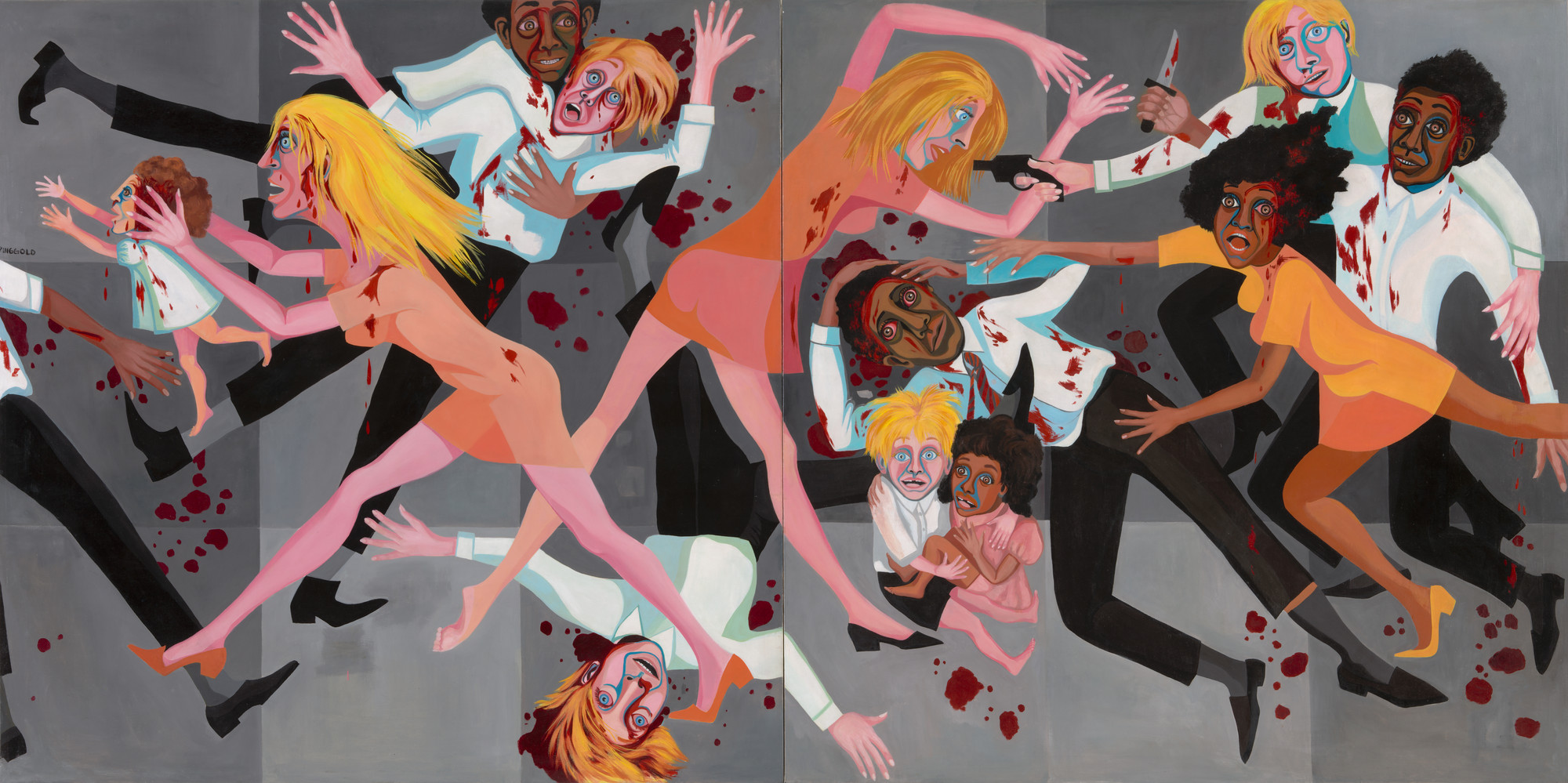
Narrator: The artist Faith Ringgold painted American People Series #20: Die in 1967, using oil paint on canvas. The work consists of two panels that form a continuous image. Together, the panels measure 6 feet high and 12 feet wide. In metric units, this is about 183 centimeters high and 366 centimeters wide.
This painting depicts thirteen men, women, and children in the midst of a frenzied and violent battle. Ringgold made this painting to capture the race and class struggles in the United States at the time—creating what she describes as an “abstraction of what the fights were really all about.”
Because streets and sidewalks often serve as the background for social protests, the artist arranged these figures against a checkerboard of 18 light and dark gray squares to look like a sidewalk viewed from above.
Ten adults and three small children—some Black, some white—lunge, tumble, fall, huddle, and splay across the sidewalk, which is spattered with blood. All of the figures wear expressions of shock, horror, or pain. Some of their facial details are outlined in bright blue lines. Dark red blotches of blood mottle the clothes and faces of each figure except two: a pair of small children who huddle together closely near the center of the canvas.
The figures are painted using mostly flat planes of color, making them appear like paper cut-outs piled on top of the background. The lack of shadows enhances their two-dimensional quality.
With few distinguishing features to differentiate them, the adults appear as the same four figures repeated in different poses: a Black man, a white man, a Black woman, and a white woman. The male figures are dressed identically in white dress shirts with light blue contours, black pants, gray socks, and black shoes. The female figures wear short-sleeved form-fitting mini-dresses in orange. The Black figures have brown skin, brown eyes, and black hair. And the white figures have pink skin, blue eyes, and bright yellow hair.
In the chaos of overlapping bodies and arms, it is unclear which people are perpetrators of the violence and which are victims.
Let’s explore the two panels in more detail, beginning with the canvas on the right.
On the right side of the canvas and near the top corner, a white man and Black man are entangled, blood staining their heads, faces, and shirts. The white man’s head hangs limply above his right shoulder. His right arm extends outward, pointing a black pistol toward a white woman at the center of the canvas. His left arm wraps around the shoulder of a Black man, who sprawls out in front of him.
The Black man’s knees are bent, as if attempting to ground himself. His left arm is gripped by the white man, but his right arm stretches out holding an upturned knife with a blood-covered silver blade and black handle.
From the right side of the frame, a Black woman lunges in front of this entangled pair. Her right leg is bent and her left leg kicks out behind her, cropped by the edge of the canvas. With both arms outstretched in front of her, she seems to reach toward a second Black man, who lies wounded on the ground. He grips his head with both hands, gazing at us with dazed, bloodshot eyes.
Beside and just below the dazed Black man are two barefoot children, sitting on the ground clutching each other tightly. They appear to be miniature versions of the white male figures and Black female figures, with similar outfits and hairstyles. The Black girl sits on the lap of the white boy, her knees folded up toward her chest. Both their faces bear the same horror as the adults. They are the only people in this scene not covered in blood.
The figures we just described are located in the right hand panel.
Creating a continuous scene between the two panels, a white woman steps across the center of the painting and toward the right. Her head, torso, and the lower part of her right leg occupy the right-hand panel while her left leg and back side occupy the left hand panel.
Her hands are above her head and her fingers splayed, as she towers over the frightened children. Her face is in profile, with wide-eyes and a gaping mouth. She looks directly down the barrel of a gun pointed just inches away from her face by the white man at the painting’s top right corner. Drops of blood spray her dress, and its sheer fabric reveals her pink buttocks. Her feet are set wide apart, so her legs form an upside-down V. She wears a black low-heeled pump on her right foot, and her other foot is bare.
In the area of sidewalk between her feet, a white man lies injured with his blood-soaked head towards the bottom of the canvas. Streaks of red outline his yellow hair and mark the contours of his face. His limbs are splayed out weaving beneath and between several of the other figures.
Behind the white woman and man we just described, a Black man and white man tackle each other in a similar way to the first pair we discussed. The white man appears to lie on the ground, arms and legs outstretched. The Black man is behind or beneath him, wrapping his left arm around the white man’s rib cage and his right arm around the man’s neck. Neither man appears to hold a weapon, but both are bloodstained and disheveled.
To the left of this entangled pair, a second white woman, with eyes wide open and parted lips, leaps across the panel in profile. Though facing the opposite direction, her pose mirrors that of the first white woman with her right foot forward and her body bent slightly at the hips. Her back foot seems like it is about to kick or trip over the head of the injured white man beneath her.
In her outstretched arms, she holds up a small child with light skin and curly brown hair, gripping her head. The girl wears a short white dress, and is barefoot and bleeding from her head. Her pose is similar to that of the woman holding her.
Directly across from the small child, a Black man disappears beyond the left edge of the canvas. The only parts of his body that are visible are his left leg, his left arm, and his right heel. His blood-stained white shirt is rolled up to his elbow, revealing a long red gash above his wrist.
Now let's hear from the artist about this work.
Educator, Kerry Downey: First stop,1960s America. But this scene could just as easily be happening today.
Artist, Faith Ringgold: Hello. My name is Faith Ringgold, and we're looking at my work, American People Series No. 20: Die, painted in 1967. There was a lot of spontaneous rioting and fighting in the street and undocumented killings of African-American people, and great racism. Everybody knew. Everybody talked about it, but I would never see anything about it on television—nothing.
How could I, as an African-American woman artist, document what was happening all around me? I want to show a kind of abstraction of what the fights were really all about. And they had a lot to do with race and class, and no one was left out. It was to make sure that certain people on the bottom don't get to the top.
So you can see they're all dressed in business suits, and they're all hooty-dooty. But they're fighting for their position in life, in America, to be retained. And then there's people who have already attacked somebody, and they're trying to beat them down. And then there's people looking for somebody, running after each other and screaming and carrying on against that background. And those squares really represent the sidewalk, which basically was always the background of a riot because everybody is going to fall on the ground.
Having women with children there was very important because women are going to protect their children no matter what. These children, they're in the center, they gravitate toward each other. They don't know each other, but they're going to try to help each other. They are the innocent victims here.
I had the courage to go ahead and speak out. I want you to be upset. You're not supposed to see people rioting and killing each other or even know that they're hating each other without being upset. This was going on then; it's happening again now. And every time I see one of those big riots in the street here today, I think back to Die.