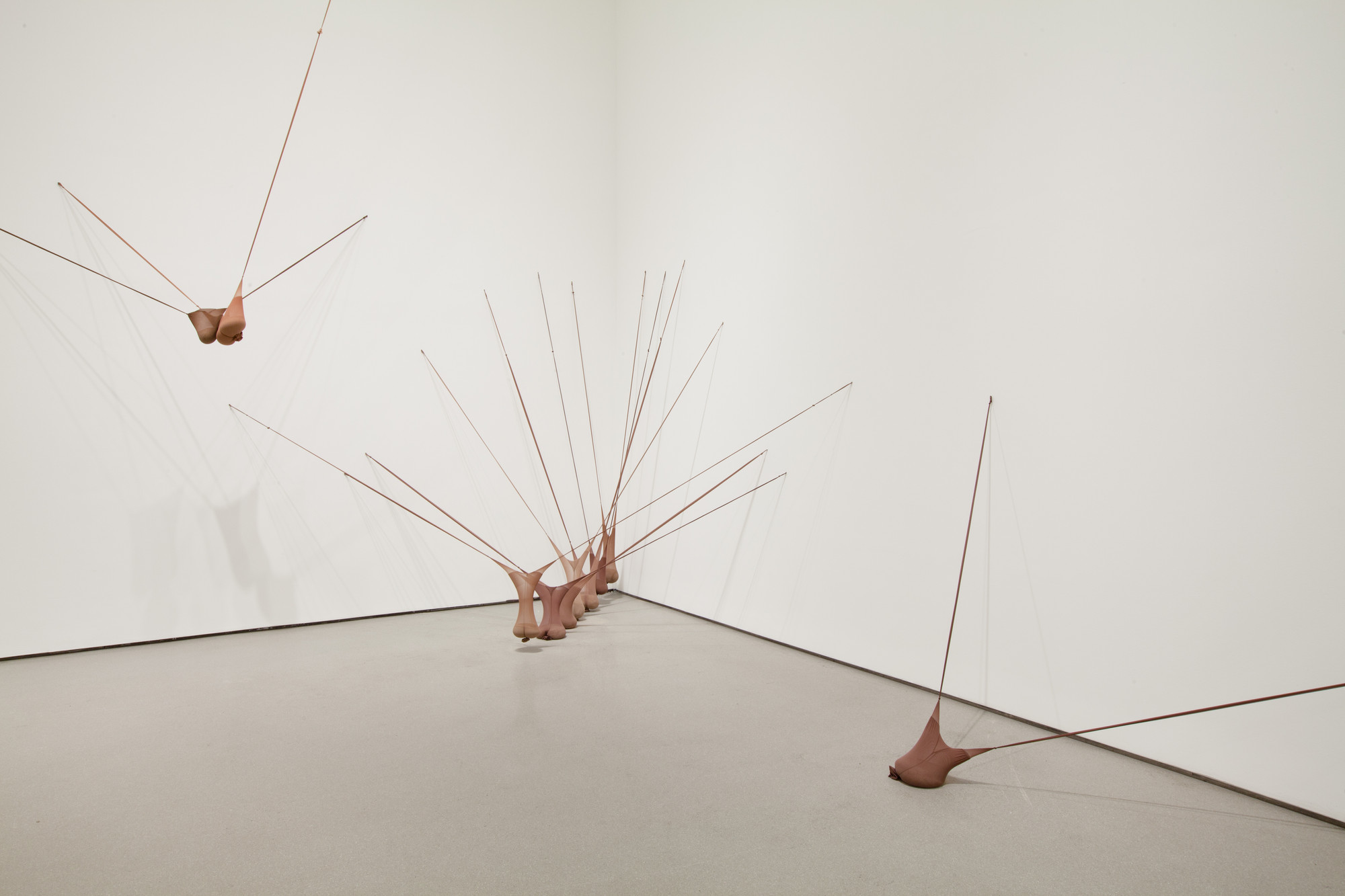
Narrator: American artist Senga Nengudi made R.S.V.P. I in 1977. It’s a sculptural installation made from ten pairs of pantyhose filled with sand. The overall dimensions are variable.
Occupying a corner of the gallery, R.S.V.P. I consists of three groupings of nylon mesh pantyhose in shades ranging from peach to dark brown. Pantyhose are a type of undergarment or sheer tights that cover a person’s body from waist to toes. They were first marketed to women in 1959 to make their legs more uniform in shape and color.
Nengudi repurposes these garments into elastic sculptures that dangle in the air, or rest on the gallery floor. She begins by using sand to fill the area of the hosiery that covers the hips, buttocks, and crotch, tying the elastic waistband with a knot to seal it off. She then pins the stocking feet to the gallery walls and ceilings at different points, stretching taut the two unfilled legs until they create a V form. In some instances, Nengudi even ties together multiple legs of fabric from different pairs of hosiery, to create longer strands that can reach across the walls. The overall composition is a succession of tense strands in an arrangement of repeating V shapes.
Here’s Nengudi describing her process for making this work:
Artist, Senga Nengudi: Oftentimes, I like to anchor my pieces with a found object. I find a found object that is interesting to me, and then I build on that, whatever comes out of that. Thrift stores like Goodwill and ARC, and so on, are great in terms of finding really interesting forms. And then, I used nails, because I was thinking about inside the body and outside of the body. And then this pain kind of energy.
Narrator: Nengudi’s work contains contradictions: the material is at once fragile (as nylon easily runs) and durable in its ability to stretch. The work is airy and light, suspended from the walls and ceiling. Yet it is also heavy, weighed down to the ground by dense masses of sand. Finally, the shape of the sandbags is organic and rounded, while the lines formed by the legs are angular and sharp.
For a more detailed description, continue listening.
We are facing the corner of the gallery where this work is installed as three separate configurations. We will begin with the configuration on our lower right, and move toward the left.
The first configuration consists of one pair of chestnut brown pantyhose. The sand-filled waist rests on the gallery floor. The two legs, stretched to their limits, are pinned at different points on the wall to our right. The overall form resembles a V-shape tilted back at a 45-degree angle. It’s as if the stretched stocking legs are dragging the sand-filled waist toward the wall.
To the left, a second configuration occupies the gallery corner. It is the most elaborate, made from seven pairs of pantyhose in shades ranging from buff tan or camel brown to cinnamon and a reddish-brown sienna. All seven pairs are filled with sand and arranged in a single-file row. Some rest on the gallery floor while others hover just a couple of inches above it. The 14 legs seem to shoot out from the sand-filled waists like tense strands of silk, latching on to different points of the corner’s adjacent walls. When viewed from different angles, the configuration is almost like an oversized spider web.
The third and final configuration, positioned to our left, consists of two pairs of peach and tan pantyhose that hang about 3 feet—or one meter—off the floor. They overlap with each other, making it appear as if all four stocking legs emerge from a single mass. The legs on one pair are evenly stretched into a wide angle on the upper left wall. The legs on the other pair are different lengths, with one fastened to the left wall, and a second, much longer leg pinned to the ceiling. This leg is the longest, measuring about 12 feet—roughly three-and-a-half meters. And it’s the result of Nengudi tying together three separate pantyhose legs.
R.S.V.P. I evokes the body through its materials—the pantyhose represent different skin tones ranging from light beige, peach, and tan, to dark brown. The filled sacks resemble the weight, volume, and elasticity of flesh. This connection was intentional as Nengudi created the work just after her first pregnancy, a time when she was observing her changing body and mind.
Senga Nengudi: I was fascinated in how resilient the body was, and I really wanted to somehow duplicate that experience. I also was dealing with the idea of the female psyche, that your psyche can stretch, stretch, stretch, and come back into shape. And when placing sand in the pantyhose, there was a sense of sensuality, which I also wanted to express with these pieces.
Narrator: The R.S.V.P. works were originally created as performance pieces activated by Nengudi’s friend, the artist Maren Hassinger, in which Hassinger positioned her entire body in, through, and around the installation, playing with the flexibility of the nylon by stretching, extending, and reconfiguring the pantyhose. Hassinger was simultaneously held and restrained by the material.
Senga Nengudi: I really had this desire to have someone respond to my work. R.S.V.P. means you’re invited, and you can either accept the invitation or not, but that was what I wanted.
Narrator: We invite you to imagine how you might dance with the installation. How might you interact with the long, V-shaped legs or the sand-filled sacks? Can you imagine pulling and stretching the pantyhose, feeling the flexibility and resistance of the nylon mesh? Try to conjure the heft of the weighty sand-filled sacks and how your muscles might tense in response. Where would you position your body within this configuration? What new shapes and arrangements would you like to make?