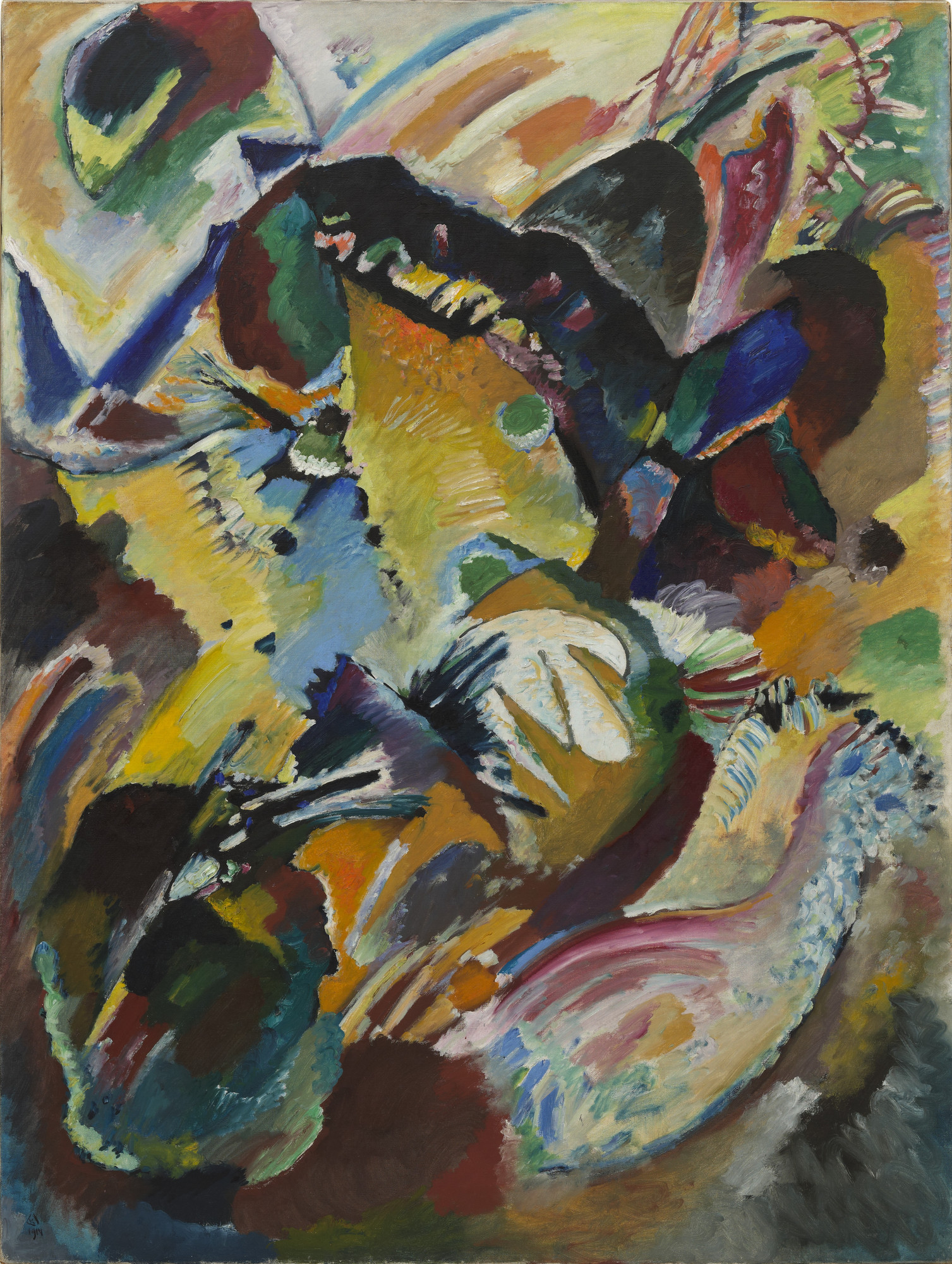
Narrator 1: Four Panels for Edwin R. Campbell. Painted in 1914 by Russian–born French artist Vasily Kandinsky. 1866–1944. Oil on canvas, varying widths, each 48 inches tall (163 cm).
Narrator 2: These four panels, framed individually and hung about two and a half feet apart, are vibrantly colored abstract paintings. Each one is approximately five feet four inches in height; each is taller than it’s wide, but the width varies. The color schemes vary, too. The first, third and fourth paintings use very bright, colors –reds, yellows and blues and include a lot of white. The second painting is denser and darker, with a many shades of green, dark red and brown. All four pictures are filled with indistinct but evocative shapes, that give the impression of needing to be brought into focus in order to take on definite form—like hearing a piece of music in the distance, and not quite being able to make out the tune. Kandinsky wanted his paintings to capture a mood, very much in the same way that music does.
The composer Arnold Schoenberg, like Kandinsky, was working towards creating a whole new form of expression. The two men met in 1911, and afterwards collaborated for several years.
Now, let’s concentrate for a moment on just one of the brighter pictures, Number 4. It’s at the far right of the group.
Number 4 is the widest of the series—it’s four feet wide. It has the most white in it, so it’s also the brightest. The painting consists of a mass of blurry shapes. Near the top right hand corner, a long, dark blue–green line begins, cutting a shallow diagonal across the picture. In the top left corner is a sweeping rainbow with broad swathes of cherry red, bright yellow and pale blue. Little dabs and dashes of paint seem to dance over the surface of the canvas – white, red, blue, deep purple, pink and green. The paint is laid on in thick strokes, leaving the effects of the artist’s moving hand clearly visible. This adds further to the sense of swirling movement, rhythm and exuberant energy.