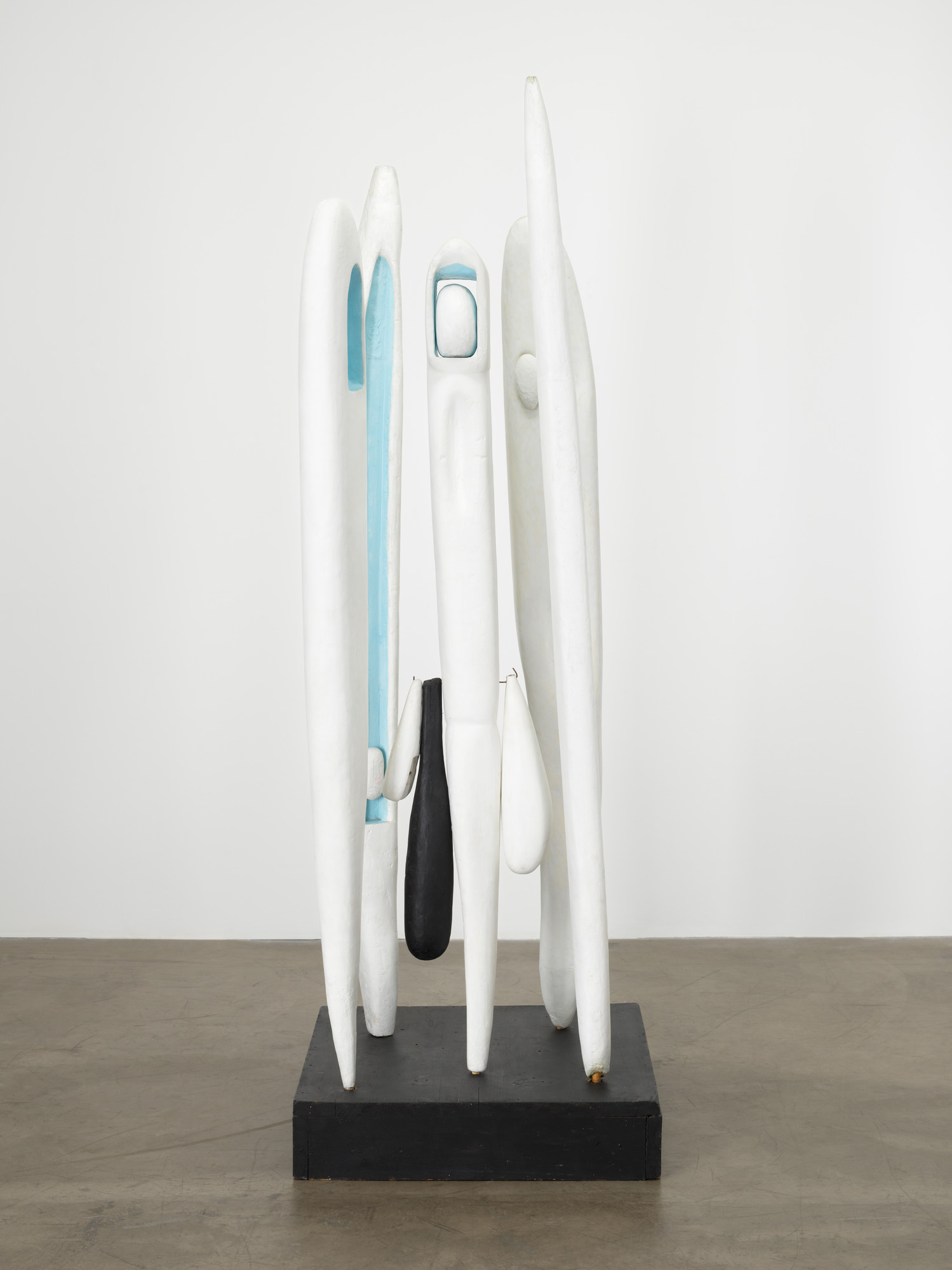
Narrator: The artist Louise Bourgeois made Quarantania, I between 1947 and 1953 by affixing painted vertical, carved wood figures to a wooden base. The base measures about 2 feet by 2 feet and is half a foot in height. With the height of the figures, this three-dimensional work has an overall height of nearly 7 feet. In metric units, the base is about 69 centimeters in length and width, and 15 centimeters in height. The overall height of the artwork is nearly 207 centimeters.
Quarantania, I consists of five elongated hand-carved wooden figures ranging from five to six feet tall. They vary in shape and width, but all are painted matte white, and three have areas of aqua blue. Bourgeois hand carved these figures from soft balsa wood, so scratches, knicks, and mottling are visible on the surface. Their elongated forms taper to rounded points at the bottom, where they are affixed by rods to the black platform.
Bourgeois called these figures “personages.” The shortest one stands near the center of the base. The other four figures are near the corners. They turn inward like a group of people huddled together in conversation.
Let’s begin with the figure in the center. The top resembles the eye of a needle with a light blue interior measuring about half a foot across. A white egg-shaped object is placed inside this opening and takes up most of the space. It looks almost like a person’s face peeking out from a hood. Just below the opening is a delicate 8-inch vertical indentation, like the mark left behind by a finger pressed into dough. More than halfway down, curved metal hooks emerge from each side of the figure. Three smooth wooden objects hang from the hooks like weighted bags—two on the left and one on the right. The object on the far left is white and oblong, about the size of a large remote control. Beside it hangs a black form shaped like a skinny bowling pin. Hanging from the hook on the right is a white form that looks like an elongated balloon partially filled with water.
This freestanding sculpture is meant to be viewed from all angles by moving around it, but let’s examine the rest of the work from a fixed position where the doughy indentation on the central figure represents the front of the work.
In the front corner of the platform, to our left, is the widest figure. It is shaped like a large tongue depressor with a rounded top and flat body. Near its top is a shallow recessed niche painted aqua blue.
Behind this form, in the back corner, is the next figure. It is slightly taller and thinner with a pointier top. A long, recessed area runs down three-quarters of the figure’s length, making it look like an open pea pod. The cavity is painted light blue. Resting near its bottom is an object the size and shape of a baked potato. It’s white and has a dab of pink paint on the lower right. There is a similar recessed area on its reverse side.
Now we will move on to the figures that appear on our right, beginning with the one farthest away from us. This personage is completely white and is shaped like a surfboard with a wide, flat surface tapering at both ends. Near the top are two side-by-side vertical indentations, each about the length of a popsicle stick. Nestled into the indentation on the left is a white object that looks like an oval bar of soap. Further down, at about waist height, there is another vertical indentation—this one about double the length of the other two.
The last figure, in the front corner of the platform, is the tallest and skinniest of the five. It is shaped like a long string bean standing upright. It is white and completely unadorned.
Now we'll learn more about this work from a curator.
Curator, Deborah Wye: Louise Bourgeois did these wooden totem-like figures early on in her career. In this piece, she's brought together some of those individual pieces on a single base.
Narrator: Deborah Wye, Chief Curator Emeritus of Prints and Illustrated Books.
Curator, Deborah Wye: The sculptures were really meant to represent friends and family that she had left behind when she left Paris and moved to the United States, but also her family at this time, with she and her husband and three small boys. So those five elements are very important to her. Also, the figure in the middle has three appendages attached to it. And this piece, when it was shown by itself was called Woman with Packages. And she said it really represents her three little boys who she was responsible for, and she felt were always attached to her in one way or another.
It's made out of a very light wood called balsa wood, and the artist chose that because it was very easy to carve, and it was very easy to carry around. One thing, though, is that because it's so soft a wood, there's lots of little indentations and creases and little chips and abrasions that you notice in the wood when you look closely at it. But I feel that it gives you the sense that this is a very homemade work of art.
What she's done here is set up a little theater. These people are enacting a little drama. And even though Louise had one idea about her family, anyone looking at it can, in their imagination, come up with another drama. Because it's really about a more universal drama than that.