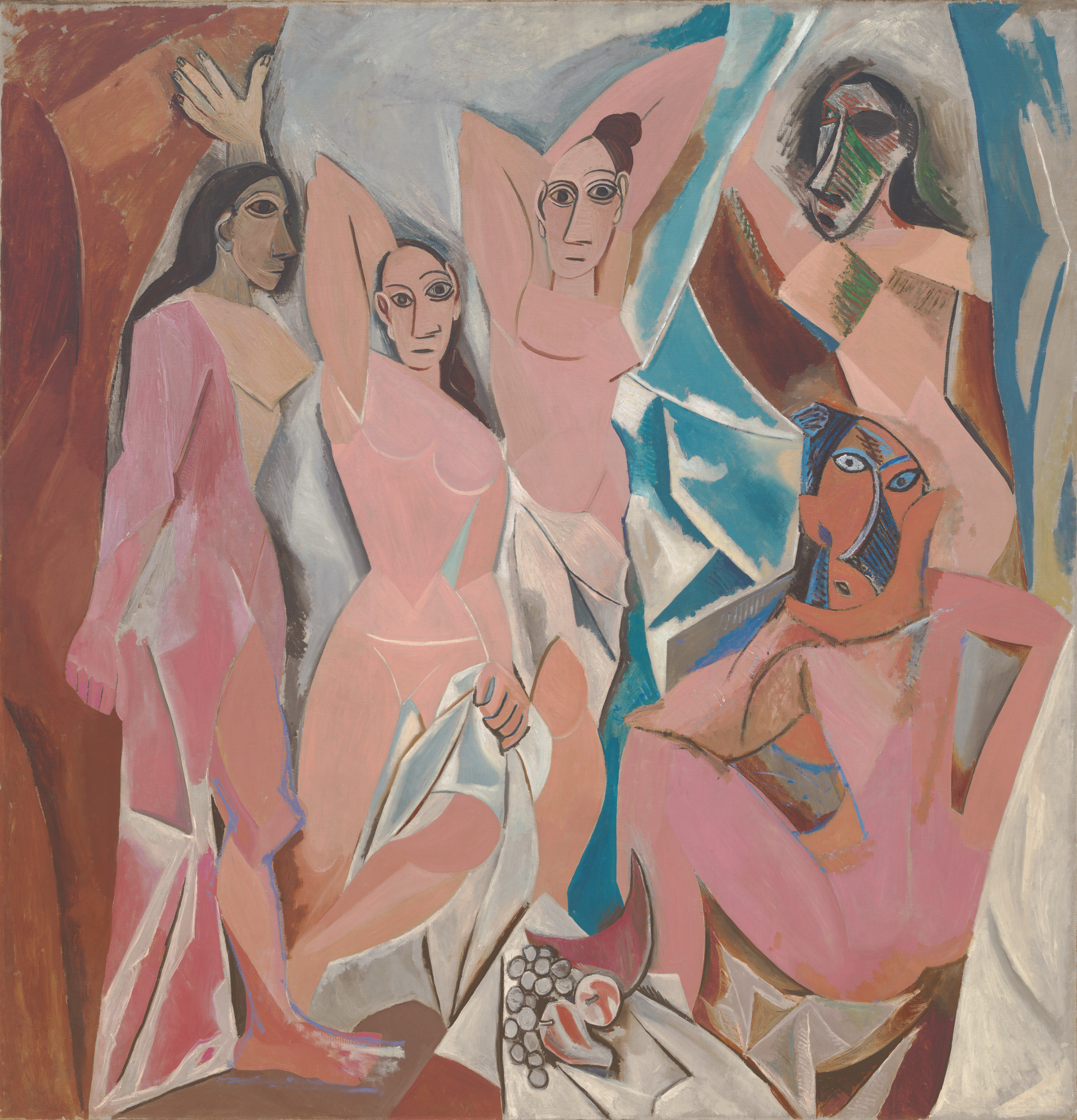
Narrator: The artist Pablo Picasso made Les Demoiselles d’Avignon in 1907, using oil paint on canvas. This large painting measures 8 feet high and 7 feet, 8 inches wide. In metric units, it is about 244 centimeters high and 234 centimeters wide.
The painting depicts a scene with five naked women looking directly at us. Their bodies are not meant to look realistic, as they are composed of angular planes and geometric shapes. The space they occupy is very shallow, and the absence of depth pushes the women forward so their bodies take center stage.
The women are painted in pinkish-peach tones, set against a backdrop of brown, white, and blue curtains. The drapery is made up of flat, splintered planes of color, and looks more like shards of glass than draping fabric.
Let’s begin by looking at the five figures from left to right: the woman on the far left stands in profile. She faces toward our right, but her right eye is shown in full as if gazing directly at us. The eye is brown and almond-shaped, with a black center and a full, curved, black eyebrow above it. Her straight, black-brown hair cascades down her back. From the neck up, her head is grayish taupe, contrasting with the peach flesh of her blocky and angular body.
With her left hand she reaches up behind her head to pull back an orangey-brown curtain. Her right arm hangs stiffly by her side, covered by a sheer pink cloth. It falls from her shoulder and over the right side of her torso and hip before dropping onto the floor behind her. Her bare, square-shaped breast juts forward. The foot of her exposed right leg is planted flat on the ground.
To the right of this figure, and at the center of the painting, are two women looking directly at us. Their faces are similar with wide and uneven black eyes. Their left eyebrows extend down in sweeping lines to form simplified noses in profile. Their mouths are short horizontal marks. Their bodies are pinkish-peach and bare, except for a bit of rumpled white fabric draped around their thighs.
The one on our left, who appears to be slightly shorter than the others, raises her bent right elbow and places her hand behind her head. Her brown hair falls behind her left shoulder. Her breasts are suggested with thin white half circles that, like the breasts of the other women, have no nipples. Her left arm hangs down by her side, holding the white fabric. Her pelvic area is indicated by a triangle outlined in white without any other details.
The woman to the right of her appears to be about a foot taller. This woman raises both arms, bending them at the elbows, so her hands are hidden behind her head. Her brown hair is pulled into a small, tight bun on the top of her head. She, too, has a white cloth covering her hips and thighs, but it is more translucent.
Now we’ll describe the last two figures on the right. One stands in the back right corner emerging from blue curtains that she parts with her raised arms. She appears in a three-quarters view facing to our left, her black hair hanging down her back. One eye is painted entirely black as though it were a hollow socket. Her nose, like her face, is elongated. It is a sloping white band outlined in black with sketchy black nostrils and a mouth. Green and brown diagonal stripes run from the right side of her nose and across her cheek, suggesting the form and texture of an African mask. Her breast is suggested by a peach colored diamond with green and red diagonal shading running down the right side. The lower portion of her body is hidden behind a seated figure who fills the lower right corner of the canvas.
The seated figure also seems to wear an African mask. Her face is a copper color, with eyes askew—one is white with a small black pupil, the other blue. Hints of orange-red peek through the blue and white of her eyes. Her blocky nose is rendered in alternating diagonal lines of black and blue. The figure’s head is set directly on her torso, which is pink with blue outlines. She sits with her legs spread wide apart. The elbow on our right forms an elongated triangle against her hip, while the one on our left rests on her bent knee. A faint vertical line down the center of her flat torso may indicate her spine, suggesting she sits with her back to us. Either she wears the mask on the back of her head, or her head swivels impossibly around.
In the center foreground, near the bottom of the canvas and to the left of this seated figure, an arrangement of fruit sits on a crumpled white cloth. It features grayish white grapes; an apple and pear, streaked with red and white; and a slice of red and gray melon. The top edge of the melon is sharply curved, like the blade of a scythe.
Now let’s hear more about this work from a curator.
Curator, Ann Temkin: This painting is the Demoiselles D'Avignon by Pablo Picasso.
Demoiselles means women and D'Avignon is the red-light district in Barcelona. And what anybody at that time would have known is that the women of Avignon Street were prostitutes. They're nude or almost nude, so one could see them as objects of male desire, but here are women looking out at the viewer in an extremely daring kind of confrontation. For me, I see the as forces of strength that's pretty unusual for the depiction of female figures that time or even now.
It's a painting that is combining different styles of representation without trying to reconcile them. You see the breakdown of form and the breakdown of a coherent structure in between the bodies. There are women who have faces that seem connected to their bodies, but then the two women on the right, have African masks plunked on top of their bodies. You don't have the sense that these women are wearing these masks, you have this sense that these masks are their heads.
The inclusion of these masks reflect Picasso’s interest in getting away from Western art traditions by identifying with the art of other cultures. He and his peers would have seen masks like these in museums in Paris. These types of objects were interesting to them because of the supernatural powers they would have had as objects in the communities in which they were made.
This is the largest painting that Picasso had made at that point in his life. He was ambitious for how it was going to change the language of his painting and that of other artists. He kept it with him in his studio for nearly 20 years, almost as if he knew how radically ahead of its time it was.