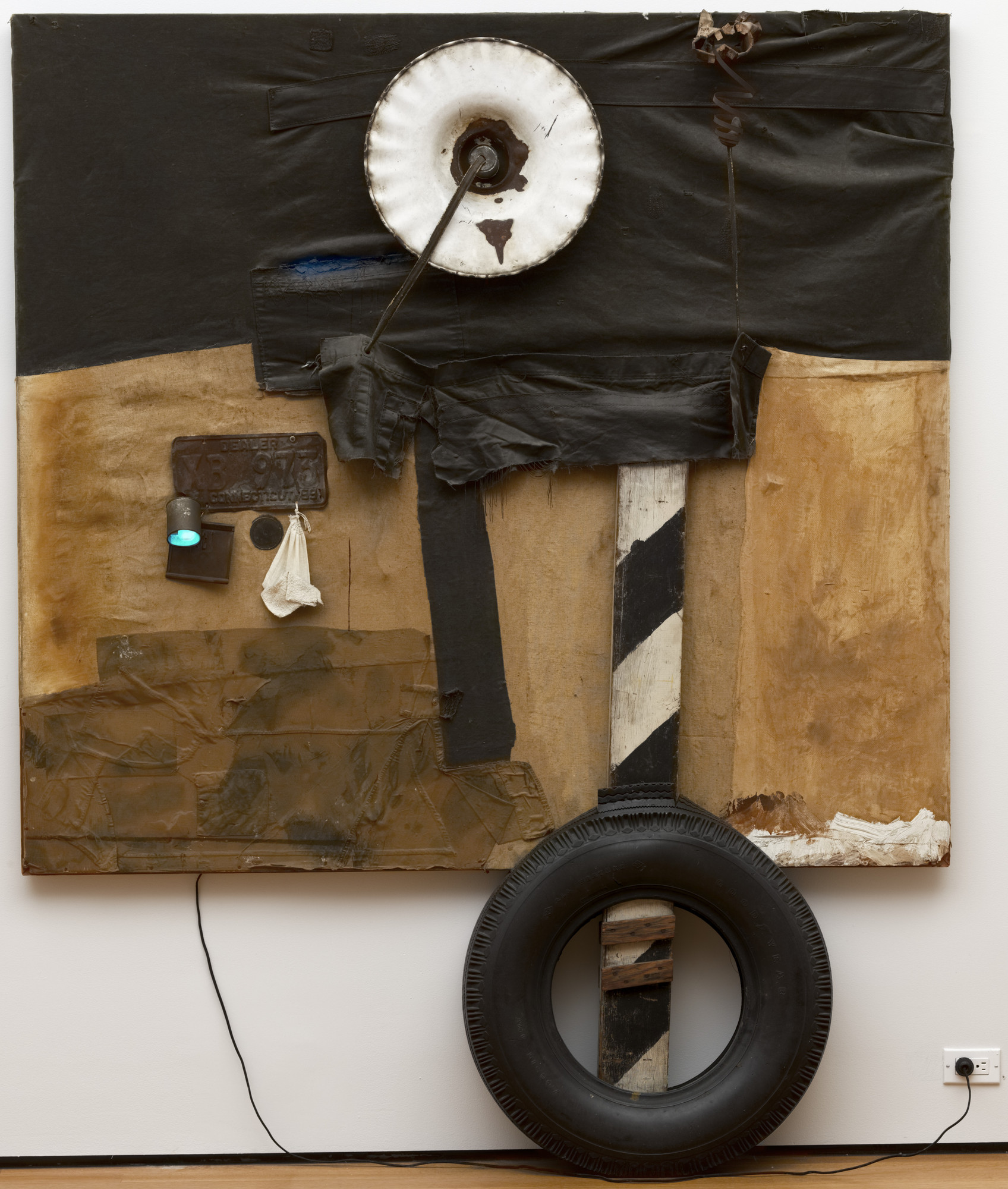
Narrator 1: 6–7. First Landing Jump, made in 1961 by American artist Robert Rauschenberg. Born 1925. This is what Rauschenberg called a “combine painting”: cloth, metal, leather, electric fixture, cable, and oil paint on a board. Overall dimensions: 89 inches high, by 72 inches wide, by nine inches deep. 226 by 183 by 23 cm.
Narrator 2: This abstract assemblage of battered, grimy objects suggests the trash left at the side of the road. A large nearly square board is mounted flat on the wall about two feet from the floor. The top third of the board had been covered in a black tarpaulin. This tarp is not stuck flat: the area towards the right, particularly, is sagging and creased. The lower two thirds of the board are covered in a flattened dirty yellowish–white cloth. Part of a man’s button–down khaki shirt has been stuck flat to the wooden surface, filling the bottom left hand corner. The shirt is heavily stained with smudges of grayish paint. And, in the center, a flap hangs down, loose and ragged.
Many objects have been attached to this rough surface, and the most significant are described here. In the top center, on the black tarp, the artist has attached a chipped and rusted white circular object about 20 inches in diameter. In its center is what appears to be a small tin can. Below, to the left, is a rectangular, rusted brown Connecticut license plate with its number XB 973 barely legible. Hanging down off the lower left corner of the license plate is a small tin can, with a blue light bulb inside. The light bulb is illuminated, and is wired to an electrical cord, which comes out from behind the bottom left edge, and runs to an outlet visible beneath the artwork.
There are two other very prominent features to the work. In the right side of the composition, a wooden plank with black and white diagonal stripes, appearing as if from a wooden street barrier, is attached vertically against the board. It runs down to the floor below this board; and, on its way, it pierces the top of the tread of a black rubber automobile tire. The resulting shape is like an upside down lollipop on a stick. The tire rests on the floor, propped so its circular shape faces the viewer. The top of the tire only slightly overlaps the bottom of the board.
Narrator 1: To hear the Collection Tour audio on this work, press 4–0–8.