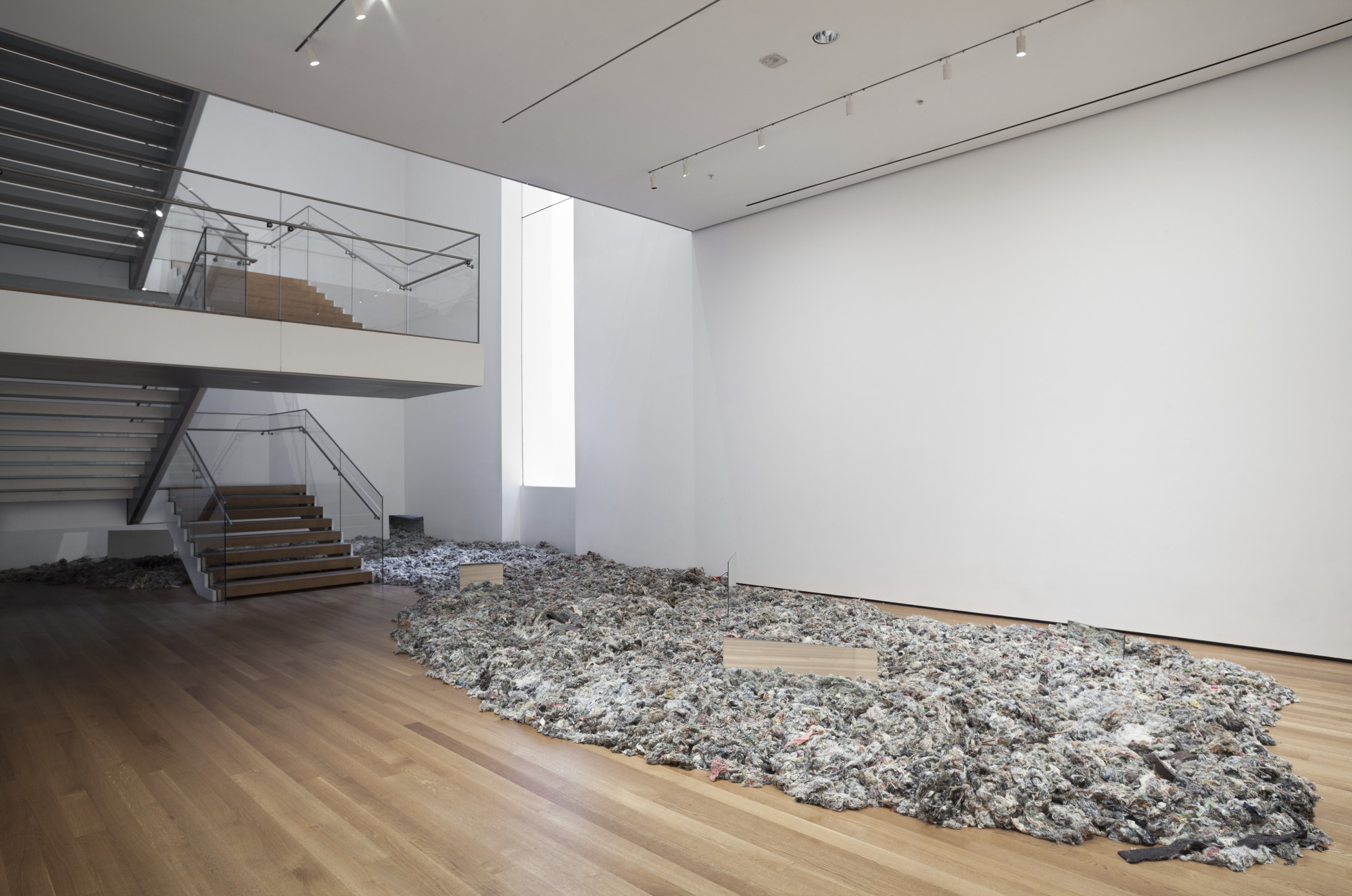
Narrator: This work looks different each time it’s installed, but the materials always stay the same.
It’s made with remnants from textile manufacturing, called scrap cloth or thread waste, and it’s scattered with copper tubing, asphalt, steel cable, lead, and mirrors. Artist Robert Morris recalls how he first discovered the material.
Artist, Robert Morris: I was working nights on the railroad, as a railroad switchman. In those early years, a boxcar rode on steel axles. The bearings were brass. And these brass bearings on the steel axles created a lot of friction. In order to lubricate them, they had these journal boxes full of shredded cloth, thread waste, basically, which was probably swept up off the floor of knitting mills, all different colors. I remembered that from the railroad, and so I used that.
There was a warehouse, and I took one of the floors and worked with all kinds of materials, thread waste, plywood, earth, grease, and so on, and changed it every day. It was a series of changes that never resolved themselves, so it was about chance and perishability, too, I suppose.
Archival audio from: Oral history interview with Robert Morris, 2018 April 19-20. Archives of American Art, Smithsonian Institution.