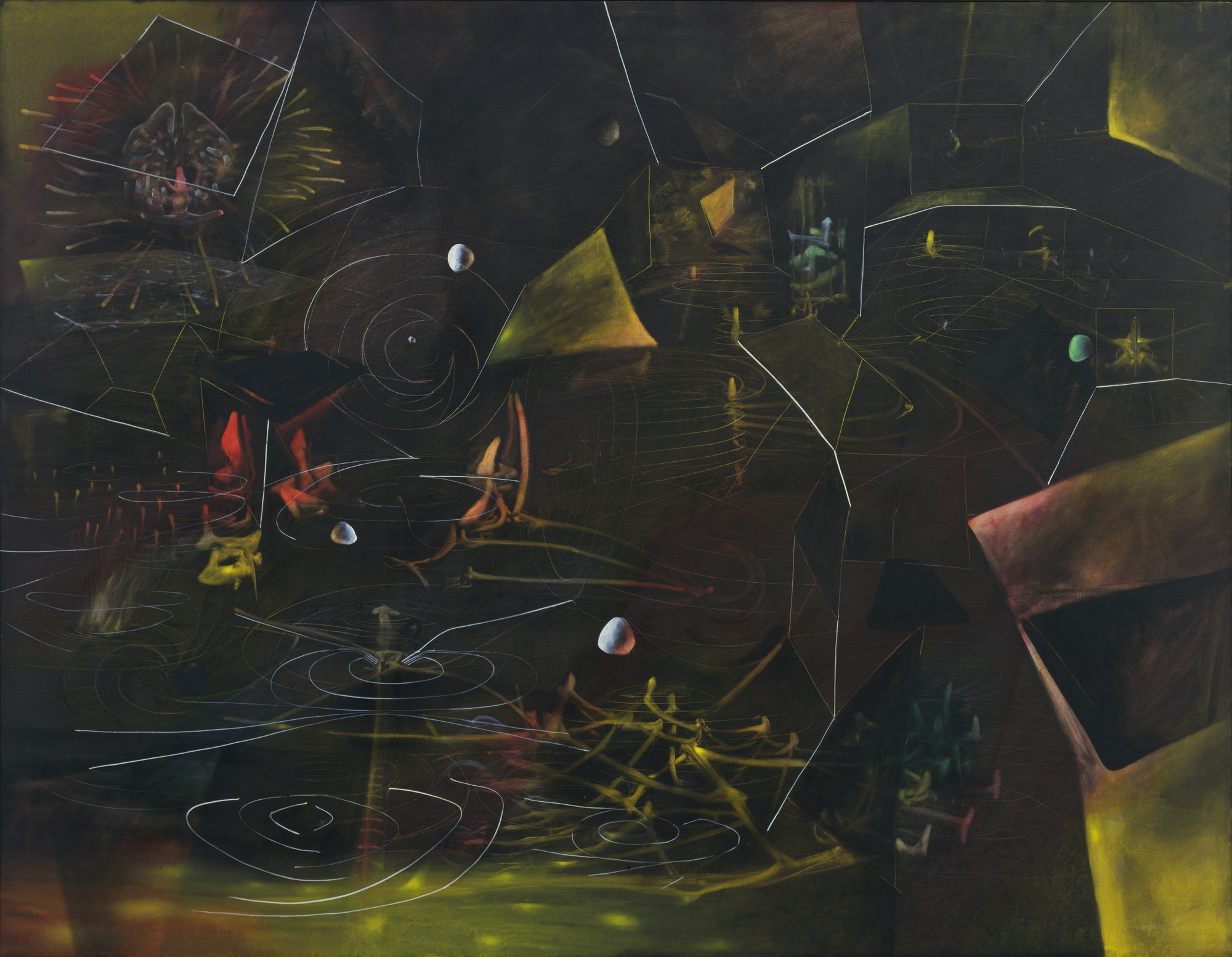
Narrator: This painting represents one of Roberto Matta’s “inscapes.” It’s a term the artist used to describe his series of imaginary landscapes representing the inner worlds of his mind.
Artist, Roberto Matta: Hallucination is this funny capacity to see in a spot something. For instance, people look at the cloud, and they see in the cloud an elephant, for instance.
Narrator: Matta’s approach to painting was informed by Surrealism, a literary and artistic movement dedicated to exploring the unconscious mind. As a young person, Matta met André Breton, a leading figure of Surrealism. And that encounter had a profound impact on him.
Roberto Matta: Because he saw in me things I didn’t know. I was an architect, so I didn’t know anything about art. I didn’t know anything about poetry, I didn’t know anything about anything. André Breton started encouraging me, as if I was an artist. And without knowing very much what an artist was.
I never painted a picture in my life! And I start painting these very early pictures with my fingers. And I start doing something which came out of the dark, so to speak. Forms came outta the dark—and bright colors—which appears like the kind of things when you press your eye, you see strange lights, you know. I didn’t know how to call these things, but they kept growing and changing. They didn't have any reference to the outside world. So I said they were the form of my psychic, and I started giving title to these pictures as if they were landscapes of my psychic.