Art Historian, Adriana Zavala: My name is Adriana Zavala and I’m an art historian who specializes in Mexican art and US Latinx art.
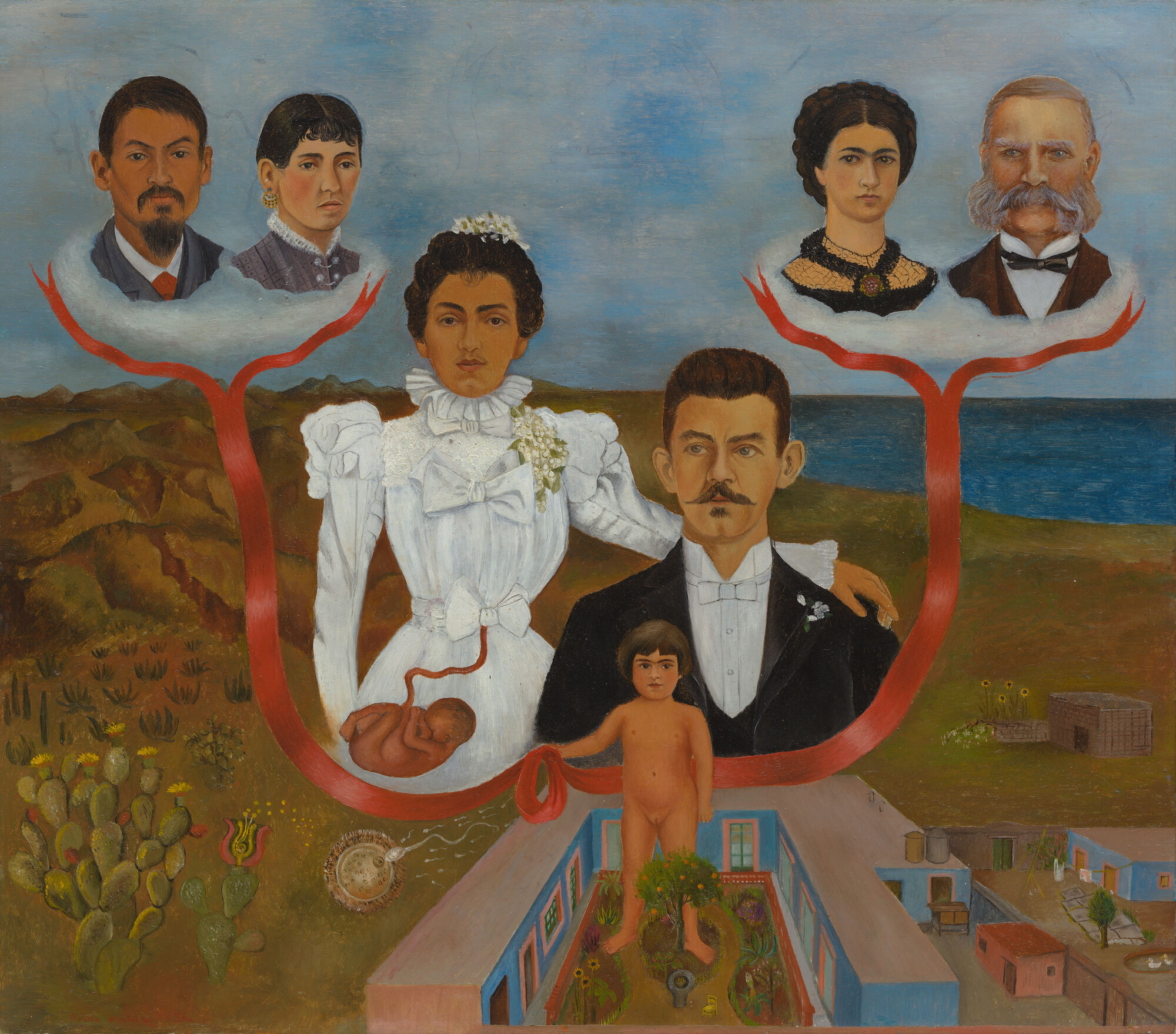
In My Grandparents, My Parents, and I, Kahlo presents us with a painting of self and family, structured like a family tree. The figure in the center is Frida Kahlo. She stands naked as a little girl in her family home that is today known as La Casa Azul, The Blue House. Immediately behind Frida is her father Guillermo Kahlo, a Hungarian-German immigrant to Mexico City, and his parents. Then, to the right, we see a beautiful portrait of her mother, Matilde Calderón and her parents.
On the left-hand side of the composition, we see an egg cell that is being fertilized by a sperm. There’s also a cactus and it has a flower releasing pollen that is just about to come into contact with the egg cell. If we interpret that egg cell as Frida before she became the fetus, then she’s communicating that she is, in her essence, of the Mexican landscape.
The period that this painting was made, 1936, these are the years of the rise of fascism and the Nazi party in Germany. There were books about the importance of tracing your genealogy in order to prove your blood purity. The way that this worked under the Nuremberg Laws, you had to demonstrate that your grandparents were German and you needed to try to disprove that they were Jews or other ethnic communities or mixtures.
She is here proudly proclaiming precisely the opposite of what these genealogies were supposed to prove. She is celebrating her mixedness and the way that Mexican society is constituted in a multiracial, multiethnic way.