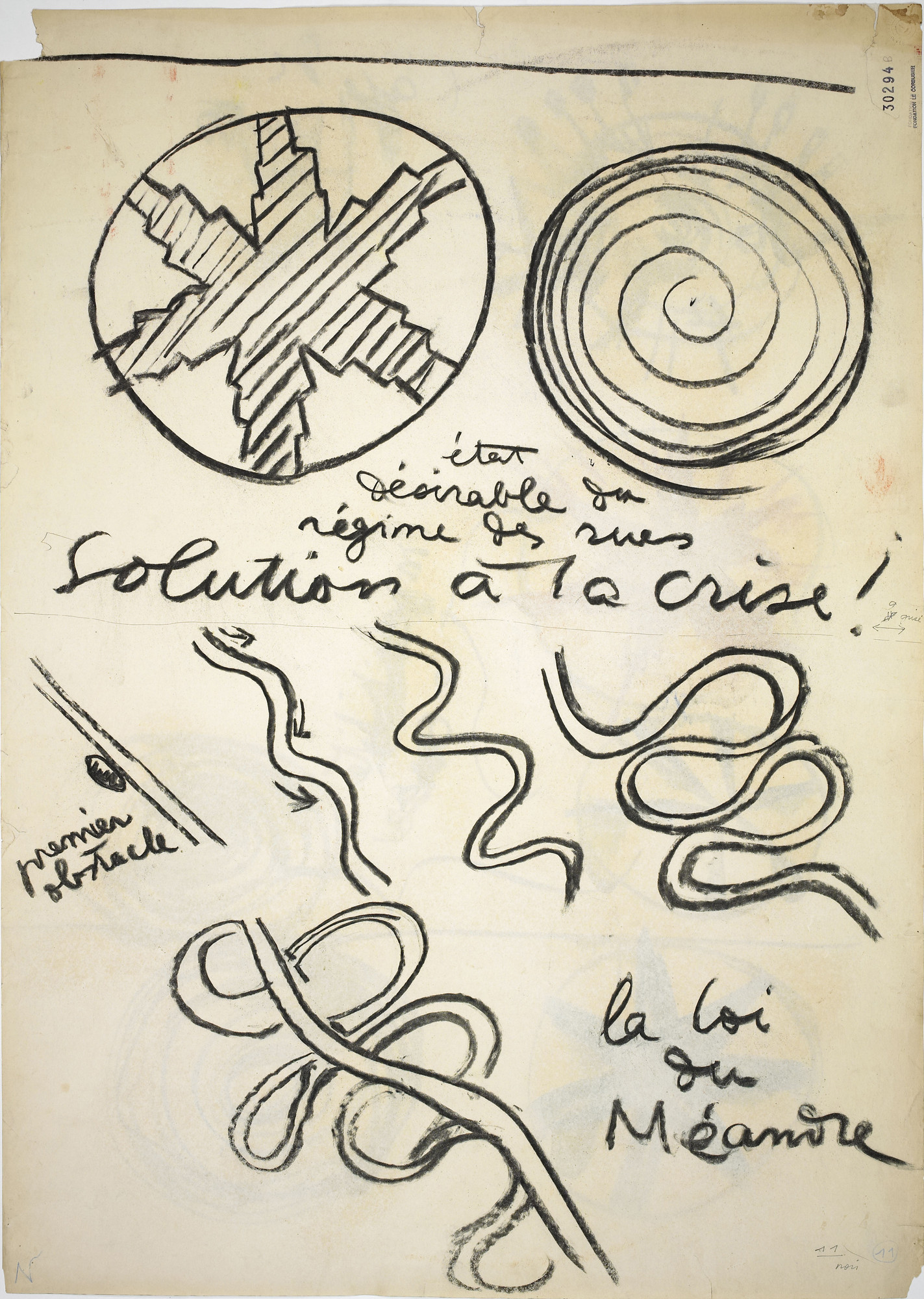
Curator, Barry Bergdoll: In 1929, Le Corbusier flew across South America, observing and documenting its landscape from the air even before he landed. He noted the way rivers meandered through the countryside, and made sketches like this one.
He christened the river’s flow the ‘law of the meander’—and from then on applied it to humans.
Architect, Jean-Louis Cohen: The ‘law of the meander’ is that after having taken a slow path, a winding path, human thinking suddenly breaks through the sand, and generates a breaking idea, just like the river breaks. The meander becomes the metaphor of human thinking. We see here how Le Corbusier was capable of taking from his own observation of the world, from an observation he made with sketches, with photographs, with films, ideas not only about buildings, but also about the way people think and act.